

I was talking to a friend a few nights ago about why most Web3 games feel like short-term experiments instead of real worlds you’d actually want to spend time in. He laughed and said, “because they’re not games, they’re reward machines.” That line stuck with me while looking at Pixels, because Pixels feels like one of the few projects that is actively trying to escape that exact trap rather than pretending it doesn’t exist.
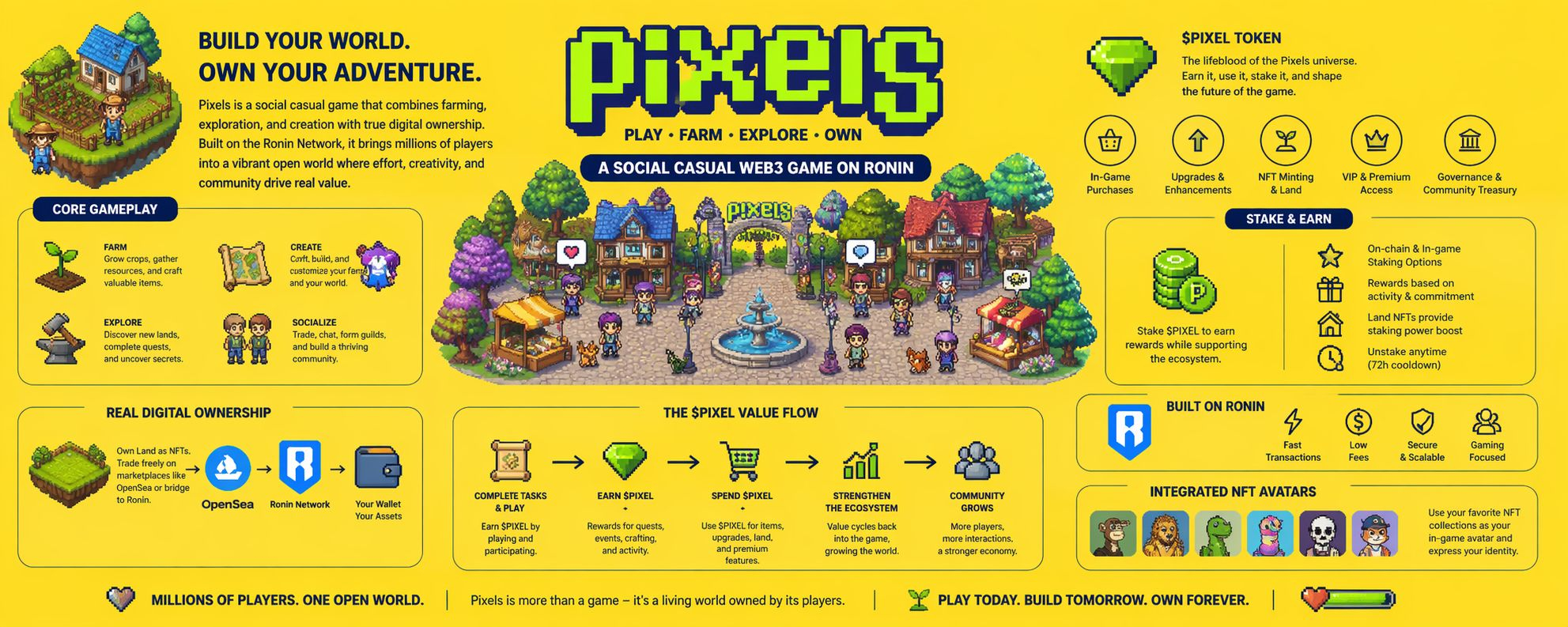
Pixels is, at its core, a social farming and exploration game built on the Ronin Network. You log in, plant crops, gather resources, interact with other players, and slowly build your place inside the world. Nothing about that sounds revolutionary if you’ve played traditional games. What makes it different is not what you do, but how ownership and value are layered underneath it. In most older GameFi projects, gameplay existed just to justify rewards. In Pixels, the team is clearly trying to flip that order, where gameplay comes first and rewards are designed to support it instead of replacing it.
The problem they’re chasing is actually very simple to describe but very hard to solve. Early play-to-earn games created systems where players were paid just for showing up, which sounds great until you realize that those rewards have to come from somewhere. Eventually, those economies started collapsing because they depended too much on constant new demand. Pixels approaches this more like a game designer than a token promoter. Instead of asking “how do we give more rewards,” it seems to ask “what actions should actually be rewarded, and how do we make sure those rewards don’t break the system over time?” That shift in thinking is subtle, but it’s the difference between a short hype cycle and something that can last.
Technically, Pixels is not trying to put everything on-chain, and that’s probably one of its smartest decisions. The actual gameplay loop runs smoothly like a normal online game, while ownership elements such as land, items, and currency connect to blockchain infrastructure in the background. Players interact with wallets, NFTs, and token transfers when it matters, but they are not forced to think about blockchain every second. Land exists as NFTs, which means players can truly own and trade their farms, but at the same time, the game controls how that land is used, upgraded, and integrated into the world. This balance between off-chain gameplay and on-chain ownership is what keeps the experience playable without losing the benefits of decentralization.
The $PIXEL token sits right in the middle of this system, and its role is more practical than flashy. It is used for things like upgrading assets, accessing premium features, minting certain items, and unlocking additional layers of gameplay. What makes it interesting is not just its utility, but how it flows through the system. Players earn it by completing in-game tasks, then spend it to improve their position or access better opportunities. That creates a loop where the token is constantly moving instead of just being held and speculated on. The game also introduces friction where needed, such as reputation requirements or activity thresholds, to prevent abuse and keep the economy from turning into a pure extraction system.
Staking adds another dimension to this flow. Instead of just holding tokens passively, players can stake $PIXEL either through the dashboard or directly inside the game. Rewards depend not only on how much you stake, but also on how active you are within the ecosystem. There are even boosts tied to land ownership, which connects NFTs back into the economic layer. This design nudges players toward long-term participation rather than quick entry and exit. It is not perfect, but it shows that the team understands that sustainability comes from behavior design, not just token supply mechanics.
Pixels doesn’t exist in isolation either. Its move to the Ronin Network connected it to one of the most established gaming ecosystems in crypto, originally built around Axie Infinity. That decision gave Pixels access to infrastructure, liquidity, and an existing user base that already understands blockchain gaming. On top of that, the token gained broader exposure through listings on platforms like Binance, which helped bring in attention beyond just the core gaming community. The game also supports various NFT collections as avatars, which quietly turns it into a social hub where different parts of crypto culture can interact inside one shared environment.
In terms of real adoption, Pixels has done something many Web3 games struggle with: it actually attracted and retained players. The numbers have grown steadily since its migration, but more important than the raw figures is the fact that the game continues to evolve. New features, systems, and content updates keep being added, which signals that this is not a one-cycle project. It behaves more like a live service game than a one-time launch, and that mindset is crucial if it wants to survive long term.
Still, there are real challenges sitting just beneath the surface. Balancing an in-game economy is difficult even in traditional games, and adding blockchain tokens makes it even more complex. If rewards become too generous, the system risks inflation and devaluation. If they become too strict, players may lose interest. There is also the constant tension between making the game accessible to new players and protecting it from bots or low-effort farming. Even small changes in reward distribution or token sinks can have large ripple effects across the entire ecosystem. And beyond the game itself, Pixels still depends on the health of the broader crypto market, infrastructure reliability, and continued user interest in Web3 gaming as a whole.
Looking ahead, the direction seems focused on expansion rather than reinvention. The project is gradually adding more systems like guilds, deeper exploration mechanics, and new economic layers while refining its reward structure. It also hints at becoming more than just a single game, potentially acting as a platform where multiple experiences can connect through a shared economy. If that vision plays out, Pixels could evolve into something closer to a social gaming network than a standalone title.
What makes Pixels worth watching is not that it has solved Web3 gaming, because no project really has yet. It is that it is clearly trying to solve the right problems. It treats gameplay, economy, and community as parts of the same system instead of separate pieces. And in a space where many projects chase attention first and sustainability later, Pixels feels like it is doing the opposite. Whether that approach fully works or not is still an open question, but at least it is asking the questions that actually matter.