
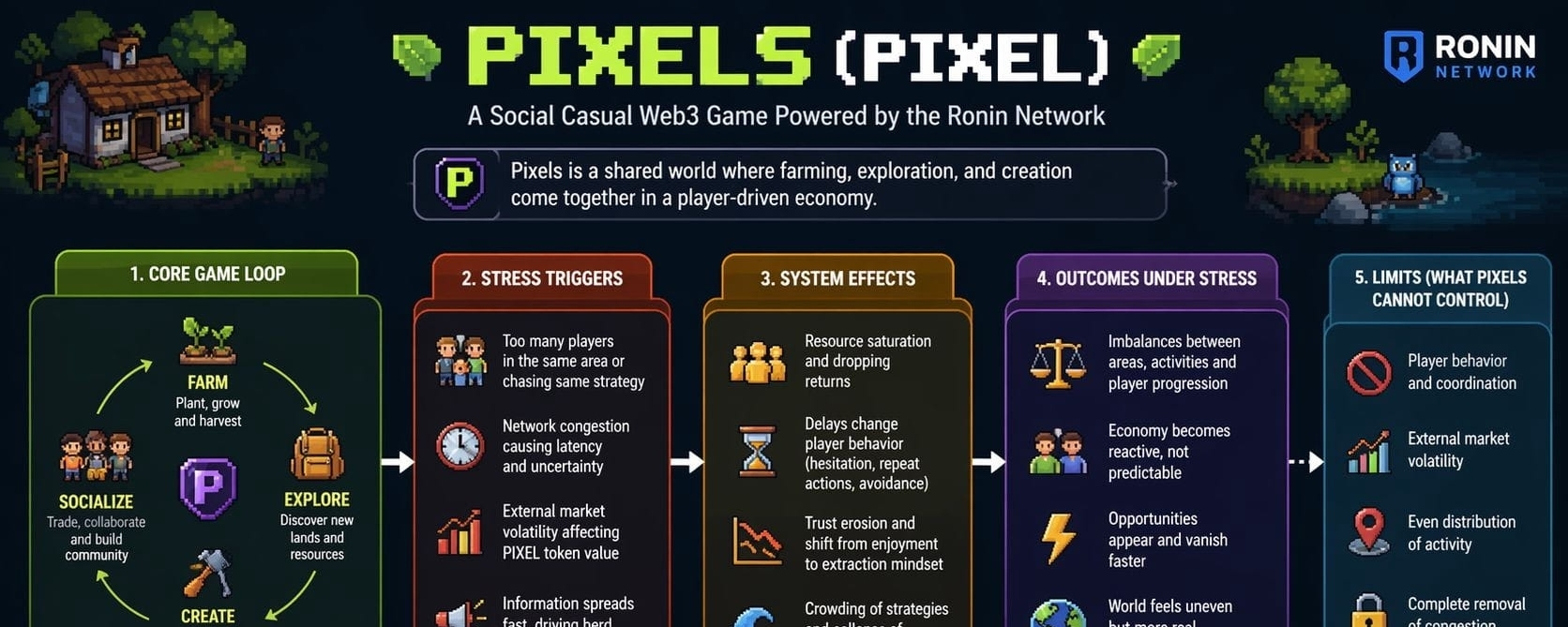
On the surface, it resembles a social gaming experience built around farming, exploration, and crafting within the Ronin ecosystem. However, a closer examination suggests something more complex: PIXEL functions less like a traditional game and more like a structured digital economy designed to coordinate user behavior at scale.
Rather than simply encouraging gameplay, the system appears engineered to shape how users enter, participate, earn, and build trust within a shared environment. Its architecture spanning reputation systems, staking mechanisms, guild shards, creator codes, and reward-linked participation points toward a deliberate effort to organize economic activity, not just entertainment.
This distinction is important. Many observers see a token attached to a vibrant game world. A more critical perspective views PIXEL as an attempt to solve a deeper challenge: how to sustain engagement in an online economy after initial excitement fades. Historically, incentive-driven games attract early growth but struggle to retain users once rewards lose their novelty. PIXEL seems designed with that risk in mind, prioritizing persistence, social structures, and reputation over short-term participation.
The central question, then, is not whether the game is engaging or the token is valuable, but whether the system can withstand the typical failure modes of GameFi bot activity, reward exploitation, speculative behavior, and transient users. The reputation layer plays a pivotal role here. By linking access to features such as withdrawals, marketplace participation, and guild creation to longer-term engagement signals, the system attempts to distinguish meaningful contributors from short-term actors. However, this balance is delicate: overly permissive systems invite exploitation, while overly restrictive ones risk limiting growth and inclusivity.
Looking deeper, the ecosystem’s power dynamics extend beyond individual players. Landowners, guild operators, and creators form the backbone of sustained participation. Mechanisms like guild shards minted and traded along bonding curves and creator codes, which channel economic value back to community leaders, demonstrate how attention and engagement are systematically converted into recurring financial flows. This is less about gameplay design and more about building repeatable economic infrastructure.
In that sense, PIXEL is better understood as a participation network layered beneath a gaming interface. The Ronin ecosystem supports this model with streamlined onboarding, transaction sponsorship, and integrated marketplaces, providing the foundational rails for user and value movement. The “game” becomes the accessible front-end, while the underlying system coordinates status, incentives, and economic exchange.
At the same time, the most critical components are not the most visible. The reputation system arguably the core control layer introduces both strength and risk. Its opacity allows flexibility in managing behavior and mitigating abuse, but it also raises concerns around transparency and fairness. If users perceive the system as unpredictable or biased, trust can erode even if the broader ecosystem remains functional.
From a long-term perspective, the potential impact of PIXEL is not necessarily a sweeping transformation of all games into decentralized economies. A more realistic outcome is the gradual evolution of online communities into structured economic units, where players, creators, and guilds are interconnected through shared incentives and revenue streams. Participation becomes measurable, loyalty becomes economically meaningful, and communities begin to resemble coordinated networks rather than loose social groups.
However, the risks are equally significant. Centralized control over reputation and access can concentrate power within the system. Incentive structures may attract extractive behavior rather than genuine community building. Most critically, a breakdown in trust whether due to opaque rules or perceived inequities can undermine the entire model without any technical failure.
There is also a broader implication: as systems like PIXEL integrate behavioral data, financial activity, and access control, they begin to blur the line between gaming environments and managed digital societies. This raises questions around governance, privacy, and accountability issues that typically emerge only once such systems reach meaningful scale.
Ultimately, PIXEL should not be viewed solely as a game or a tokenized ecosystem. It represents an attempt to build a controlled, behavior-aware digital economy where participation, reputation, and value are tightly interlinked. This is an ambitious direction, but also a demanding one. Systems like this do not fail simply when users leave; they fail when incentives drift out of alignment with human behavior. Turning a game into a durable coordination network is a far more complex challenge than capturing initial attention and that will be the true measure of its success.