
I found myself opening $PIXEL again this morning and getting pulled into the same internal argument I’ve had a few times already. The chart looks small, almost insignificant at first glance, but the turnover doesn’t match that feeling. 🤔
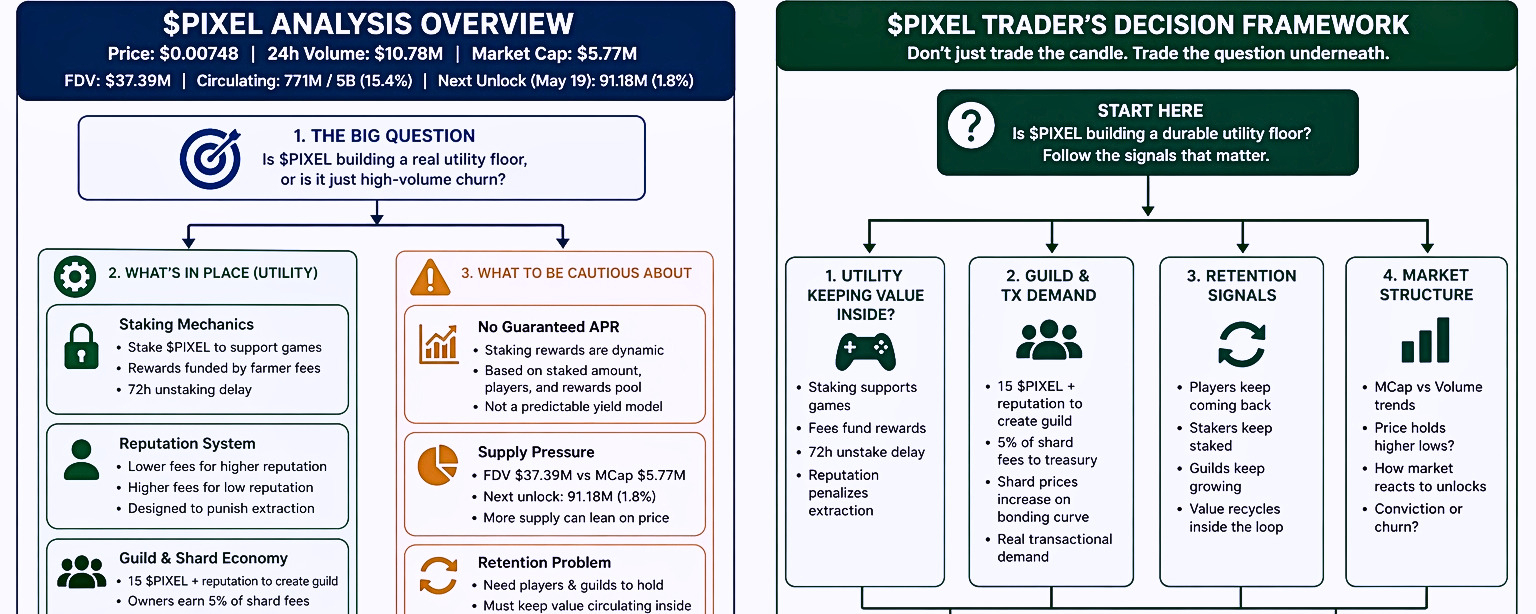
PIXEL is trading around $0.00748 today, with roughly $10.78 million in 24-hour volume against a market cap of about $5.77 million. That kind of ratio makes you pause and question what is actually happening underneath whether this is a genuine utility floor forming, or simply traders rotating the same liquidity back and forth faster than the market cap can realistically reflect.
Here’s how I see it. Pixels is clearly trying to build a floor, but I don’t think it has fully earned one yet. There is real token utility active right now, and that part shouldn’t be ignored. Staking allows players to lock $PIXEL to support ecosystem games, rewards are partially funded by farmer fees, and those fees are dynamically adjusted based on reputation higher costs for low-reputation users and lower costs for high-reputation, more engaged players. On top of that, unstaking comes with a 72-hour delay, which means capital is not instantly mobile. That detail matters more than it seems, because a true utility floor only starts to form when exiting becomes meaningfully less convenient than staying. Pixels clearly understands this behavioral constraint and is designing around it.
However, utility alone is not the same thing as durable demand. This is where my caution starts. The staking system explicitly states there is no fixed or guaranteed APR. Everything is dynamic depending on how many players are staking, how much total value is staked, and how rewards are distributed across the system.
In other words, this is not a predictable yield instrument where returns can be modeled like a bond or fixed-income product. Instead, it behaves more like a living economic system that constantly adjusts incentives to influence behavior. That is useful for engagement, but it does not necessarily create long-term demand stability.
The guild system is where the argument for a potential floor becomes more interesting. Creating a guild requires 15 $PIXEL along with sufficient reputation, which immediately introduces a baseline demand for the token. Guild owners also receive 5% of shard purchase fees into a treasury wallet, and shard prices are structured on a bonding curve starting at 1 $PIXEL for the first shard, then 2, and increasing progressively. This creates a direct transactional sink for the token that is tied to progression and system activity rather than purely speculative demand. That design choice stands out because it connects growth inside the ecosystem directly to token usage in a more structural way, not just cosmetic or optional spending.
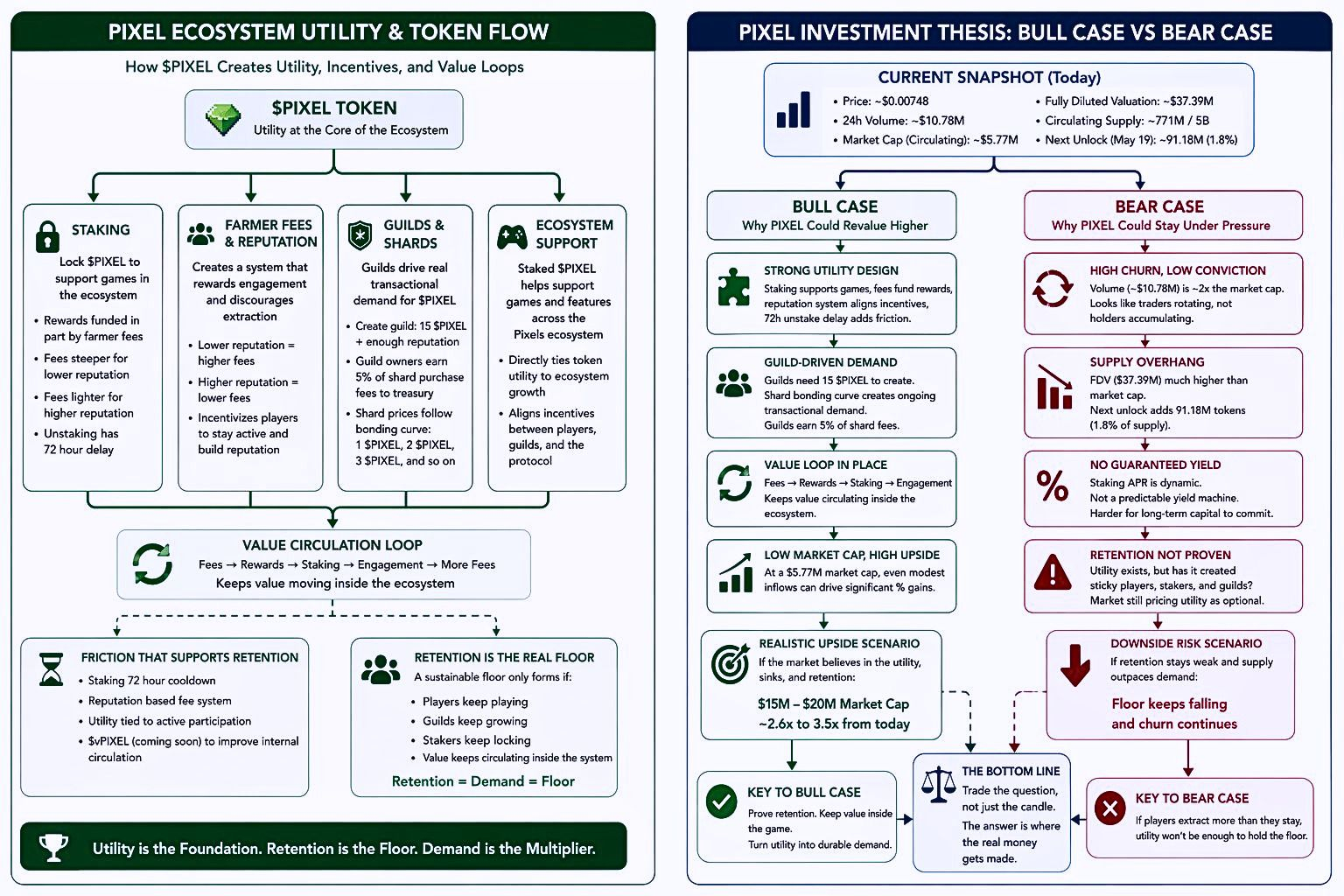
Still, the reality check remains important. A true price floor cannot survive on design alone it has to survive weak sentiment, not just documentation or optimistic mechanics. Today, PIXEL has a fully diluted valuation of about $37.39 million versus a circulating market cap of around $5.77 million, with roughly 771 million tokens already circulating out of a 5 billion total supply. On top of that, CoinGecko data shows the next unlock scheduled for May 19, releasing another 91.18 million tokens, which is about 1.8% of total supply. Even if the utility side continues to improve, supply-side pressure is still structurally present. That is the part bullish narratives often underweight.
You can design sinks, fees, and engagement loops, but if token emissions consistently outpace sticky demand, the effective price floor keeps drifting downward. That imbalance is what ultimately defines whether an economy stabilizes or keeps resetting.
This is why retention matters more here than almost anywhere else. I’m not particularly interested in whether Pixels can generate short bursts of demand over a week or two. What matters more is whether players, guild leaders, stakers, and land users consistently choose to keep value circulating inside the system rather than extracting it immediately. The entire design seems to be moving toward rewarding that behavior. Farmer fees discourage pure extraction, reputation reduces friction for engaged users, and staking is positioned as ecosystem support rather than passive yield generation. Even $vPIXEL is still marked as “coming soon,” which signals that the internal economic architecture is still being actively shaped rather than fully stabilized.
The realistic bull case is fairly straightforward. At a $5.77 million market cap, PIXEL does not require massive capital inflows to reprice meaningfully. If the market begins to believe that there is a credible combination of in-game sinks, fee-supported staking loops, and real guild-driven demand, then even a move to the $15–$20 million circulating market cap range would represent a significant repricing from current levels roughly a 2.6x to 3.5x move without requiring extreme assumptions. For traders, that kind of range is enough to matter.
The bear case, however, is equally difficult to ignore. Trading volume is still almost twice the market cap, which rarely signals strong conviction it signals rotation and churn. And when a token remains down over 99% from its all-time high, with future unlocks still ahead and no guaranteed staking yield, the market often continues to treat “utility” as optional rather than structural. That is my main tension with PIXEL: the design is clearly becoming more sophisticated, but it is still unclear whether the holder base is strengthening at the same pace.
So the real thing to watch is not just price action. Watch whether utility actually leads to retention inside the game. Watch whether staking and guild systems feel genuinely embedded in player behavior rather than just available features on paper. And watch whether the market cap begins behaving like a forming floor instead of a structure sitting above constant liquidity churn.
If you trade PIXEL, don’t just trade the candle. Trade the question underneath it because that question is still open, and in systems like this, the answer is often where the real edge is found.🧐