
The first time I saw a pet: Doggo appear in someone's Pixels profile, my first reaction was: wow, that's cute. My second reaction, about three seconds later, was: this person is saying something without using words.
Pixels is an online farming game running on the Ronin blockchain. Players cultivate land, craft items, trade resources, and earn ..., the game's official token that can be converted into real money on exchanges. The in-game land is capped at 5,000 NFT plots, and the team has stated they won't mint more for several years. Those without land can play on Specks, a public area with fewer resources, or join a guild to borrow land from others. A guild is a group of players that organizes, shares land, and builds crafting infrastructure to optimize earnings together. To join a good guild, you need approval from the guild leader.
Pets appear in the ecosystem @Pixels with a role described quite clearly: daily companions, increasing interaction radius, adding backpack slots, with a happiness meter that needs care like a Tamagotchi. The official description calls this "cosmetic enhancement." That's not wrong. But to mint a pet, players need to use $PIXEL real tokens, which have a market price fluctuating from a few cents to over a dollar depending on the moment. After minting, that pet is an NFT, which can be resold on Mavis Market, the main NFT exchange of the Ronin ecosystem. Currently, there are over 4,400 pet NFTs being traded, with a floor price around 10 USD, and a total market cap of nearly 50,000 USD. Pets have their own stats: Strength, Speed, Luck. Rare pets are valued differently from common pets.
This is where the label "cosmetic" starts to misalign with operational reality.
Cosmetic in the traditional sense refers to something that doesn't affect gameplay, having no economic value beyond aesthetics. But pets in Pixels have a real mint cost in $PIXEL, a secondary market with stable floor prices, and stats that directly affect performance in the game. This is not cosmetic in that sense. This is a capital asset being called by another name.
This is a form of categorical masking: the gap between the label the system assigns to an asset and how the market actually operates it.
That mask creates a layer of consequences that Pixels hasn't encoded into any official rule, but is happening in the operational reality of the guild system.
When the guild leader reviews an application, they don't have much information to evaluate a stranger. The Reputation Score is verifiable: you need 1,200 points to use the marketplace, 2,000 points to withdraw $PIXEL ra to an external wallet; these milestones are indicators of certain commitment. But the Reputation Score measures past behavior, not future commitment. The guild leader needs to know if this person is really investing in the game, if they'll stick around, and if they'll contribute to the guild.
Pet ownership in Pixels answers that question with a non-verbal signal. Someone with a rare Doggo on their profile has spent real money to mint or buy it on Mavis. They're taking care of the pet daily to keep the happiness meter from hitting zero, because if the pet loses happiness, it loses stat bonuses. This is not the behavior of a casual player just passing through. This is a behavioral signal of someone committed enough to maintain an asset with ongoing costs.
The guild leader reads that signal without needing anyone to explain. Not because there's a rule requiring it. But because it's the most logical inference from the available information.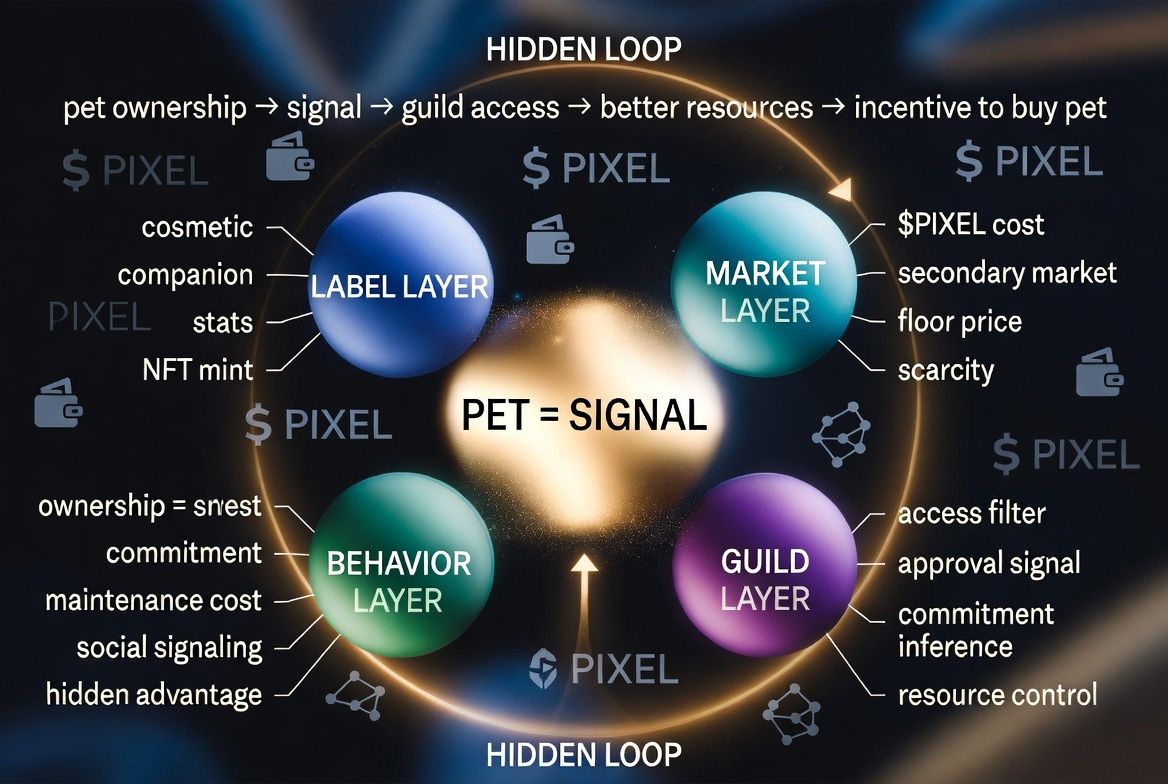
Concrete consequence: players without pets entering the guild application process have less commitment signaling, even if they might be equally or more skilled players. Those with rare pets are making a statement that no one is requiring them to make, and that statement is being heard. Access to better guilds, to better land, to higher resource tiers begins to be influenced by an asset labeled as cosmetic.
This is a cycle of implicit signaling: a pet with real cost creates a commitment signal, that signal is read unofficially by the guild layer, the guild layer controls economic access in Pixels, economic access creates the incentive to buy pets, and that incentive keeps Mavis Market pets always being traded even though no one declares pets as pay-to-win.
Barwikowski, the founder of @Pixels , has stated outright that guilds can require ownership of various assets to access perks. Pets are on that list of assets. When guild leaders are given the power to set requirements, and pets are assets that can be checked on-chain, the cycle of implicit signaling becomes a real operating mechanism, not just a hypothesis.
This doesn't mean Pixels is scamming players. Pixels isn't lying when it calls pets cosmetic in the sense that their stats don't directly determine victory in any combat mechanics. But the advantage in Pixels doesn't operate through combat mechanics. It operates through resource access, through guild membership, through the network of players who have land and organization. And at that layer, pets are no longer just cosmetic. They are an entry signal into a part of the game that isn't described in the tutorial.
Pixels doesn't eliminate pay-to-win. Pixels decentralizes it into a layer without a clear audit trail. No guild leader has to write "having a pet gets priority" in their charter. The system doesn't need to encode that. It just lets the market and social inference do the rest.
The Doggo pet in someone's profile is not just cute. It's an unspoken statement in a conversation that no one, including Pixels, officially acknowledges is happening.