
There was a moment when I looked at the end of day summary and saw that everything was still positive, yet the feeling was heavier than a loss. It was not because I had made one big mistake, but because Pixel made the very small deviations across the whole process suddenly impossible to pretend were harmless.
I think many people misread the role of taxes in Pixel. They see it as a technical deduction sitting at the end of a transaction. But Pixel does not work that way. Taxes push backward from the end to the beginning, changing the weight of every decision that came before. Harvesting early or late, selling raw or processing further, holding materials for a better margin or rotating capital immediately, all of it gets pulled into the same calculation.
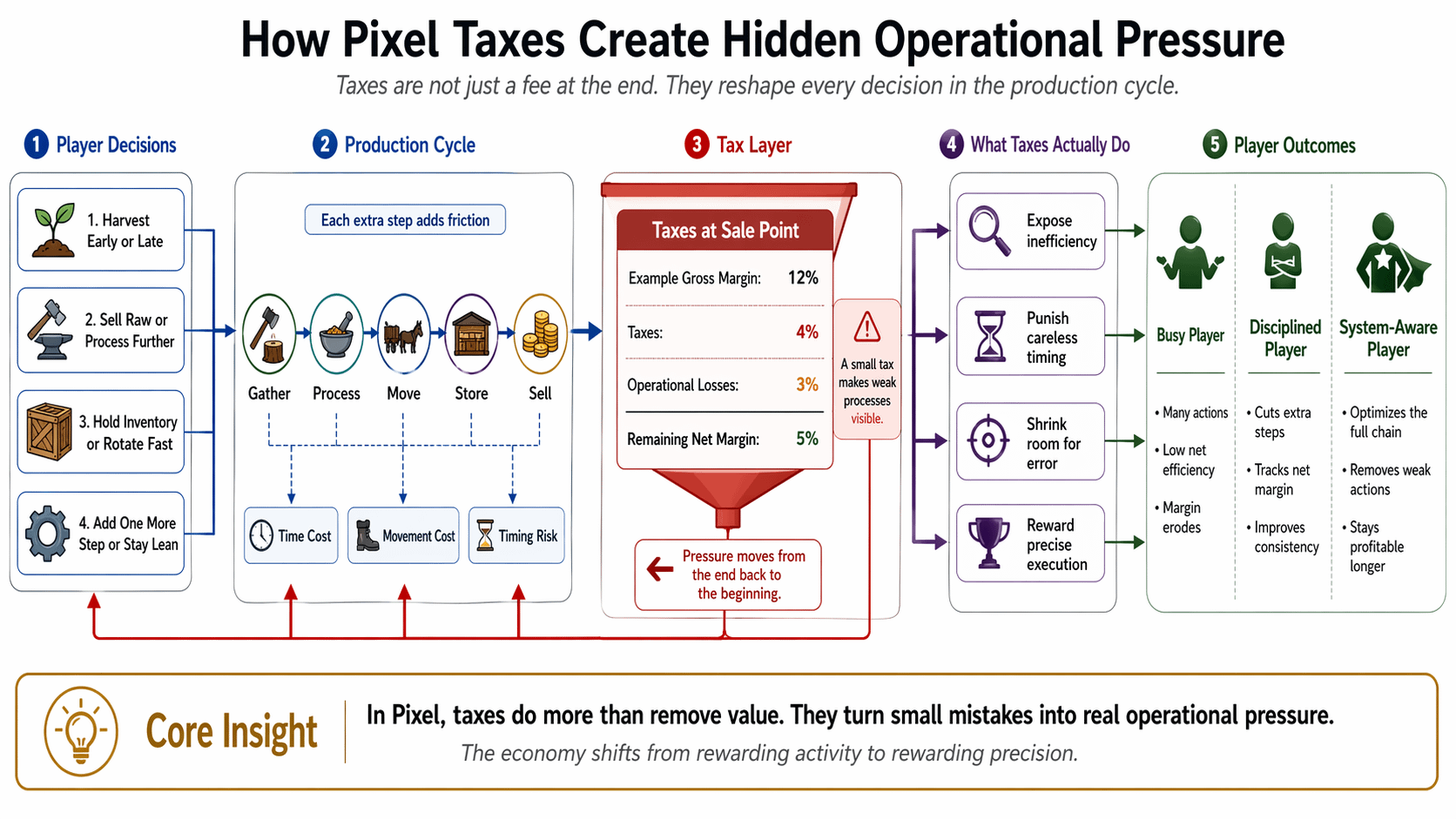
The deepest part of Pixel is here. It does not use taxes to make players visibly poorer. It uses taxes to make inefficiency more expensive. Suppose one production cycle gives a gross margin of 12 percent. If taxes take 4 percent, and another 3 percent disappears through waiting, movement, and mistimed harvesting, the remaining margin is almost no longer enough to support a bloated process. At that point, the question is no longer whether the goods can be sold, but whether that process still deserves to exist.
To be honest, this is the kind of pressure I value in a game economy. A weak system usually gives players the illusion of productivity. They do many things, spin many cycles, and end up believing efficiency has improved. Pixel cuts straight through that illusion. Once taxes enter at the end of the chain, every step before that is forced to prove its value. If one action does not clearly increase the final output, then it is no longer optimization, it becomes a burden.
Maybe that is why taxes in Pixel are more subtle than many people think. They do not feel like a wall blocking the path, but more like an extremely sensitive scale. New players often fail to see where they are losing, because each individual deduction still looks small. But players who have been around long enough will see the real issue elsewhere. Taxes expose the cost of carelessness. Planting one beat off, harvesting one round late, holding inventory too long, or forcing one more processing step on a thin expectation, those decisions are now starting to be fully accounted for.
Ironically, many people only look at taxes as a tool to absorb value and preserve economic order, then stop there. But with Pixel, the more interesting layer is that it reclassifies players. Average players who survive on the feeling of being busy will gradually be worn down. Players who measure their chain of actions by net efficiency will cut away steps that only seemed important. And the ones who truly understand the system will not ask how to sell at a higher price, but which step should disappear so that the final margin becomes thicker.
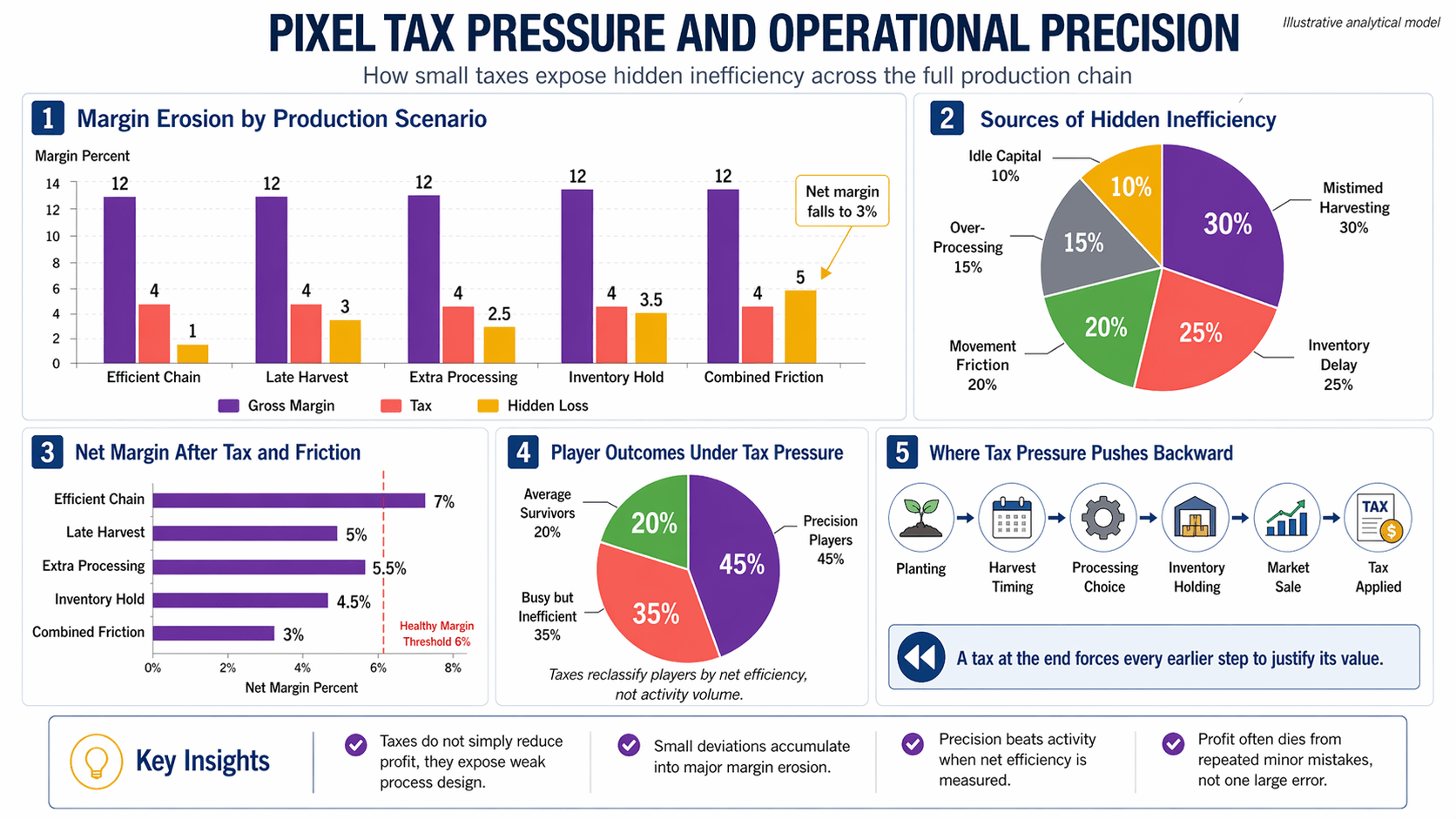
Few would expect a tax mechanism to become such a sharp tool for governing behavior. But Pixel is doing exactly that. It is forcing the economy to move from rewarding output to rewarding precision. Two players can gather the same amount of resources and still end up with completely different outcomes, simply because one keeps the operating rhythm tight while the other lets the process swell unconsciously. Or put another way, the system is reminding players that profit does not die from one major mistake, but more often from too many small deviations repeated over time.
I am no longer interested in designs that make everyone feel like they are winning, because I have seen too many systems inflate on that illusion and then collapse very quickly. What draws my attention here is the way this project uses a small tax to force players to reexamine every link in their daily profit making habits. Pixel does not need to create a loud effect to build pressure deep enough on the way people operate, and that is the part that makes me want to keep watching, because in the end, who will still remain when profit can no longer hide every error.