
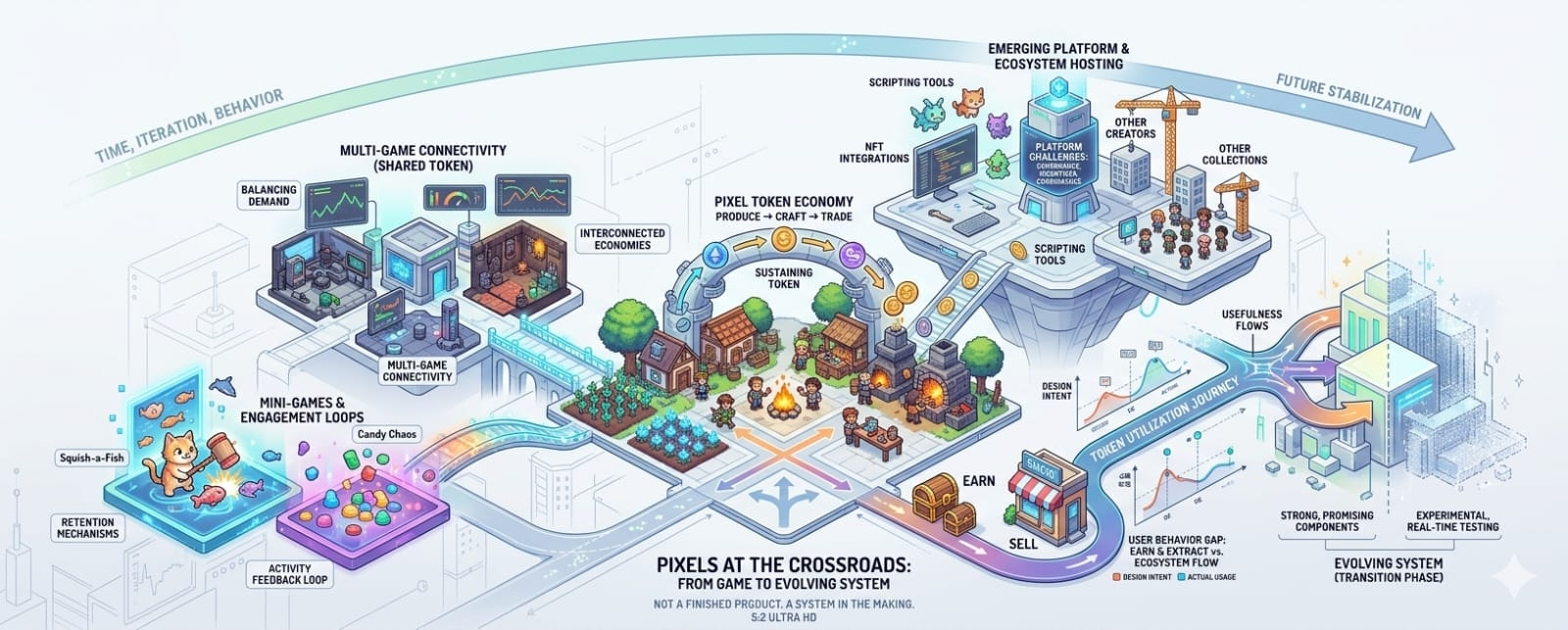
Let me say this honestly, because it’s something that becomes clearer the more you follow the updates Pixels doesn’t really feel like just a game anymore. It feels like a collection of small systems slowly growing inside a game-shaped shell. And as we move toward 2026, that shift is becoming harder to ignore. What used to feel like a single experience now looks more like a layered ecosystem trying to hold multiple ideas together at once.
At the center, the main game still matters. Chapter 3 is clearly the core loop farming, crafting, social interaction. On the surface, it looks soft and casual, almost simple. But once you spend time in it, you realize it’s not built just for fun. There’s a structured economy running underneath. People aren’t just farming for progression; they’re producing, circulating, and feeding into a system that is trying to sustain a token. That loop produce, craft, trade, repeat is doing more work than it first appears.
But Pixels doesn’t stop there anymore. It’s expanding outward.
What’s happening now is less about improving one game and more about connecting multiple experiences. The idea of having several games tied together through the same token is where things start to get complicated. On paper, it sounds powerful a shared currency flowing across different environments. But in reality, each game creates its own behavior. What works in one place doesn’t always translate cleanly into another. Demand can rise in one layer and disappear in another, and suddenly the system needs constant balancing.
That’s where you start to see both the ambition and the risk at the same time.
And then there are the smaller pieces, the ones that don’t look important at first. Mini-games like Squish-a-Fish or Candy Chaos almost feel like jokes when you first hear about them. But they’re not there by accident. They exist to keep people inside the system. Quick loops, easy engagement, something that pulls you in for just one more round” until time disappears. In a Web3 environment, where activity directly affects the economy, these loops are doing critical work. Without retention, nothing else holds.
The bigger shift, though, is happening at a higher level. Pixels is slowly positioning itself less as a game and more as a platform. Things like scripting tools and NFT integrations aren’t just features they’re signals. It’s opening the door for other creators, other collections, other systems to exist inside its world. That changes the role of Pixels entirely. It’s no longer just building content; it’s trying to host it.
But becoming a platform is where things usually get difficult.
A single game is already hard to balance. A platform adds layers of coordinationdevelopers, economies, incentives, governance. It’s not just about keeping players engaged anymore; it’s about managing an entire ecosystem of participants who all behave differently. Many projects reach this point and struggle, not because they lack vision, but because complexity starts to create friction.
And right in the middle of all of this sits the token.
PIXEL is clearly trying to move beyond being just something people earn and sell. The intention is to make it useful, something that flows through different parts of the ecosystem. But user behavior doesn’t change overnight. A large portion of people still treat it the same wayearn, extract, exit. And that gap between how the system is designed and how people actually use it is probably the most important challenge right now.
Because no matter how well-designed a system is, it only works if people engage with it the way it was intended.
That’s why Pixels today feels like it’s in a transition phase. It’s growing, expanding, connecting pieces together but it hasn’t fully stabilized yet. Some parts feel strong and promising, like they could support something much bigger. Other parts still feel experimental, like they’re being tested in real time.
And maybe that’s the most honest way to look at it.
It’s not a finished product. It’s not a clear success or a failure either. It’s something in between—an evolving system that’s still trying to figure itself out. There are moments where it feels like it could genuinely shape a new kind of gaming economy. And there are moments where it feels like it might be trying to do too much at once.
Right now, it exists in that middle space. Not driven purely by hype, but not fully proven either. Just slowly unfolding, shaped by time, iteration, and how people choose to behave inside it.
