
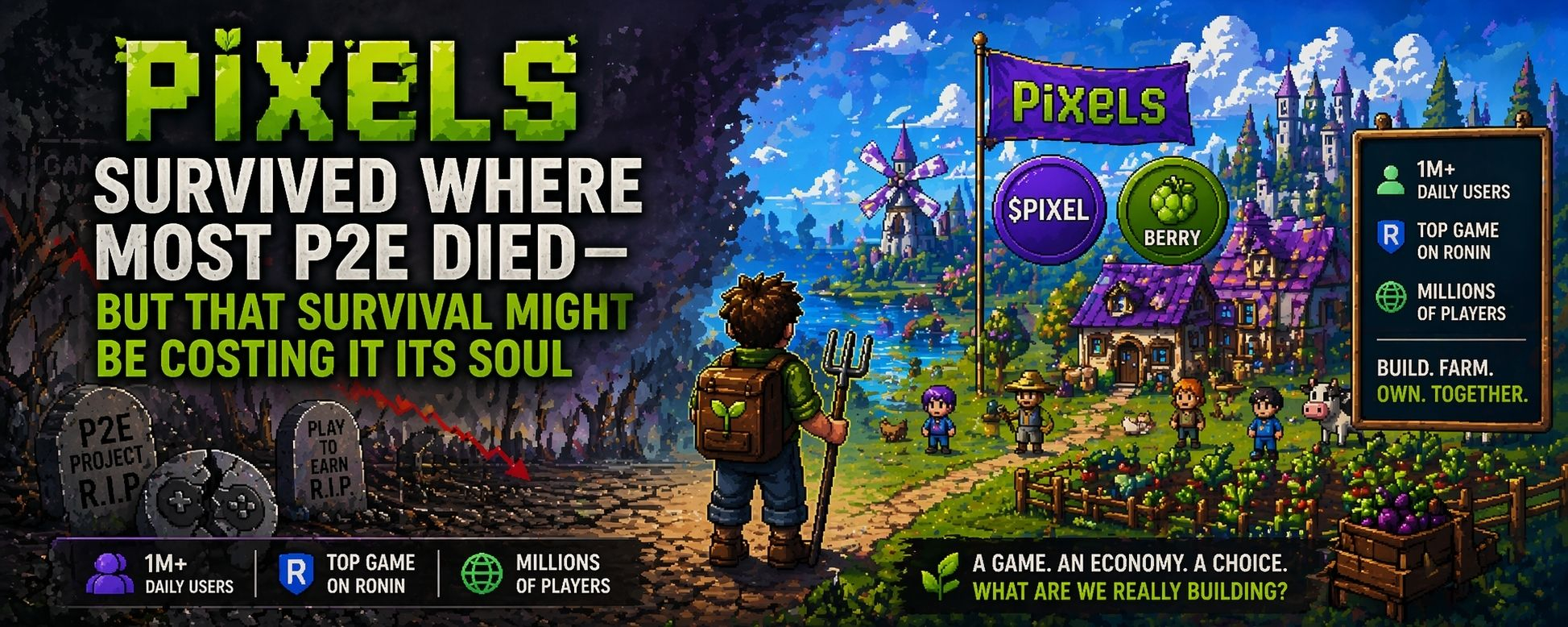

I’ve watched a lot of play-to-earn projects come and go. Some exploded overnight and disappeared just as fast. Others never even got a real player base to begin with. But Pixels did something different—it survived. And not just survived, it scaled. It onboarded hundreds of thousands of players, pushed daily activity to levels most Web3 games could only dream of, and actually built something people log into every day. That alone puts it in a completely different category.
But the more I look at it, the more I start questioning something deeper. Survival in Web3 gaming isn’t neutral. It forces trade-offs. And in Pixels’ case, I think that survival may have come at a cost that most people aren’t fully paying attention to yet.
At first glance, Pixels looks like the success story we’ve all been waiting for. A farming MMO, simple mechanics, easy onboarding, running on Ronin—fast, cheap, accessible. No complicated wallets blocking entry. No friction. That alone solved one of the biggest problems that killed early play-to-earn games. They were too complex for normal users. Pixels removed that barrier completely.
And the numbers backed it up. At its peak, Pixels pushed into the top ranks of blockchain games with hundreds of thousands of daily active wallets. Millions of players interacted with the ecosystem over time. Compared to older P2E models like Axie’s early days, Pixels felt smoother, more casual, more “real.” It didn’t feel like you were working a second job—it felt like you were playing a game.
But that’s where the first crack starts to show.
Because underneath that smooth gameplay, the same fundamental economic pressure still exists. Players are not just playing for fun. They are farming. Farming resources, farming tokens, farming progression that can eventually be monetized. And when a system is built around extraction—even if it’s disguised as gameplay—it creates a silent imbalance.
I started noticing that Pixels didn’t actually eliminate the grind. It just made it feel better.
That’s a big difference.
The introduction of the dual-token model—$BERRY as the in-game resource and $PIXEL as the premium layer—was supposed to stabilize the economy. On paper, it makes sense. One token absorbs inflation, the other captures value. But in practice, it creates a separation between effort and reward that most players don’t fully realize.
You spend hours farming $BERRY, but the real value sits in $PIXEL.
That gap matters.
Because it slowly shifts the experience from ownership to participation. You’re active, you’re engaged, but you’re not necessarily capturing meaningful value unless you move up the ladder. And moving up usually requires either time, capital, or both.
This is where survival starts to feel different.
Pixels didn’t collapse like early P2E games because it reduced the immediate pressure on the economy. It slowed things down. It stretched the lifecycle. It made inflation less obvious. But it didn’t remove it. It just redistributed it across time and across players.
New players come in, they enjoy the game, they farm, they engage. But over time, many of them hit the same wall: the realization that progression doesn’t always translate into real upside.
And when that realization hits, behavior changes.
Some players leave quietly. Others stay but reduce activity. A smaller group doubles down, invests more, and tries to optimize the system. This creates a layered player base—not everyone is playing the same game anymore, even though they’re in the same world.
That’s the part I think most people overlook.
Pixels is no longer just a game. It’s an economy with different classes of participants.
There are casual players who treat it like a farming sim. There are grinders who try to extract as much value as possible. And there are investors who position themselves around land, NFTs, and token exposure. All of them coexist, but their incentives are not aligned.
And when incentives start to diverge, the system slowly changes its identity.
I’ve seen this before in Web3. A project starts with a simple vision—fun, ownership, community. Then growth kicks in. Metrics become important. Retention becomes critical. Token performance becomes a narrative driver. And gradually, decisions start optimizing for sustainability of the system rather than purity of the experience.
That’s not necessarily wrong. It’s just a shift.
Pixels optimized for survival. It avoided the death spiral that killed many P2E games. It built a loop that keeps players engaged without collapsing instantly under sell pressure. That’s an achievement.
But the question I keep coming back to is this: what did it have to give up to achieve that?
Because the more stable the system becomes, the more controlled the economy needs to be. Rewards get balanced. Progression gets tuned. Extraction gets limited. And over time, the “earn” part becomes less direct, less obvious, more conditional.
At that point, you’re not really in a play-to-earn system anymore.
You’re in a play-and-maybe-earn system.
And that subtle difference changes everything.
It changes how players think. It changes how they engage. It changes how long they stay.
Pixels still has one of the strongest positions in Web3 gaming right now. It has users, liquidity, infrastructure, and momentum. Most projects would do anything to be in that position. But strength in numbers doesn’t automatically mean strength in design.
Because long-term, the real challenge isn’t onboarding users.
It’s aligning them.
If new players feel like they’re feeding an existing economy without clear upside, friction builds. If older players rely on new entrants to sustain value, pressure builds. And if the system constantly needs growth to maintain balance, then sustainability becomes conditional, not guaranteed.
That’s the deeper tension inside Pixels.
It survived where most P2E projects died by adapting its model. But in doing so, it may have moved further away from the original promise of true player ownership and open value creation.
And maybe that’s the reality of Web3 gaming right now.
Maybe you can’t have both—mass adoption and pure economic freedom—at least not yet.
Pixels feels like a middle ground. A compromise between fun and finance, between game and economy, between player and participant.
And I don’t think that’s a failure.
But I do think it’s something we need to look at more critically.
Because survival is important.
But what you become while surviving matters even more.