
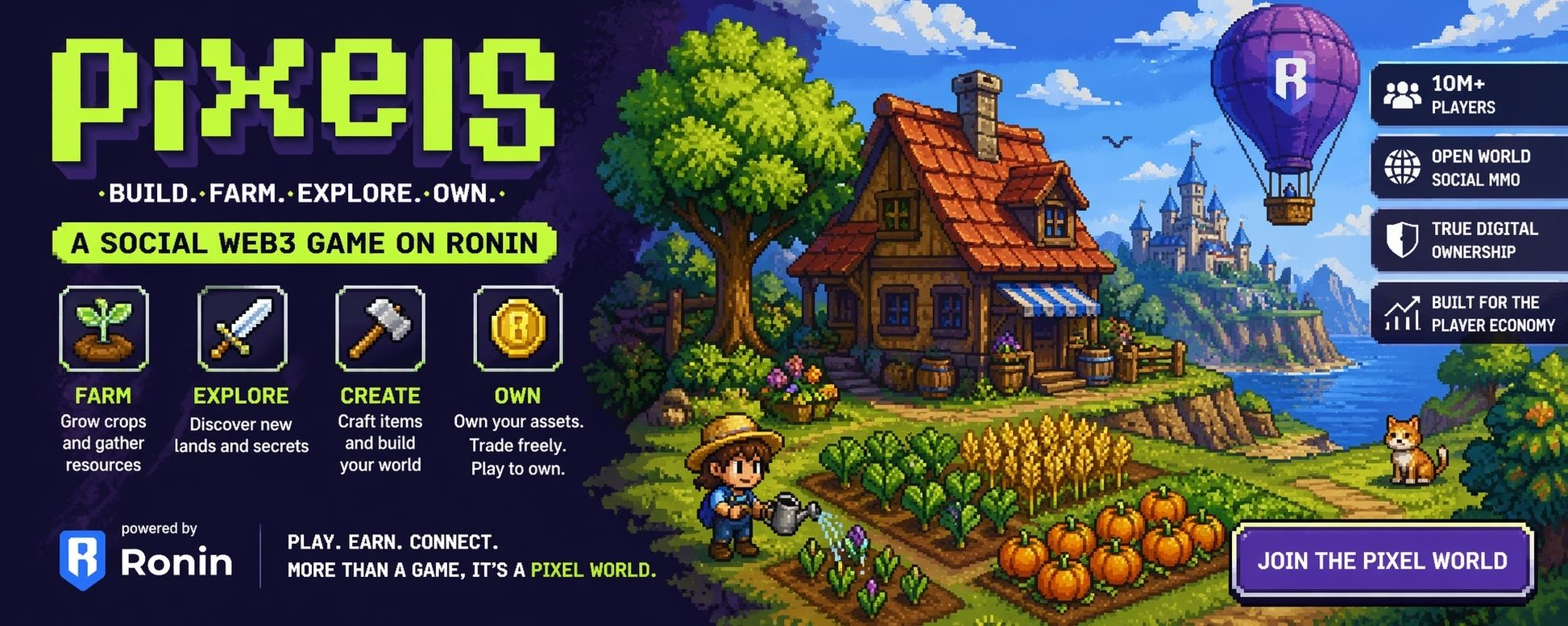
Pixels is easy to misunderstand if you only look at it from the outside.
A lot of people see the pixel art, the farming, the soft social vibe, and they assume they already know what it is. Just another cute Web3 game. Plant crops, collect items, maybe earn something, maybe move on. That kind of first impression makes sense. Pixels does look simple at first. But I think that simplicity hides the real reason the project matters.
What Pixels is trying to build feels bigger than a farming game with a token attached to it.
At its core, the project is built around a world that people can actually spend time in without feeling pushed every second. That sounds small, but it matters. Many Web3 games made the mistake of turning every action into a transaction and every player into a worker. The result was always the same. People showed up for rewards, stayed for a while, then disappeared when the rewards stopped feeling worth it. The game never became the reason to stay. It was just the wrapper around the economy.
Pixels feels like it is trying to flip that.
The project leans into farming, exploration, gathering, land, pets, progression, and social interaction in a way that feels more natural than most blockchain games. It wants the world itself to have value. Not just the assets inside it. That is a very important difference. A healthy game usually starts with the experience. The economy should support the world, not replace it. Pixels seems to understand that better than most projects in this space.
That is probably why it has managed to stay relevant in a sector where attention disappears very fast.
There is something smart about the way Pixels presents itself. It does not try too hard to look complicated. It does not lead with technical noise. It feels approachable. The art style is familiar. The gameplay loop is easy to enter. The environment feels social instead of cold. That kind of accessibility is not weakness. It is one of the project’s strengths. A game does not need to look intense to be effective. Sometimes the softer design is exactly what makes people stay longer.
And staying matters more than hype.
What makes the project more interesting is that Pixels does not feel satisfied being only one simple game. The direction around it suggests something broader. It feels like a growing ecosystem, not just a single product. The idea is no longer only about letting players farm and collect. It is also about building a wider economy around participation, progression, and connected projects. That gives Pixels more depth than people give it credit for.
You can see that clearly in how the project handles PIXEL itself.
The token is not being pushed only as something to trade. It is meant to be part of the project’s internal life. Through staking and ecosystem participation, Pixels is trying to turn the token into something with a role inside the world rather than leaving it as a detached market asset. That effort matters. In Web3 gaming, tokens usually fail when they become too separate from the actual player experience. If the token only lives on exchanges, then the game starts losing its center. Pixels appears to be trying to keep that connection alive.
I think that is one of the most important things about the project right now.
It is trying to build alignment between the player, the world, and the economy. Not perfectly. No project does that perfectly. But the attempt is real. And in this sector, a real attempt already puts it ahead of many others.
Another thing that stands out is the tone of the project. Pixels does not feel like it is forcing people into a heavy financial mindset every minute. That changes the whole atmosphere. It gives the game room to breathe. It allows players to enjoy routine, creativity, and slow progression without making everything feel like a yield strategy. That kind of design choice is easy to overlook, but it changes the emotional texture of the game. It makes the project feel more alive and less mechanical.
That is why Pixels has a different kind of appeal.
It is not trying to win by being louder than every other project. It is trying to become a place people recognize, return to, and build habits around. There is something more durable in that idea. Hype can bring people in, but habit is what keeps a game alive. Pixels seems to understand that a long-lasting project is not built only through token action or market attention. It is built by creating a world that feels familiar enough to revisit and flexible enough to keep growing.
The Ronin connection also gives Pixels extra weight. It places the project inside an ecosystem that already has real gaming identity. That matters because it gives Pixels a stronger foundation than many isolated Web3 games. It does not feel like a random experiment floating alone. It feels connected to a chain where gaming is actually part of the culture. That kind of environment gives the project more credibility and more room to develop naturally.
Still, the real strength of Pixels is not just where it is built. It is the fact that the project still feels like a project, not just a token narrative pretending to be one.
That may sound obvious, but in crypto it really is not.
A lot of projects lose themselves because the market starts speaking louder than the product. Once that happens, every conversation becomes about price, volume, momentum, and speculation. The original idea starts fading into the background. Pixels still has enough identity in its world, style, and player experience that the project itself remains visible. That is valuable. It means there is still something real underneath the market layer.
And that is probably why Pixels continues to feel worth watching.
It has charm, yes, but it is not surviving on charm alone. It has a recognizable world, a player-friendly design, and a broader vision that hints at something more connected and more sustainable than the usual play-to-earn cycle. It feels like a project trying to grow carefully instead of just expanding loudly. That slower kind of growth is often harder to notice, but it is usually more meaningful.
Pixels does not need to pretend to be everything. That is part of its strength too. It knows its identity. It knows the kind of world it wants to create. And instead of forcing complexity onto the player, it keeps the surface light while slowly building more depth underneath. That balance is difficult. Too simple, and the project feels shallow. Too complicated, and the magic disappears. Pixels sits in a rare middle space where the world feels easy to enter, but the project itself has enough substance to keep the conversation going.
That is what makes it stand out to me.
Not that it is perfect. Not that it has already solved Web3 gaming. But that it still feels believable. It feels like a real attempt to build a living digital world where gameplay, ownership, and community can exist together without one destroying the others. In a space full of projects that burn bright and vanish, that kind of steady identity is not something to ignore.
Pixels feels like one of the few projects still trying to prove that a blockchain game can be more than a short-term cycle.