
I’ll be honest… when I first started playing Pixels, I thought I had it figured out.
Log in.
Farm fast.
Craft.
Sell.
Repeat.
That loop felt clean. Simple. Like every other GameFi model we’ve seen before.
But the longer I stayed, the more something felt… off.
Not in a bad way. Just different.
I kept noticing players moving ahead of me, not randomly, but consistently. Their land looked more developed. Their setups felt smoother. And the weird part? They weren’t even playing more than me.
That’s when it clicked.
Pixels is not rewarding activity the way most Web3 games do. It’s rewarding timing and decisions.
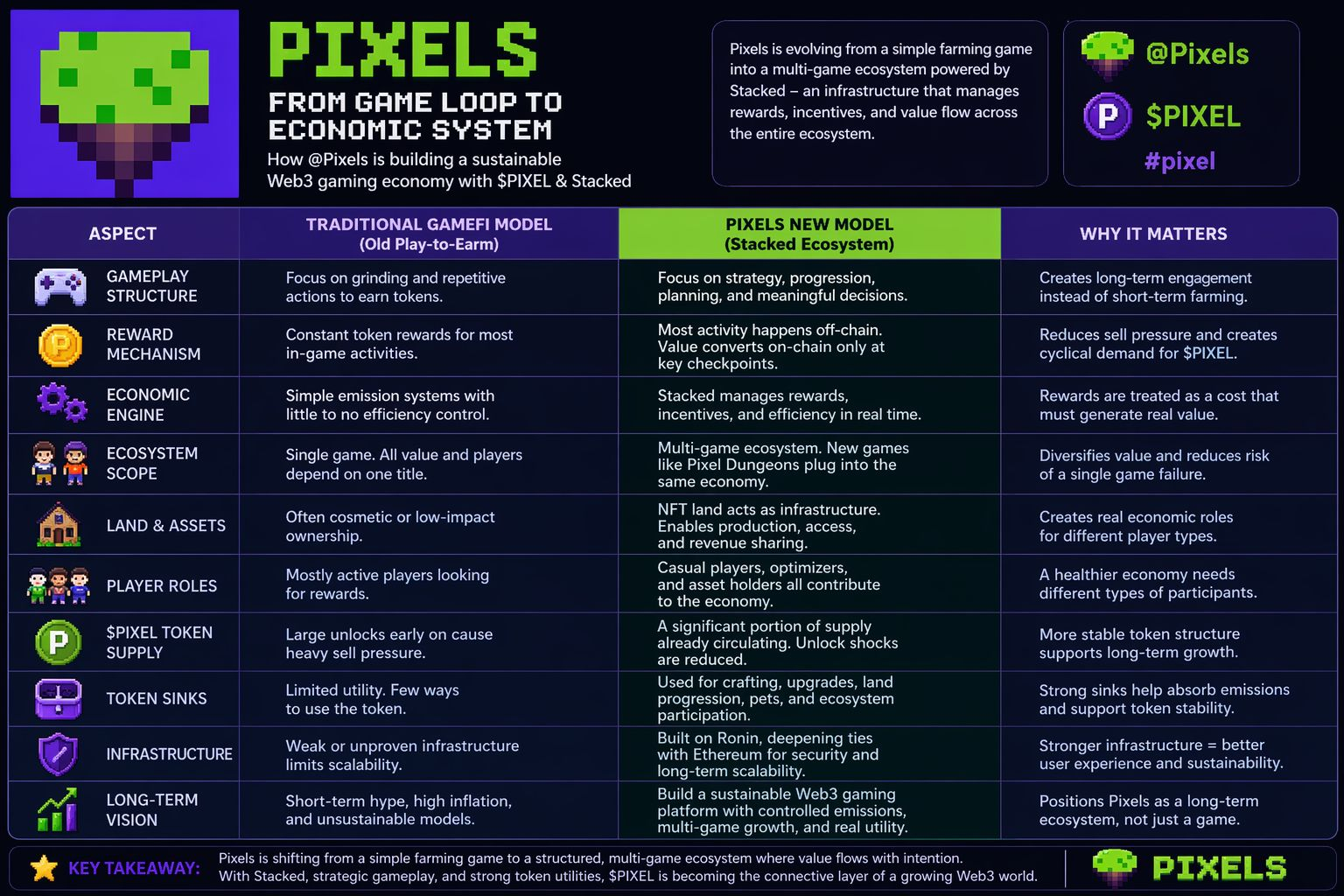
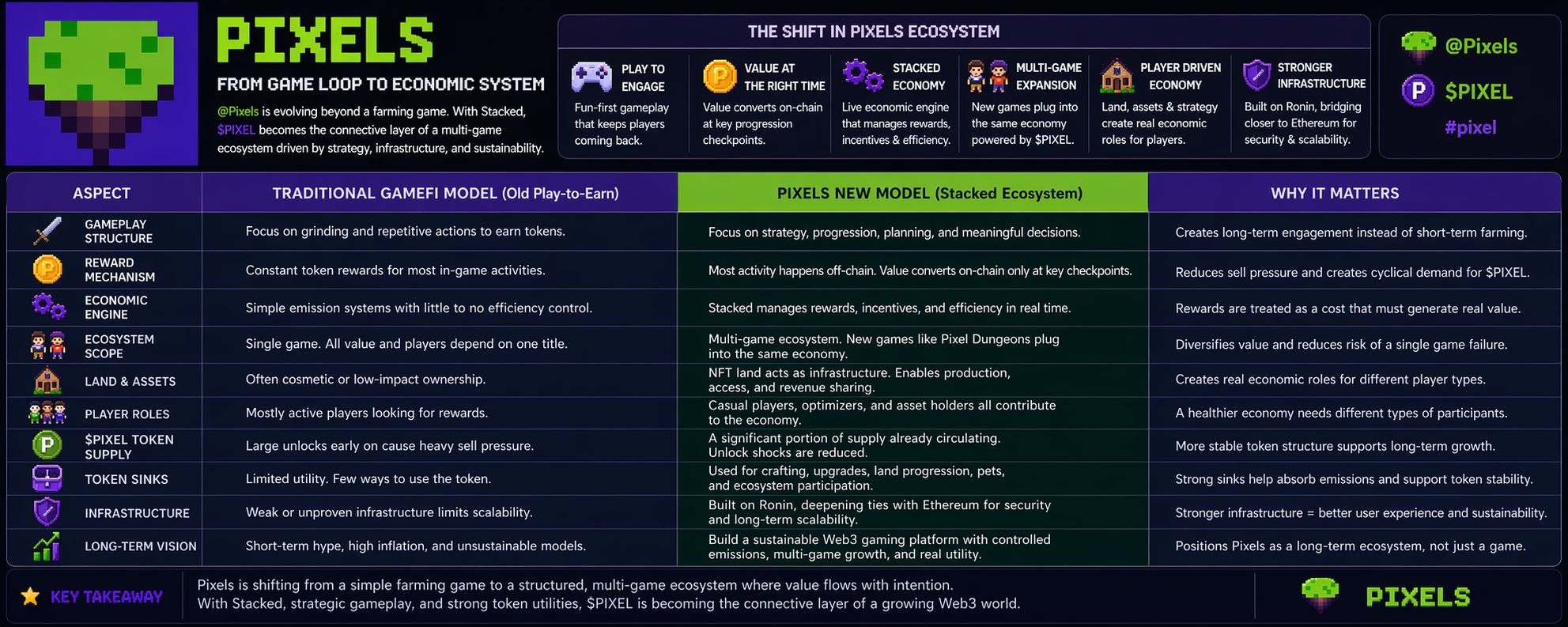
Most of what you do inside the game doesn’t instantly touch $PIXEL. Farming, crafting, waiting… it all builds quietly in the background. The real value only shows up at certain moments, when that progress converts into something on-chain.
And those moments don’t feel random at all.
This is where things start getting interesting.
Instead of constant demand for $PIXEL, you get waves. Periods where players need the token for upgrades, land progression, or ecosystem actions… followed by quieter phases where the game keeps running but the token isn’t being used as much.
That explains why gameplay activity and token price don’t always move together.
Once you see that, your whole approach changes.
Then comes the bigger layer most people still ignore… Stacked.
At first, I thought Stacked was just another rewards system. But it’s not. It feels more like a control system running behind everything.
It decides how rewards are distributed, who gets incentivized, and when it actually makes sense to push value into the system. Instead of flooding players with tokens, it tries to balance engagement with sustainability.
That alone separates Pixels from most GameFi projects.
Because let’s be real… most of them failed for the same reason.
Too many rewards. Not enough real value.
Pixels is trying to fix that.
And now it’s going even further.
The game isn’t staying as just one game anymore. It’s slowly turning into an ecosystem where multiple experiences can plug into the same economy. $PIXEL is starting to feel less like a single-game token and more like a shared layer across everything being built.
That changes the long-term picture a lot.
If one game slows down, the system doesn’t die.
It shifts.
On the gameplay side, things have also evolved more than people realize.
Higher-level progression is no longer about grinding harder. It’s about thinking ahead. Land matters more. Setup matters more. Timing matters more.
Owning land isn’t just for flex anymore. It actually acts like infrastructure. You can build on it, let others use it, and earn from the activity happening on your land.
So now you’ve got different types of players:
Some just play casually.
Some optimize everything.
Some build systems and earn from others.
That mix is what makes the economy feel alive.
On the token side, $PIXEL is in a different phase now too. A big portion of the supply is already circulating, which means we’re not in that early unlock shock stage anymore. But new tokens are still entering through gameplay rewards.
So the real question is simple…
Can the game absorb what it keeps producing?
Right now, it’s trying.
Crafting, upgrades, pets, land systems… all of these act as sinks pulling tokens back into the game. And if those sinks stay strong, the system holds. If not, pressure builds.
That balance is everything.
Another important piece here is the network itself. Pixels runs on Ronin, which is closely tied to Ethereum. As the infrastructure improves, the game becomes easier to scale, cheaper to use, and more stable overall.
And that’s something people usually ignore when they look at GameFi.
They focus on price.
But infrastructure decides survival.
When you step back and look at everything together, Pixels doesn’t feel like a typical Web3 game anymore.
It feels like a system that’s still being built in real time.
Not perfect. Not finished. But clearly moving in a direction most projects never reached.
It’s slower. More controlled. Less hype-driven.
But also… more real.
Right now, most people are still playing it like it’s a simple farming loop.
But if you spend enough time inside, you start seeing it differently.
It’s not about grinding anymore.
It’s about positioning.
And Pixel is quietly turning into something much bigger than people expect.