
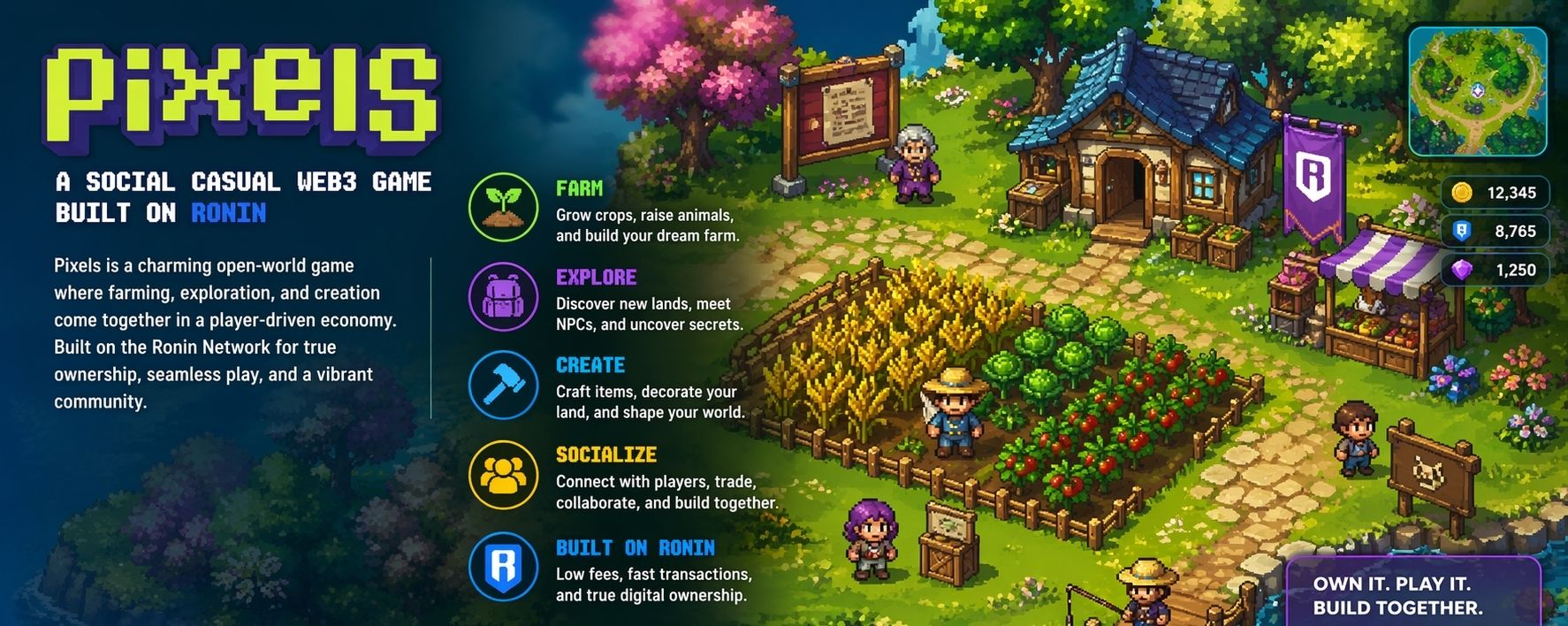

Pixels is one of those projects that makes me pause a little, mostly because it is trying to build something more ordinary than what crypto usually likes to celebrate.
A farming game does not sound revolutionary on paper. Open-world, casual, social, crafting, exploration — none of that is new. And maybe that is exactly why it is worth watching. In crypto, too many things arrive wrapped in language about disruption, while very few teams are willing to do the slower work of making people come back for simple reasons: routine, curiosity, habit, fun.
That is what makes Pixels interesting to me. Not because it is loud, but because it feels closer to an actual product than a lot of token-first experiments. A game built around farming and creation sounds almost unglamorous in this space, and that gives it a different kind of seriousness. If people stay, it will not be because of a perfect narrative. It will be because the loop works.
Being on Ronin matters too, but not in the usual market sense. It matters because infrastructure only becomes meaningful when it supports something people actually use. A network can promise scale, speed, low fees, all of that. The real test is whether builders turn those things into behavior. Pixels seems to be part of that test.
I am still a little skeptical, honestly. Web3 games have trained people to be careful. Too many of them confuse temporary attention with real retention. Too many mistake speculation for community. So the question is not whether Pixels looks charming. The question is whether it keeps learning, keeps shipping, and keeps turning a simple game world into something people want to live in a bit longer.
That is why I think it deserves attention. Not blind praise, just attention. Sometimes the most useful signal in crypto is not the biggest promise, but the projects quietly trying to make something work. Pixels feels closer to that category. And there is always something to learn from builders who keep making, adjusting, and seeing what actually sticks.