
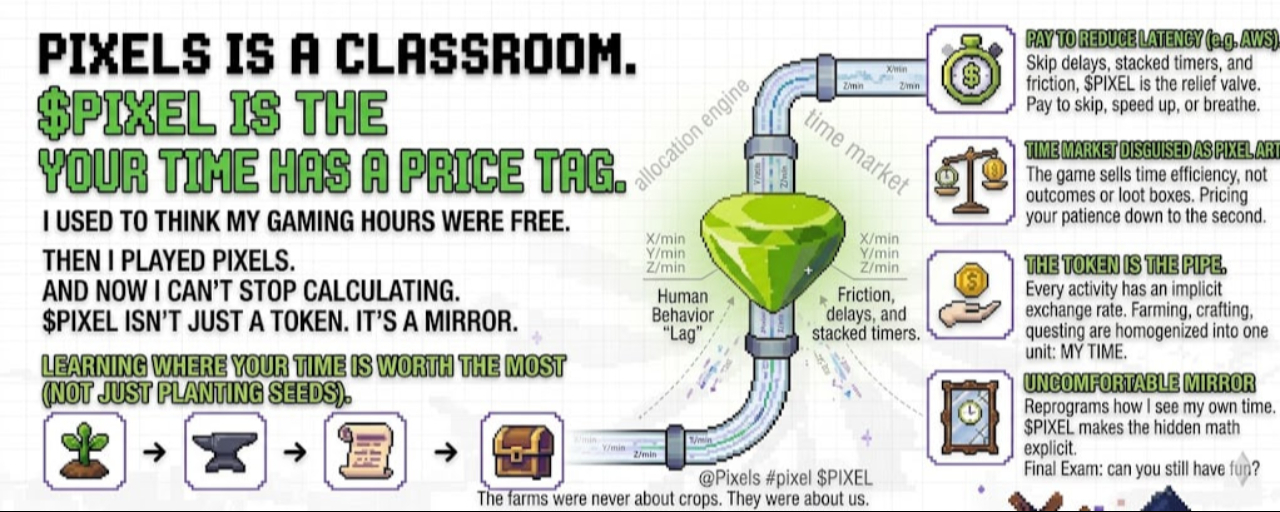
I used to think my gaming hours were free. Just leisure. Soft currency.
Stuff I burned without thinking.
Then I played Pixels. And now I can't stop calculating.
$PIXEL isn't just a token. It's a mirror. And I don't like what I see.
Here's what happened.
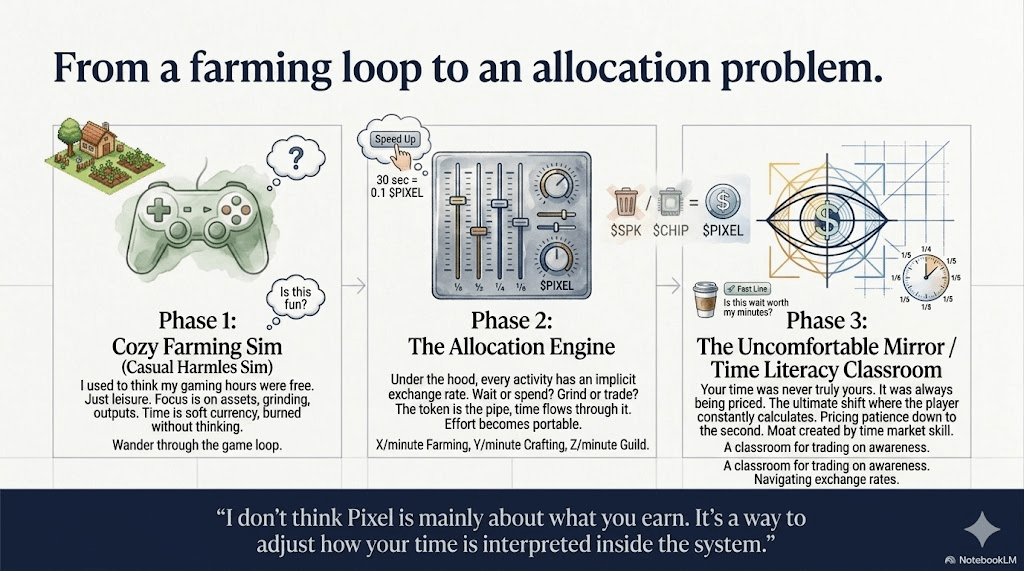
I started farming. Then crafting. Then guilds. Normal loop. But something felt different. Every click had a shadow cost. Wait or spend? Grind or trade? Play or optimize?
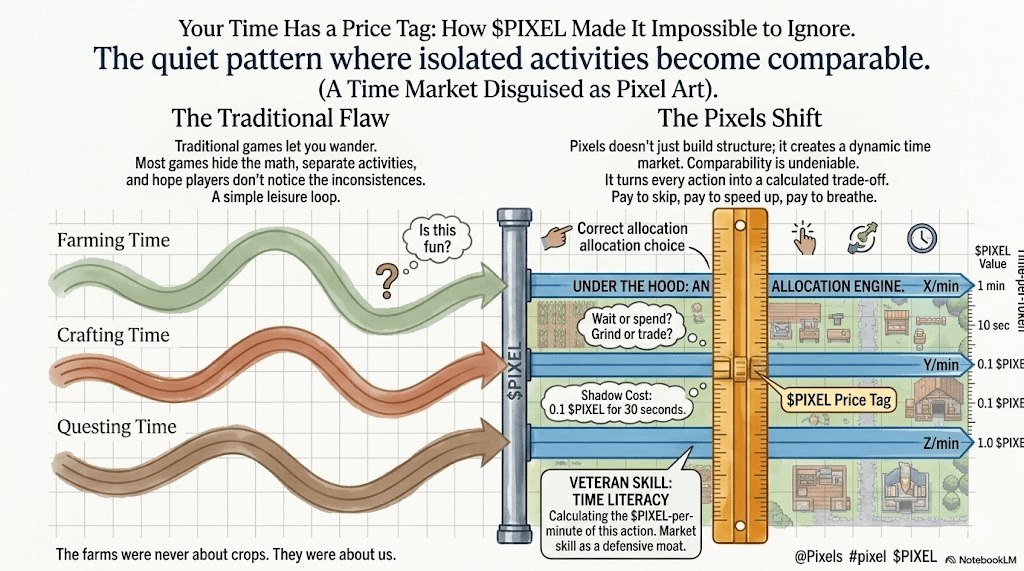
Traditional games let you wander. Pixels doesn't. It turns every action into a trade-off. Farming, crafting, questing—all homogenized into one unit of measurement. My time.
Suddenly the question wasn't "is this fun?" It was "is this the best use of my minutes?"
That's uncomfortable. And that's the point.
I caught myself doing something weird.
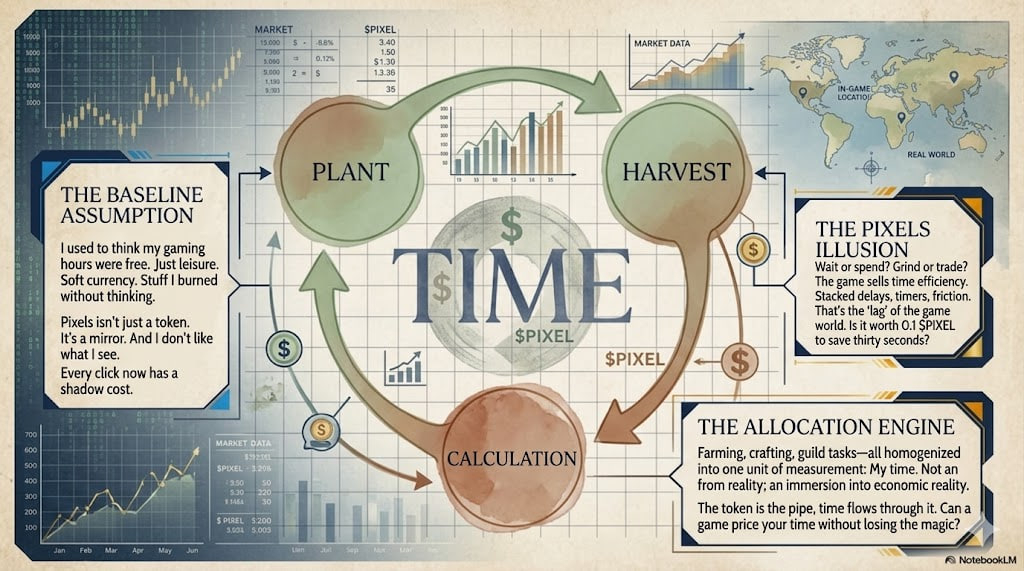
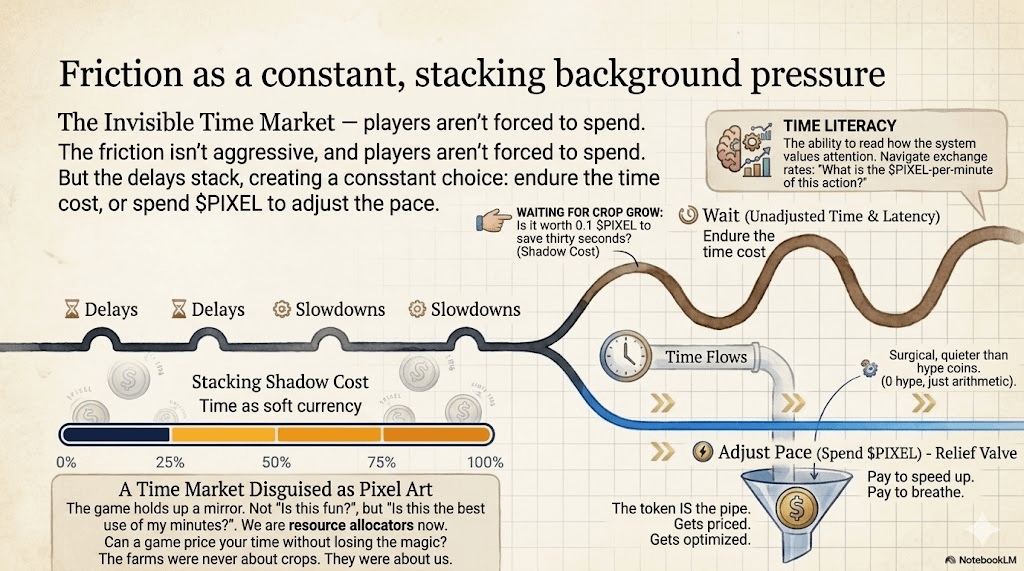
I was waiting for a crop to grow. Thirty seconds left. My finger hovered over the "speed up" button. And I thought—is it worth 0.1 PIXEL save thirty seconds?
Thirty seconds. I calculated it. Out loud.
That's when I realized this isn't a game anymore. It's a time market disguised as pixel art.
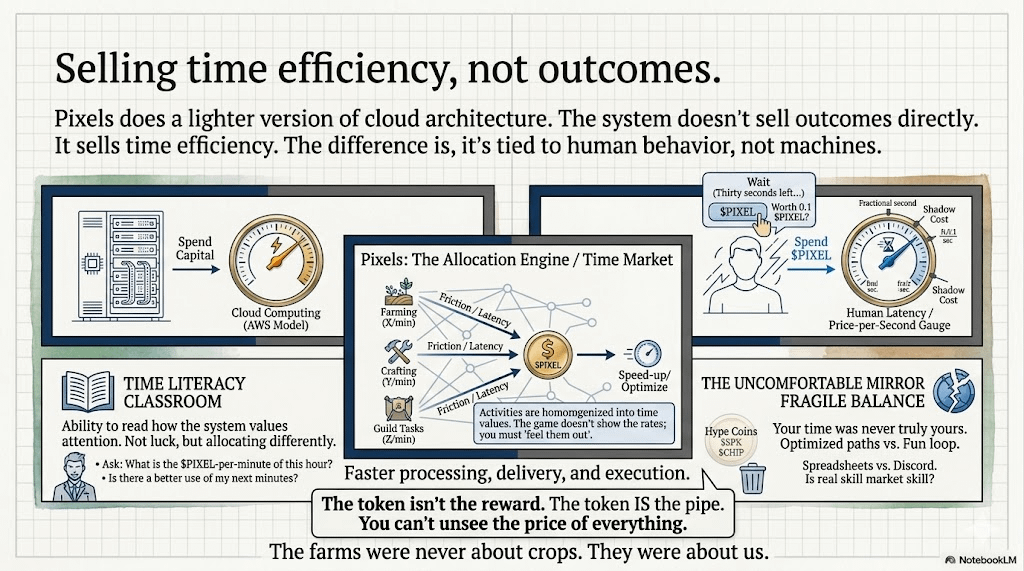
The game sells time efficiency. Not outcomes. Not loot boxes. Just speed.
Think of it like AWS. In cloud computing, you pay to reduce latency. Pixels does the same thing to human behavior. Stacked delays. Timers. Friction. That's the "lag" of the game world. PIXEL he relief valve—pay to skip, pay to speed up, pay to breathe.
I've seen hype coins come and go. $SPK had its moment—loud, ambitious, community-driven. But hype without sinks is just noise. $CHIP tried to gamify micro-bets. Fun, but shallow. Pixels isn't either of those. It's quieter. More surgical. It's pricing my patience down to the second. No hype. Just arithmetic.
Here's what most people miss.
They look at Pixels and see a farming sim. Cozy. Casual. Harmless.
They're wrong.
Under the hood, this is an allocation engine. Every activity has an implicit exchange rate. Farming gives you X per minute. Crafting gives you Y. Guild tasks give you Z. The game doesn't show you these numbers. You have to feel them out. Test. Fail. Adjust.
That's the real gameplay loop. Not planting seeds. Learning where your time is worth the most.
I noticed something else about veteran players.
They don't look luckier. They look sharper. They're not grinding more hours. They're just allocating differently. They know when to wait and when to burn tokens. They've developed something I didn't have a name for until now.
Time literacy.
It's the ability to read how the system values attention in real time. A novice just plays—waters crops, crafts randomly, joins a guild because someone invited them. A veteran navigates exchange rates. They ask: what's the $PIXEL-per-minute of this action? Is there a better use of my next hour?
That's not gaming skill. That's market skill. And it creates a moat that traditional games never had.
I'm not saying it's beautiful. I'm saying it's real.
And real is messy.
Because once you start seeing your time as a priced asset, you can't unsee it. I caught myself last night. Not in game. In real life. Waiting for coffee. And I thought—is this wait worth my minutes? Should I just pay for the faster line?
Pixels did that to me. It reprogrammed how I see my own time.
Here's what scares me.
The game holds up an uncomfortable mirror. Your time inside the system was never truly yours. It was always being priced and optimized. Pixels just made that explicit. Most games hide the math. Pixels puts it in your face.
And that's fragile.
If every action becomes an optimized path, the "game" risks being swallowed by the "market." The fun loop dies. The spreadsheets win. I've seen that movie too. It ends with empty Discords and tokens at zero.
But maybe that's the real test.
Can a game price your time without losing the magic? Can it force you to calculate without killing the joy? I don't know yet.
What I do know is that Pixels isn't an escape from economic reality. It's an immersion into it. Every harvest, every craft, every guild decision—it's an allocation problem. The token isn't the reward at the end of the pipe. The token is the pipe. Time flows through it. Gets priced. Gets spent. Gets optimized.
I'm not here to cheerlead. I'm here to observe.
Most Web3 games extract your attention and give you trash back. Pixels does something different. It makes you aware of your attention's value. Then it lets you trade on that awareness.
That's not a game. That's a classroom.
And the final exam is whether you can still have fun once you know the price of everything.
Once you start seeing your time as a priced asset inside a game?
You can't go back to just playing.
Now tell me I'm overthinking it. I want to be. Because if I'm right, we're all just resource allocators now. And the farms were never about crops.
They were about us.