
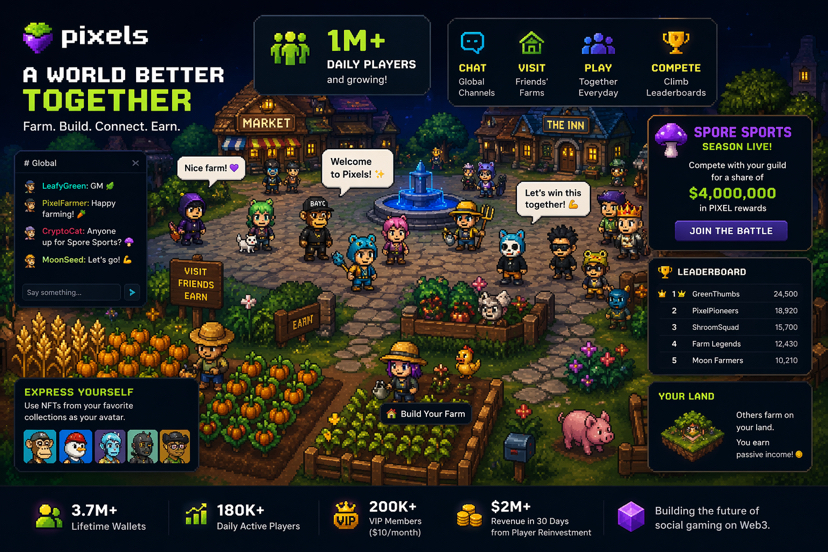
I didn’t expect a farming game to feel like a crowded town square. But that’s exactly what happened the first time I logged into Pixels. People chatting in global channels. Players walking into each other’s farms. Avatars that clearly didn’t belong to just one universe. It clicked fast this isn’t a solo grind. It’s a social layer wrapped in a game.
And that’s the first lesson most Web3 games missed.
They focused on token
Pixels focused on people
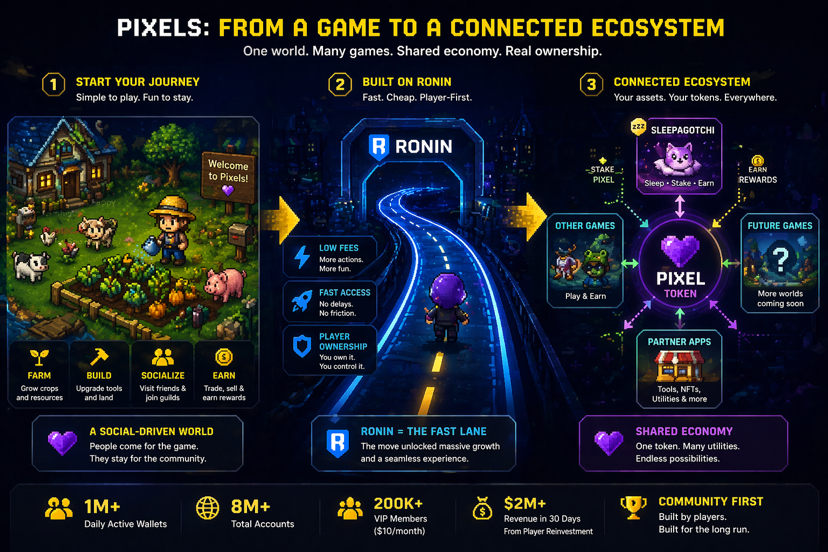
Let me break that down in simple terms. You’ll often hear a stat like Daily Active Wallets. Sounds technical. It’s not. It just means: how many real people are showing up every day and doing something. Think of it like counting how many shops are open and how many customers are walking around in a city. When Pixels crossed 1 million daily wallets, that wasn’t just a vanity number it was proof the place was alive. Busy. No empty streets.
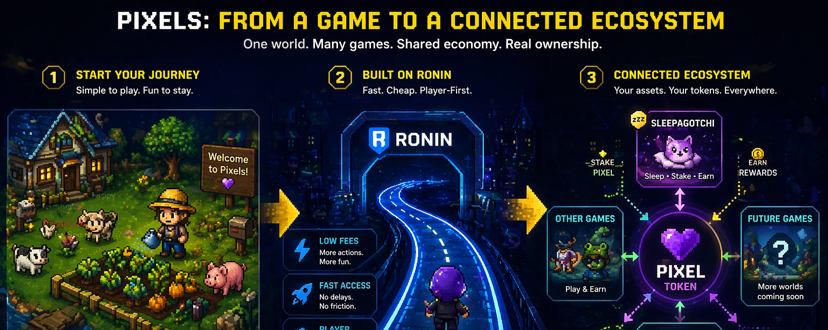
Now here’s where it gets interesting. That kind of activity doesn’t happen by accident. Pixels had a turning point. A real one. The move to Ronin Network.
If you’ve never dealt with blockchains, think of this like switching from a congested highway to a smooth private road. Before, things were slower, more expensive, a bit frustrating. After the move? Faster logins. Cheaper actions. Less friction. More people stayed. More people joined. It went from a few thousand daily players to hundreds of thousands. That’s not growth. That’s a population boom.
But here’s the part most people overlook Pixels didn’t just make it easier to play. It made it easier to belong.
You can jump in with a normal login. No wallet stress. No figure this out or leave attitude. Play first. Learn later. That alone filters out 90% of the friction that killed earlier Web3 games.
And then comes the real hook.
It’s not just about digital carrots. It’s about digital camaraderie.
Guild events. Competitive seasons. Stuff like Spore Sports where players farm, compete, sabotage each other (yeah, it gets chaotic), and climb leaderboards together. You’re not farming alone you’re part of something slightly unpredictable. That unpredictability is what keeps people coming back.
Now let’s talk identity, because this is where Pixels quietly does something bigger than most realize.
You can bring NFTs from other collections and use them as your in-game avatar.
On paper, that sounds like a cosmetic feature. In reality, it’s a statement. It means your digital identity isn’t locked inside one game. You own it. You carry it. Today it’s a farmer. Tomorrow it could be something else entirely. That’s the early version of what people like to call the metaverse. Just simple ownership that travels with you.
And then there’s land.
Not the speculative kind people flipped in 2021. I’m talking about land that actually does something. You own a plot, other players use it, and you earn from that activity. It turns passive ownership into participation. Again subtle shift, big impact.
Now zoom out for a second.
It’s starting to look like a network.
This is where things like Sleepagotchi come in. Through something called a staking network, you can use your PIXEL tokens across different games and earn rewards. Sounds complex, but here’s the simple version: your progress and assets aren’t stuck in one place. They move. They connect. They grow beyond a single game loop.
That’s the second big lesson.
The future of Web3 gaming isn’t one game dominating everything. It’s multiple games sharing value.
Pixels is leaning into that early.
And honestly, the strongest signal isn’t even the tech. It’s the behavior.
When players are paying monthly for VIP access when millions of wallets are created when revenue is coming from players reinvesting back into the world you’re not looking at a short-term earn and leave system anymore. You’re looking at a functioning economy.
That’s where most play-to-earn projects collapsed. They treated players like extractors. Come in, farm tokens, exit.
Pixels flipped that.
Make the world fun enough… and people stay.
Make it social enough and they invest.
Make it open enough and it grows beyond itself.
I’ve spent enough time around Web3 games to know when something feels forced.
This doesn’t.
It feels like a place. And in Web3, that’s rare.