
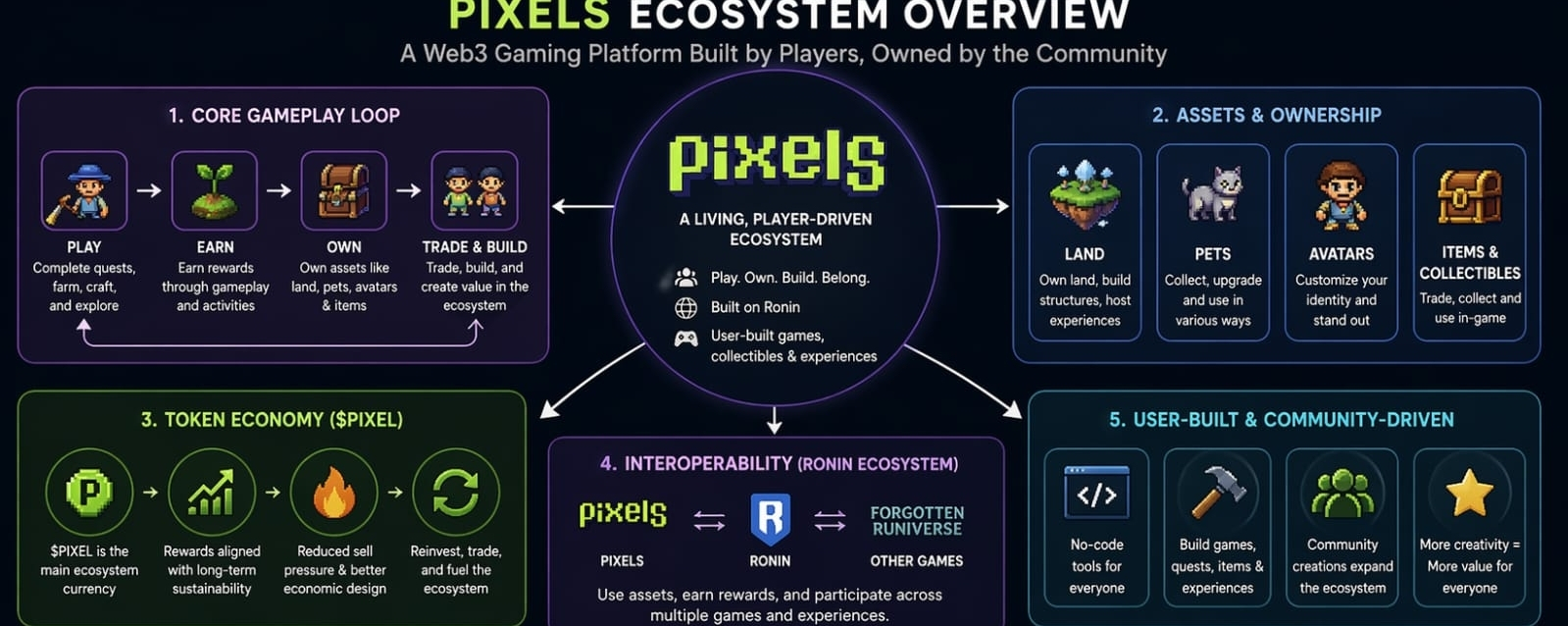
Most people are still looking at Pixels like it’s just another farming game on the surface. I don’t see it that way at all. When I watch how this project is evolving, I see something much bigger trying to form underneath — a system where players don’t just play, they participate, build, and stay because it actually makes sense to stay.
That difference matters more than people realize.
From my point of view, Pixels is quietly shifting from being a “game you try” into something closer to a platform you live in. And that’s a completely different game. Anyone can launch a Web3 game, hype it for a few weeks, and watch it fade. But building something where users keep coming back, not because of rewards alone but because the ecosystem keeps expanding… that’s where things start getting serious.
I’ve been paying attention to how Pixels is structuring its core. Land, pets, avatars — these are not random features. These are anchors. They create attachment. When a player owns land or invests time into building something, they’re not just farming tokens anymore. They’re tied into the world. That’s how you reduce churn. That’s how you build retention without forcing it.
And then there’s the part most people overlook — the shift toward user-built experiences.
This is where I start leaning in.
Because once a platform lets users create value inside it, the dynamic changes completely. It stops being a top-down system controlled only by developers. It becomes a network. Now you’re not just relying on the team to keep things fresh. The users themselves start expanding the ecosystem. That’s how some of the biggest Web2 platforms scaled, and Pixels is clearly trying to move in that direction within Web3.
But I don’t just look at vision. I look at pressure points too.
The token economy is always where things either hold up or collapse.
Pixels moving toward a single main token and trying to reduce sell pressure tells me one thing clearly — they’ve already felt that pressure. And that’s actually a good sign. It means they’re not ignoring the problem. Most projects pretend everything is fine until liquidity drains and users disappear. Pixels is actively adjusting, trying to create a more sustainable loop where players don’t just farm and dump.
Still, this is where I stay cautious.
Because balancing a game economy is not theory — it’s execution. If rewards are too easy, the system inflates. If they’re too hard, players lose interest. If assets don’t hold utility, they get abandoned. It’s a constant tension. And no matter how good the idea sounds, the market always tests it brutally.
What I find interesting is how Pixels is pushing toward interoperability. Not just talking about it, but actually experimenting with cross-game interactions within the Ronin ecosystem.
That’s a big deal, if it works.
Because now you’re not locked into a single experience. Your assets, your progress, your time — they start to carry weight beyond one game. That’s where Web3 has always promised value but rarely delivered in a meaningful way. Pixels is at least stepping into that direction, and I’m watching closely to see if it sticks or just remains a surface-level feature.
From a trader’s mindset, this is where the gap between retail and smart money becomes obvious.
Retail sees events, rewards, short-term hype. They chase momentum.
Smart money watches behavior. Are players staying? Are they reinvesting time and assets? Is the ecosystem expanding organically, or is it being forced through incentives?
That’s the real signal.
Right now, Pixels is somewhere in between — not early experiment phase anymore, but not fully proven either. It’s building structure. It’s testing systems. It’s adjusting economics. That’s exactly the stage where things either evolve into something durable… or start breaking under pressure.
So I don’t treat this like a quick flip narrative.
I treat it like a developing ecosystem thesis.
If Pixels successfully aligns three things — player engagement, asset utility, and economic sustainability — it becomes much stronger than most Web3 games out there. But if even one of those pillars weakens, the whole structure feels it.
Simple as that.
Personally, I’m watching how players behave more than what the team says. Are they building? Are they holding? Are they coming back without needing constant incentives?
That’s where the truth always shows up.
Because at the end of the day, no matter how clean the vision is, the market only respects what actually works.
So the real question is this — are we looking at a game that people play for now… or a platform that people will stay in long term?
That answer is forming right now.
