

There’s a certain kind of system most people don’t question because it feels too small to matter.
A message you plan to reply to later. A task you leave halfway. A notification you clear but don’t really resolve. None of it feels urgent, yet it lingers somewhere in the background, quietly asking you to come back. Not through pressure, but through incompleteness.
Over time, you don’t return because you need to. You return because something feels unfinished.
That same pattern shows up in systems like Pixels.
At the surface, the Pixels game presents itself as a calm, open-world experience built around farming, exploration, and creation. It looks simple, almost intentionally so. There’s no overwhelming complexity, no immediate sense of pressure. Just land, crops, and time.
But structurally, it is not built around activity. It is built around return.
At its core, Pixels is not about farming. It is about scheduling behavior.
The loop is straightforward: plant, wait, return, collect, repeat. What appears as progress is actually a cycle of timed interruptions. The system does not demand continuous attention. Instead, it distributes attention across time.
The waiting phase is often misunderstood as idle time. In reality, it is the most important part of the design.
Because waiting creates a reason to come back.
Without waiting, the loop would collapse into a single session. With waiting, the system stretches itself across hours, sometimes days. It occupies space in the user’s mind even when the user is not actively playing.
This is where the system shifts from interaction to presence.
Pixels doesn’t compete for focus in a single moment. It positions itself as something that should not be forgotten.
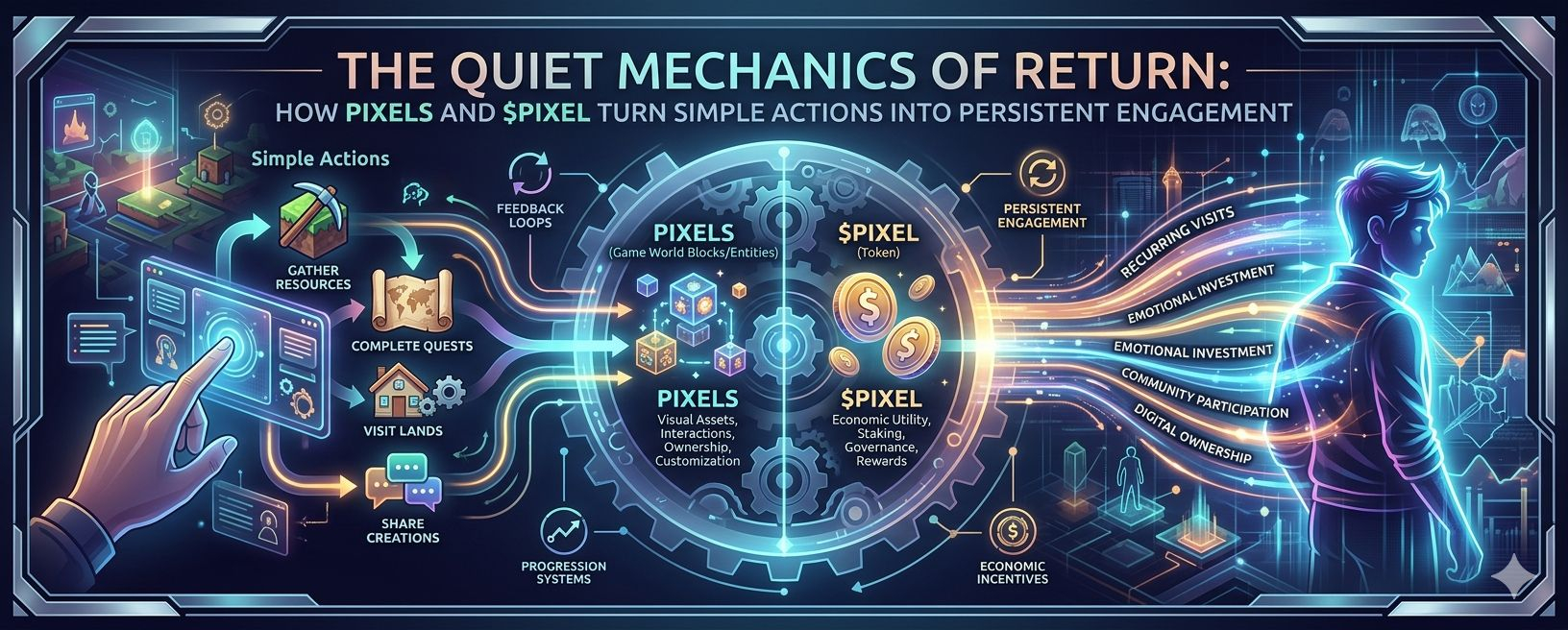
What makes this more interesting is that the game does not operate as a single loop. It runs on two layers that quietly reinforce each other.
The first loop is internal. Farming, crafting, progression, land usage. This loop creates rhythm. It keeps the environment alive and predictable. It gives users something to do and something to return to.
The second loop exists outside the game but is tightly connected to it. The PIXEL token introduces a parallel layer of meaning. Actions inside the game are no longer isolated. They are now part of a broader crypto ecosystem.
Within the context of a Binance campaign, this second loop becomes even more pronounced. The system is no longer just sustaining engagement internally. It is now aligned with external visibility, liquidity, and narrative.
One loop keeps users active.
The other keeps the system relevant beyond itself.
This dual structure is what separates Pixels from many other Web3 gaming experiments. It does not rely solely on gameplay, nor does it rely purely on token speculation. It blends both into a system where each reinforces the other without needing to be explicitly connected in every moment.
The result is subtle.
A player may log in to harvest crops, but the presence of $PIXEL in the background changes how that action is perceived. Not necessarily in terms of value, but in terms of significance. The activity is no longer just a task. It becomes part of something that exists outside the immediate session.
That shift is small, but it accumulates.
Around this dual-loop structure, smaller systems begin to layer themselves. Timers create predictable return points. Visible progress bars create a sense of forward movement. Social elements like shared land or guild participation introduce light external awareness.
Individually, none of these elements are strong enough to define behavior.
Together, they form a quiet pressure.
Not a force, but a pull.
The system doesn’t need to demand attention because it builds an environment where absence feels slightly out of place. Missing a cycle doesn’t create loss in an obvious way, but it creates a subtle gap in continuity.
And continuity is what the system is really optimizing for.
In traditional Web3 gaming, many projects struggle because they focus too heavily on entry. Token launches, early incentives, rapid growth. What often gets ignored is what happens after the first interaction.
Retention is harder than attraction.
Pixels approaches this differently. It slows everything down. It replaces intensity with repetition. Instead of asking for large amounts of attention upfront, it asks for small amounts of attention repeatedly.
This makes the system feel lighter than it actually is.
Because small actions are easier to justify.
But repetition changes the weight of those actions over time.
This is where a more uncomfortable question begins to surface, not as a criticism, but as an observation.
At what point does returning stop being a decision and start becoming a pattern?
The system never explicitly asks this. It doesn’t need to. The structure answers it indirectly.
When actions are simple, and intervals are predictable, behavior becomes easier to automate mentally. The user doesn’t evaluate each return independently. It becomes part of routine.
And routines rarely feel like obligations, even when they function as one.
To be clear, this is not inherently negative.
From a design perspective, it is efficient. It creates consistency without overwhelming the user. It lowers the barrier to participation. It allows the Pixels game to remain accessible while still maintaining depth through structure rather than complexity.
In the broader Web3 gaming landscape, this is relatively rare.
Many systems overcomplicate mechanics or rely heavily on speculative incentives. They build for attention spikes rather than sustained engagement. In contrast, Pixels leans into simplicity, but uses that simplicity to build something more controlled beneath the surface.
It is a system that understands that attention does not need to be captured all at once.
It only needs to be revisited often enough.
At the same time, this structure carries its own trade-offs. Repetition, even when well-designed, can flatten experience over time. Engagement can become passive. Actions can lose their meaning while still being performed.
The system continues to function, but the user’s relationship with it subtly shifts.
From active participation to maintenance.
This is where the presence of $PIXEL and the broader crypto ecosystem becomes important again. It reintroduces a layer of external relevance that helps sustain interest even when internal actions become routine.
Not by changing the loop, but by reframing it.
Within a Binance campaign context, this effect is amplified. Visibility increases. External narratives strengthen. The system gains momentum not just from its design, but from its position within a larger network.
And yet, beneath all of this, the core mechanism remains unchanged.
Plant. Wait. Return.
A loop simple enough to ignore, but structured enough to persist.
Pixels does not force attention. It does not overwhelm with complexity. It does not rely entirely on external incentives.
It simply builds a system where leaving feels slightly incomplete.
And over time, that feeling becomes enough to bring people back.
