
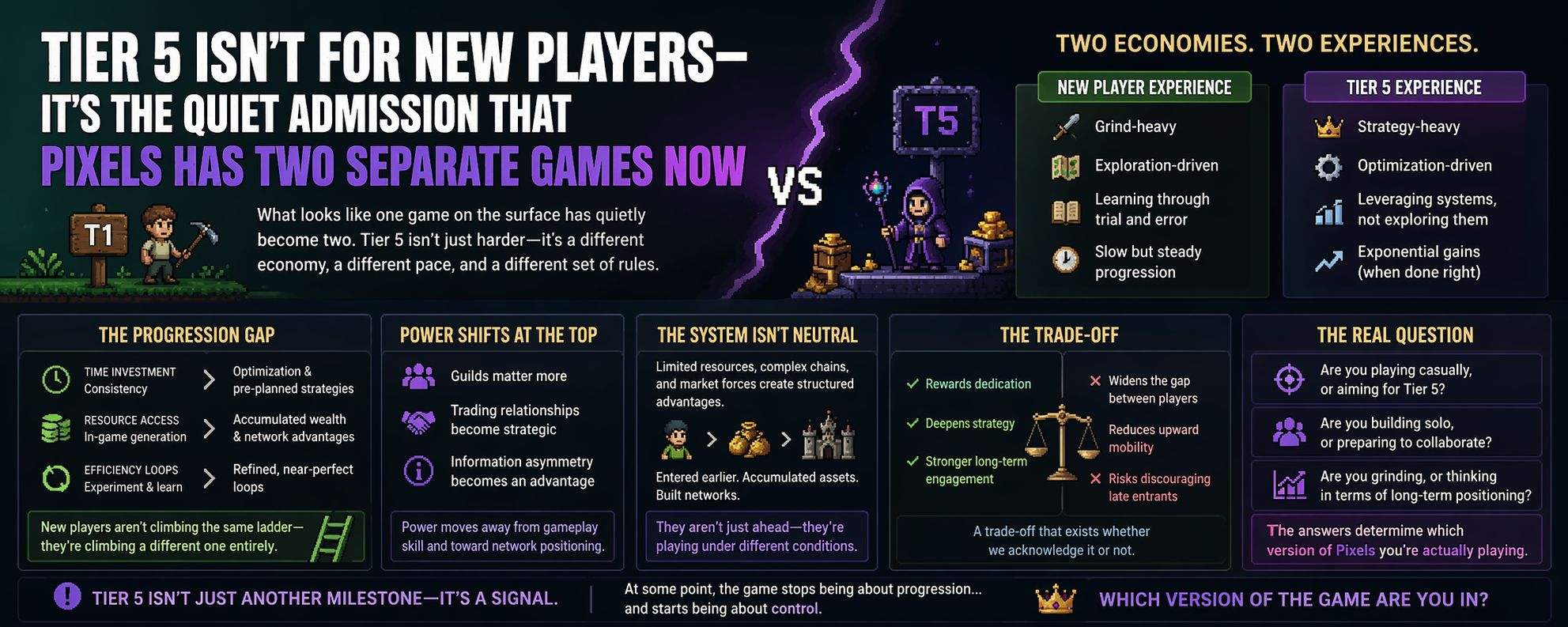
I didn’t notice the shift all at once. It wasn’t a single update or a loud announcement. It was slower than that—almost subtle. But the introduction and progression of Tier 5 made something clear to me: Pixels isn’t one game anymore. It’s two. And if you’re new, you’re probably not playing the same one as everyone else.
At first, Tier 5 felt like a natural extension—something for late-game players who had already “figured things out.” That’s normal in most games. You expect higher tiers to demand more effort, more coordination, more resources. But as I dug deeper, I realized this wasn’t just harder content. It was a different economy, a different pace, and a different set of rules. Tier 5 didn’t just raise the ceiling—it quietly raised the floor for what “competitive” even means in Pixels.
What stood out immediately is how disconnected the resource flow becomes. In early tiers, progression feels straightforward: you grind, you craft, you sell, you upgrade. It’s time-based, effort-driven, and mostly linear. But Tier 5 introduces something else entirely—scarcity-driven inputs, heavier reliance on coordination or capital, and increasing dependency on optimized loops. At that point, it’s no longer just about playing well—it’s about positioning.
From what I’ve observed across the Pixels ecosystem, early-tier players operate in a labor economy, while Tier 5 players operate in a capital economy. That distinction changes everything. On paper, Pixels still looks accessible. Anyone can start. Anyone can grind. But in practice, the gap between Tier 1 and Tier 5 isn’t just distance—it’s friction.
Time investment shifts. Early tiers reward consistency, while Tier 5 rewards optimization and planning. Resource access shifts too—lower tiers rely on in-game generation, while Tier 5 often depends on accumulated wealth or network advantages. Efficiency loops evolve from experimentation to near-perfect systems. New players aren’t climbing the same ladder—they’re climbing a different one entirely.
Another shift I noticed is how much social coordination starts to matter. In earlier stages, Pixels is mostly solo-friendly. You can progress at your own pace. But at higher tiers, guilds, trading relationships, and information advantages become central. The players who succeed aren’t just active—they’re connected. Power begins to move away from gameplay skill and toward network positioning.
One thing I used to appreciate about Pixels was how neutral it felt. Systems rewarded effort, and progress felt fair. But once you introduce limited high-tier resources, complex production chains, and market-sensitive outputs, the system stops being neutral. It starts to favor those who entered earlier, accumulated assets, and built networks. They aren’t just ahead—they’re operating under entirely different conditions.
The contrast between player experiences becomes hard to ignore. New players face a grind-heavy, exploration-driven journey where progress is slow but steady. Tier 5 players experience a strategy-heavy, optimization-driven environment where gains can scale rapidly if executed well. Both are part of the same game, but they don’t feel the same.
This creates a psychological divide. New players begin to feel slower returns, higher barriers, and less clarity on how to break through. High-tier players, on the other hand, experience increased control, predictability, and stronger returns on their decisions. One group is chasing progress, while the other is managing it.
I’ve thought about whether this is intentional. Games need endgame content. Dedicated players need challenges. Complexity can extend longevity. But Tier 5 feels like more than an extension—it feels like a shift in who the game is really built for at the top. It’s not just about progressing further; it’s about entering a different system altogether.
There’s a trade-off here. By creating a high-efficiency, high-strategy Tier 5 layer, Pixels rewards dedication and deepens engagement. But it also widens the gap between players, reduces upward mobility, and risks discouraging late entrants. That trade-off exists whether it’s acknowledged or not.
If I’m being honest, I don’t think Tier 5 is meant for new players anymore—not immediately. And that’s fine, as long as it’s understood. The issue is that the game still presents itself as a single continuous journey, when in reality it branches.
So the real question for any player becomes simple: are you playing casually, or aiming for Tier 5? Are you building solo, or preparing to collaborate? Are you grinding, or thinking in terms of long-term positioning? Because those choices determine which version of Pixels you’re actually playing.
I still enjoy the game, but my perspective has changed. Tier 5 isn’t just another milestone—it’s a signal. At some point, the game stops being about progression and starts being about control. And once you see that, it’s hard to ignore.
So if you’re playing right now, it’s worth asking yourself one thing: which version of the game are you in?