


I used to think more activity meant a healthier game.
More clicks, more sessions, more missions completed it looked like growth. If players were showing up and doing things, the system must be working.
But after watching a few of these loops play out, it starts to feel wrong.
You can have a game full of activity and still feel like nothing is actually building.
That’s the tension I kept coming back to while thinking through the Stacked direction from Pixels.
Because most reward systems don’t fail because they don’t attract players.
They fail because they can’t tell the difference between movement and value.
And once you reward both the same way, the system starts paying for its own decline.
You see it in small ways at first. Players figure out the easiest path to complete missions. They optimize for speed, not depth. They show up when rewards are high, disappear when they drop, and never really connect to anything inside the game.
From the outside, it still looks healthy.
Numbers go up. Activity spikes. Engagement charts look strong.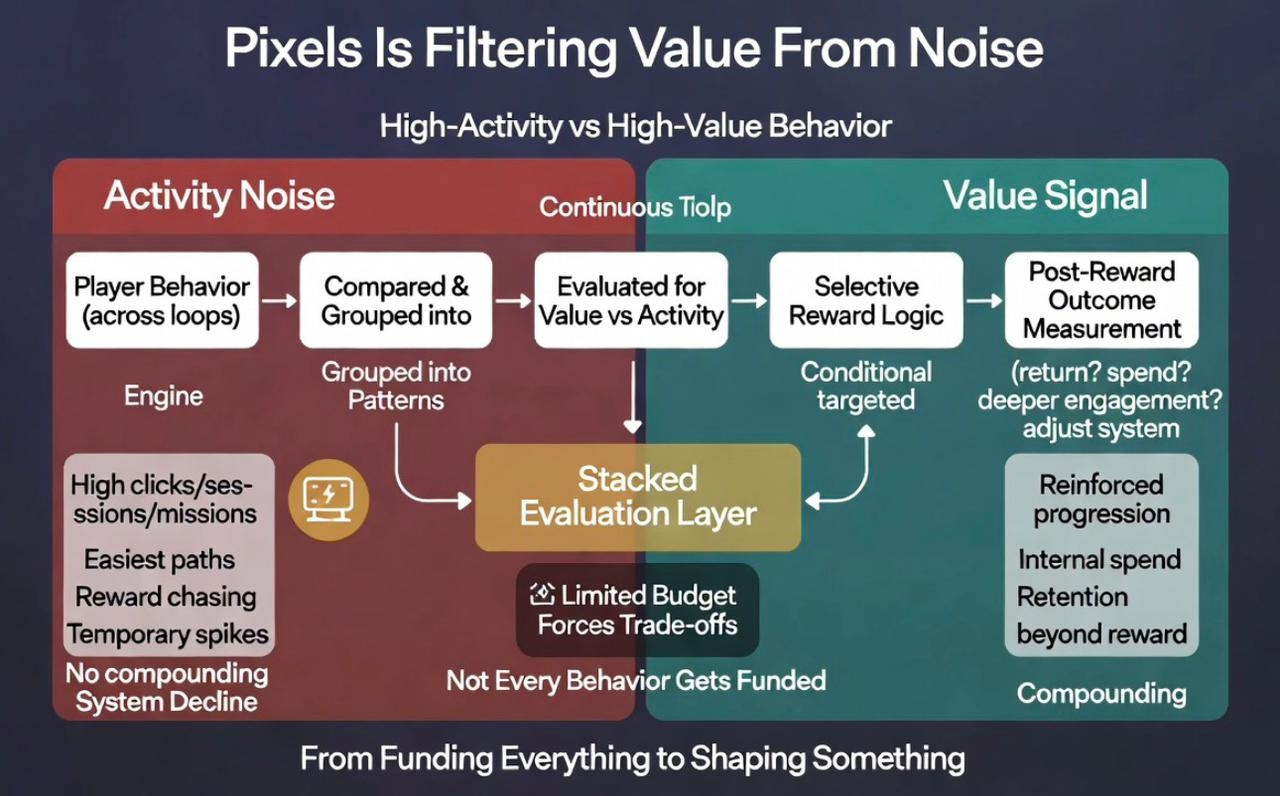
But inside the loop, nothing compounds.
That’s the part most systems never correct.
They keep adding more rewards, more tasks, more ways to keep activity high, without asking whether any of that activity is actually useful.
What stood out to me is that Pixels is starting from the opposite question.
Not “how do we get players to do more?”
But “which behavior is worth paying for at all?”
That shift sounds small, but it changes everything.
Because the moment you stop treating activity as inherently valuable, you need a way to filter it.
And that’s where Stacked starts to feel different.
At the surface, it still looks like a familiar layer. Missions, streaks, rewards, a single app connecting multiple experiences.
But underneath, it’s not built around tasks.
It’s built around evaluation.
Player behavior isn’t just recorded as isolated actions. It’s tracked over time, across loops, and compared against patterns that the system has already seen before.
What happens after the reward matters more than what happened before it.
Do players come back?
Do they spend inside the game?
Do they explore deeper loops or just repeat the easiest path?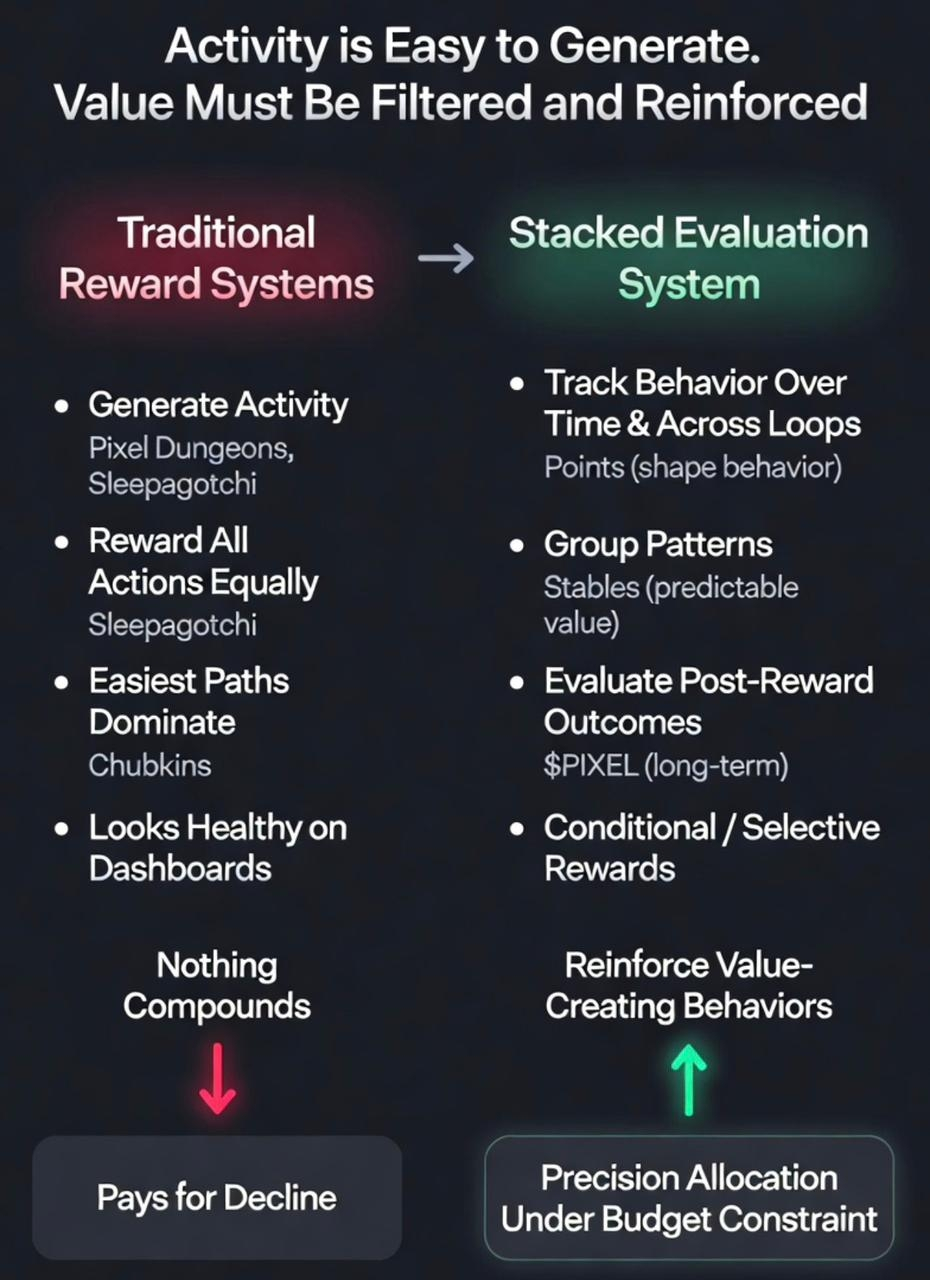
Those signals get grouped.
And once they’re grouped, they stop being observations.
They become inputs into decisions.
That’s where the mechanism shifts.
Instead of attaching rewards to actions, the system decides which behaviors deserve to be funded.
Player behavior → compared → grouped → evaluated → reward logic applied → outcome measured → system adjusts
That loop runs continuously.
And it runs under constraint.
There isn’t infinite budget.
So every reward becomes a choice.
Funding one type of activity means not funding another.
That’s the pressure most reward systems avoid.
They try to reward everything equally, because it feels fair.
But that fairness is what breaks them.
Because high-activity behavior and high-value behavior are not the same thing.
If you pay both equally, the easier one wins.
And over time, the system fills up with the wrong kind of activity.
Stacked is trying to stop that from happening.
Not by removing rewards.
But by making them conditional.
Not every mission is shown to every player. Not every action leads to the same payout. Not every behavior gets reinforced.
That’s what filtering actually looks like in practice.
And it only works because the system sits above multiple loops.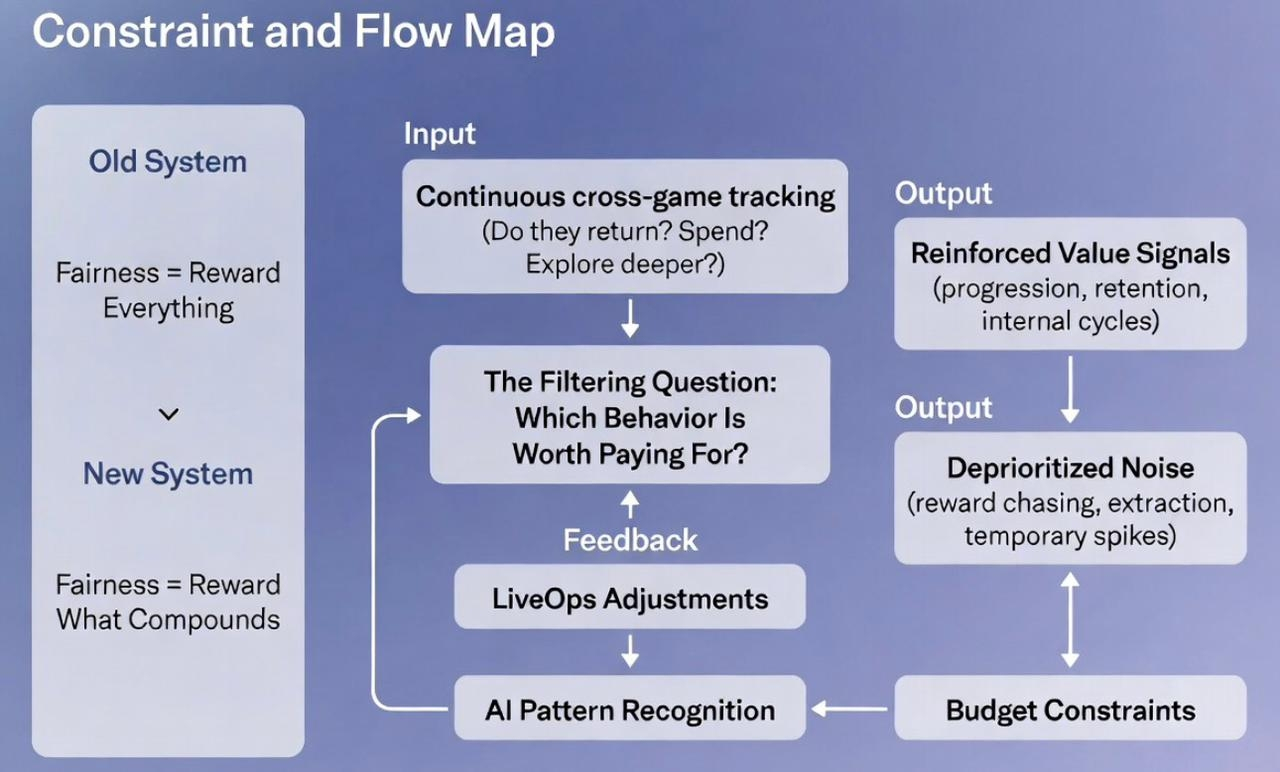
Pixel Dungeons, Sleepagotchi, Chubkins different environments where behavior shows up differently.
A player who looks valuable in one loop might behave very differently in another.
That variation gives the system context.
And context is what allows it to separate signal from noise.
That’s also why the rollout is controlled.
From the outside, it might look like a slow expansion.
Inside a system like this, it’s necessary.
If you scale reward allocation before you trust your signals, you just amplify mistakes.
The system starts funding behavior that looks good in isolation but doesn’t hold up over time.
And because rewards shape behavior, those mistakes compound.
So Pixels starts where it has the most clarity.
Its own games.
It already understands where incentives leak, where players churn, where activity looks strong but doesn’t translate into anything meaningful.
That context makes every experiment inside Stacked more useful.
Because when something changes, they know what it means.
That’s how the system gets trained.
And that’s also where the token design starts to shift.
If rewards are being filtered, a single token can’t handle every role efficiently.
One-token systems force everything through the same output. Grinding, building, experimenting, extracting all paid in the same way.
That flattens the system.
Because it removes the ability to differentiate behavior at the reward level.
Pixels is moving away from that.
Different rewards for different functions.
Points can shape behavior without creating immediate sell pressure. Stable rewards can provide predictable value where needed. And $PIXEL can move toward staking and longer-term participation instead of constant emission.
That separation only works if the system deciding rewards is already disciplined.
Otherwise, it just fragments incentives.
But here, the allocation layer is the core.
Which means rewards can be precise.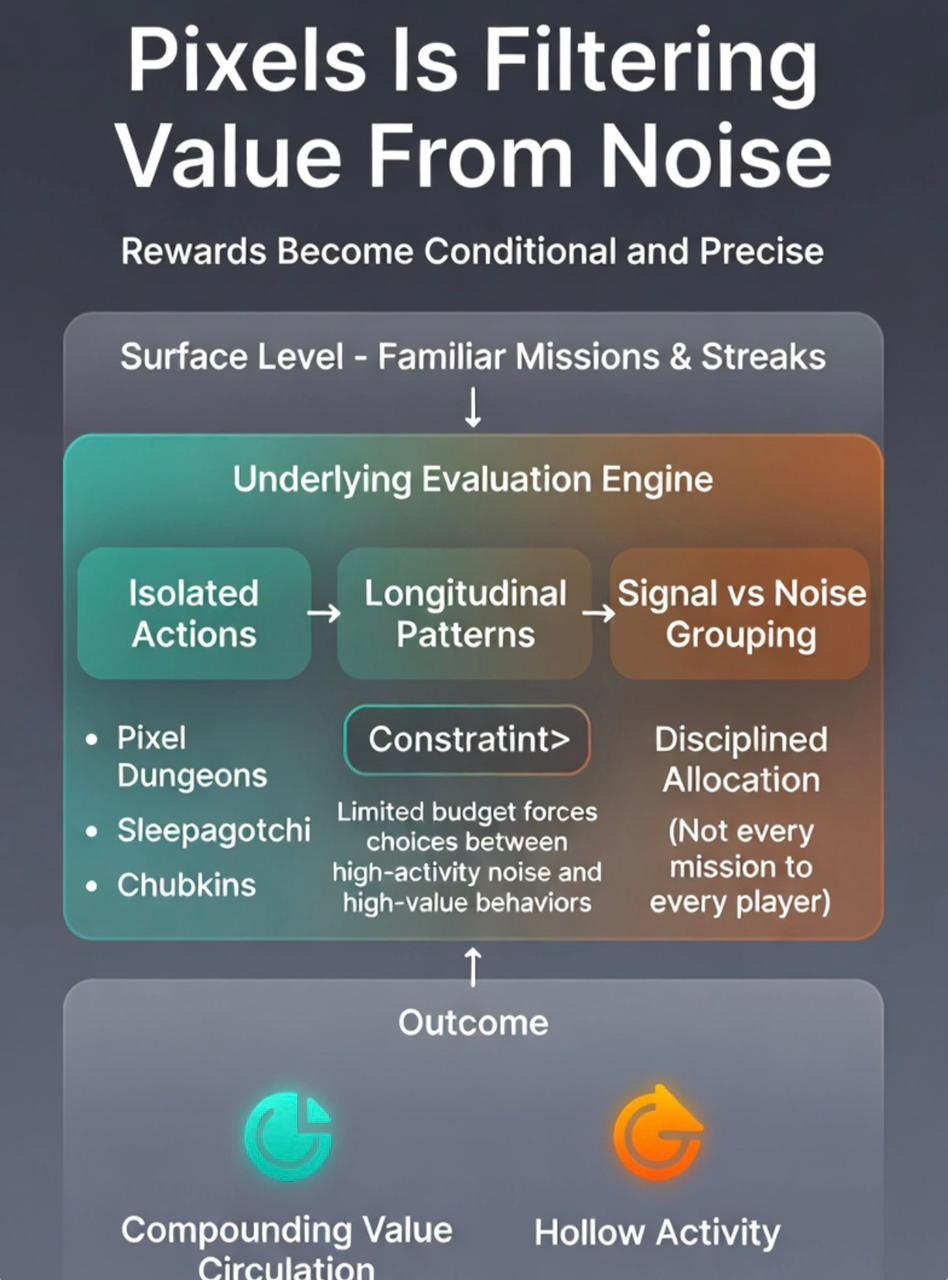
And precision is what allows value to accumulate.
That’s the deeper shift.
Activity is easy to generate.
Value is not.
Activity can be bought with rewards.
Value has to be reinforced through the right incentives over time.
And that’s what most systems never solve.
They assume activity will turn into value.
Stacked is built around the idea that it doesn’t.
And once you accept that, the question changes.
It’s no longer “how do we pay players?”
It becomes “which rewards deserve to exist?”
That’s a harder question.
But it’s also the one that determines whether the system survives.
Because once rewards stop funding everything…
they start shaping something.