
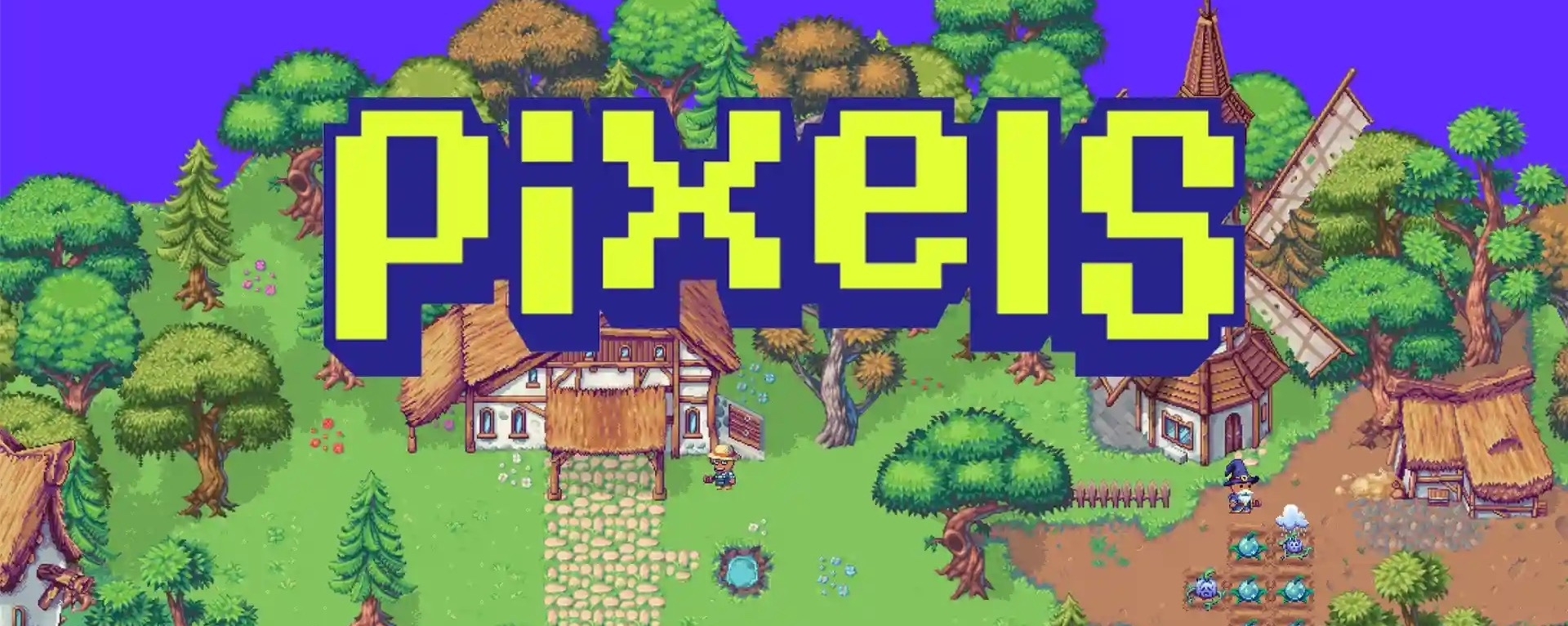

I’ve been watching Pixel, and the more I sit with it, the more it feels less like a single game and more like a layered system where emotion and infrastructure quietly overlap.
On the surface, Pixel is easy to understand in the way all good slow games are. You log in, tend to your land, repeat familiar routines. Farming, crafting, moving through small daily loops that don’t demand urgency. It has this calm rhythm that makes the world feel personal without needing spectacle. Over time, that repetition becomes attachment. Your space starts to feel like something you maintain rather than something you merely play in.
And that’s where Pixel does something subtle but powerful it builds a sense of ownership through familiarity.
You don’t just “use” the world. You start to feel responsible for it. The crops you plant, the resources you gather, the patterns you repeat they begin to reflect your time in a way that feels emotionally yours.
Then comes the Web3 layer, sitting quietly underneath that experience.
Pixel connects into the Ronin Network, which is a big reason the gameplay feels smooth compared to many blockchain-based games. Transactions don’t interrupt the flow. Actions feel immediate. The system fades into the background in a way that makes the game feel closer to a traditional experience than a technical experiment.
That design choice matters, because it protects immersion. Most players don’t want to think about infrastructure when they’re farming or building they want the world to respond naturally.
But that smoothness is built on structure.
Ronin isn’t fully decentralized in the idealized sense often associated with Web3. It uses a limited validator model and is closely tied to Sky Mavis, which helps it stay fast and coordinated. That structure is what allows Pixel to scale without collapsing under friction.
Still, it introduces a quiet asymmetry.
Because while the player experience feels open, the system behind it is guided by a smaller set of decision-makers. Not in an obvious or intrusive way but in the way infrastructure always exists just out of sight, shaping what is and isn’t possible.
So I find myself thinking about Pixel in two layers.
The first is the player layer:
A world that feels soft, personal, and responsive. A loop of effort and reward that makes time feel meaningful. A sense of ownership that grows naturally from repetition and presence.
The second is the system layer:
Validators maintaining the network. A core development team shaping updates. A governance structure that can adjust, respond, or intervene when needed.
Both layers are real. But they don’t always move at the same speed.
That tension isn’t unique to Pixel. The broader Web3 space has already revealed moments where decentralization meets reality.
The Ronin Network hack is one of those moments. When the system was compromised, recovery wasn’t handled by distributed consensus alone it required coordinated intervention from the core team. Decisions had to be made quickly, centrally, and decisively to restore stability.
And earlier in the ecosystem’s history, the The DAO hack showed something similar on a larger scale. Even in systems designed to remove centralized control, human judgment still emerged when the stakes became too high for pure code to resolve.
These moments don’t break the idea of decentralization. They just reveal its edges.
And Pixel exists right in that same space between promise and practicality.
Because what it offers players is real, but not absolute. There is ownership, but it sits inside boundaries. There is freedom, but it operates within a designed structure. There is decentralization, but it is shaped to remain usable at scale.
From inside the game, though, those boundaries are almost invisible.
You don’t feel validators when you’re planting crops in Pixel. You don’t think about governance when you’re managing resources. You just experience continuity. And that continuity is what makes the system feel alive.
But when you step back, you start to notice how carefully that experience is held together.
The freedom in Pixel is real but it is also framed. The ownership is meaningful but it depends on infrastructure that is still guided. The world feels open but it is still maintained by a smaller group of hands behind the scenes.
And none of this feels accidental. It feels like a compromise between ideals and usability.
Because full decentralization would likely change Pixel entirely. It would slow it down, complicate it, and possibly break the fluidity that makes it enjoyable in the first place. So instead, what exists is something more balanced but also more layered.
A system where:
Players experience ownership
Infrastructure ensures stability
Control still exists, but is less visible
What makes Pixel interesting isn’t that it chooses one side or the other it’s that it sits in between, quietly holding both realities at once.
And maybe that’s the real takeaway.
Not whether Pixel is truly decentralized or not but how it reflects the current state of Web3 itself: still evolving, still negotiating between ideal freedom and functional control.
So I keep coming back to the same thought, not as criticism, but as observation:
If Pixel feels like it belongs to the players on the surface, but depends on a smaller group to maintain, shape, and stabilize it underneath…
