
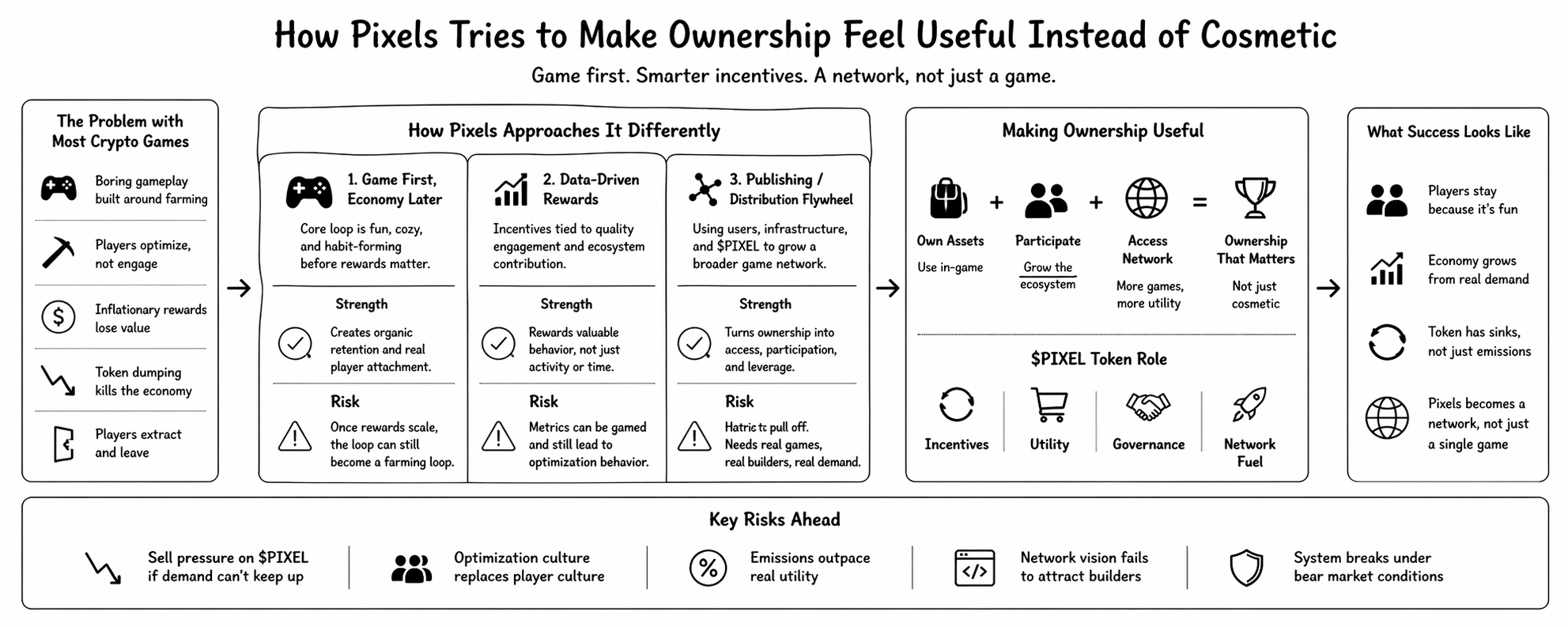

At some point, play-to-earn stopped feeling like play-to-earn and started feeling like play-to-extract.
That, to me, is still the core problem with most crypto games.
The pitch always sounds great in the beginning. Players own assets. Time spent in-game has value. A token ties the whole thing together. On the surface, it feels like a better deal than traditional gaming, where people sink hours into closed systems and walk away with nothing. But in practice, a lot of these games never really built player economies. They built exit systems. People came in, farmed rewards, sold them, and moved on. The “game” was often just a wrapper around that behavior.
To be completely honest, that is why so many Web3 games never really lasted. The issue was never just bad graphics or weak marketing. The real issue is that most of them were not fun enough to survive the financial layer sitting on top of them. Once the token became the main reason to show up, player behavior changed fast. People stopped exploring and started optimizing. They stopped playing and started farming. And once that happens, the whole thing usually becomes inflation, dumping, and slow collapse.
That is why Pixels is interesting.
Not because it has solved all of this. I do not think it has. But because it at least seems to understand where the older model went wrong. It feels like Pixels is trying to make ownership actually do something inside the game instead of just existing as a cosmetic promise. And that is a much better place to start.
Still, it is worth being a little skeptical here. Because a smarter version of the same model can still end up with the same result.
One thing Pixels clearly does better than a lot of crypto games is that it feels like a game first and an economy second. That matters more than people think. A lot of Web3 titles start from the token and build outward. You can feel it immediately. The systems are there to support emissions, not enjoyment. Pixels feels different because the gameplay loop has its own logic. Farming, collecting, upgrading, exploring, doing small tasks over time — it has that soft, repeatable rhythm that people can actually settle into. It feels more natural, more familiar, and less like a DeFi dashboard wearing a game skin.
That is a real strength.
If people are spending time in Pixels because they like being there, that already puts it ahead of a lot of projects in the space. It means the economy is being placed on top of a behavior loop that might have existed anyway, instead of forcing artificial activity through rewards alone.
But it sounds good on paper, and that is where I think caution matters.
Because even a good loop can become a farming loop once rewards get serious enough. A cozy game can still become a job if players realize there is money to optimize. That shift can happen slowly, and then all at once. Suddenly the charm is still there visually, but the behavior underneath has changed. People are no longer engaging with the world because it feels good. They are engaging with it because it pays, or because they think it might. And once that becomes the dominant mindset, the tone of the whole system starts changing with it.
So yes, “game first” is the right direction. But it is not automatic protection. It just gives Pixels a better shot.
Another thing that makes Pixels stand out is how it seems to think more carefully about rewards. Instead of just handing out emissions in the usual broad and messy way, it has moved toward a more data-driven reward structure. That is a meaningful improvement, at least conceptually. In theory, it means incentives can be directed toward the behaviors that actually help the ecosystem instead of just rewarding whoever can grind the hardest or show up the earliest.
And honestly, that is the kind of thinking crypto gaming needed a long time ago.
Because not all activity is equally valuable. Some behaviors deepen the world. Some support retention. Some create actual economic usefulness. Others just drain reward pools and add sell pressure. If Pixels can tell the difference and reward accordingly, that is much healthier than the old model of spraying tokens everywhere and calling it community growth.
But again, there is a catch.
Smarter incentives are still incentives. And players are very good at learning what systems want from them.
So the risk is that “data-driven rewards” just creates a more advanced form of farming. Instead of mindlessly repeating the same action, players begin studying the reward logic and shaping their behavior around whatever the system favors most. The behavior looks cleaner from the outside, but it is still behavior being pulled by emissions. That does not mean the system is bad. It just means that better design does not erase the basic tension. It only manages it.
And I think that tension is central to understanding Pixels.
Because Pixels is not really trying to be just one game. It looks more like it wants to become a network. That is where the publishing and distribution angle becomes important. The idea seems bigger than just running a successful farming MMO with a token attached. It feels like the project wants to use its player base, its infrastructure, and its economic layer as a base for something broader — maybe a game ecosystem, maybe a distribution layer, maybe a platform that other experiences can plug into.
That is ambitious. Probably the most ambitious part of the whole thing.
And to be fair, it makes sense. A single crypto game is fragile. One ecosystem with shared users, shared incentives, and a broader network effect has a better chance of lasting. If Pixels can actually turn its audience and systems into a real flywheel, then ownership starts to matter more. It becomes less about holding an asset for speculative reasons and more about having some actual position inside a living ecosystem.
That is the idea, anyway.
The problem is that this is also where execution risk gets much higher. It is already hard to make one game work long-term. It is even harder to build a network around it. The token cannot just float above the experience as a symbol of participation. It has to do real work. It has to connect players, developers, incentives, and demand in a way that feels natural. Otherwise the whole “ecosystem” story risks becoming a bigger narrative layer placed on top of the same old pressure points.
And that brings everything back to $PIXEL.
Because no matter how thoughtful the design is, token sustainability is still the question sitting underneath all of it.
This is the part where I think people should stay grounded. Web3 gaming has said a lot of smart things over the years about alignment, utility, and community-owned economies. But when things get tested, the weak point is usually the same: too much sell pressure, not enough real demand, and a token that ends up carrying more meaning in theory than in actual use.
Pixels does seem to be trying to avoid that. It wants the token to feel useful, not decorative. It wants ownership to be functional, not just symbolic. It wants the economy to support participation rather than just extraction.
That is all good.
But to be completely honest, a lot depends on whether that utility becomes real enough to hold up when growth slows down and players get more rational. Because that is when these systems reveal what they are. When the excitement fades, are people still using the token in ways that matter? Are there enough sinks? Enough reasons to hold? Enough reasons to deploy it back into the ecosystem instead of just taking value out?
If the answer is no, then even a well-designed game can still slide into the same pattern that hurt everything before it.
That is why I find Pixels more interesting than most crypto games, but not necessarily proven.
It feels smarter. More self-aware. More grounded in how players actually behave. It seems to understand that ownership has to be tied to utility, and that economy design has to follow player experience, not replace it. That alone already puts it ahead of a lot of the space.
But the old danger is still there.
If players start treating every system like an extraction surface, then even the best-designed incentives can become fuel for the same cycle. If the token ends up under constant pressure, then the whole ownership thesis gets weaker. If the network vision does not materialize, then Pixels risks being remembered as a well-packaged attempt to improve the model without fully escaping it.
So my view is somewhere in the middle.
Conceptually, Pixels is doing a lot of the right things. It is asking better questions than most crypto games asked. It is trying to make ownership actually useful. It is trying to make the economy more selective, more behavioral, and more tied to the long-term health of the system.
But execution risk is still high. Token pressure is still real. And player incentives are still one of the hardest things in gaming to get right — especially when money is involved.
So yes, Pixels looks more thoughtful than the average play-to-earn project.
Whether that means it is actually solving the real problem, or just repackaging it in a smarter way, is still open.
Interesting, definitely.
Proven? Not yet.
Time will tell.