
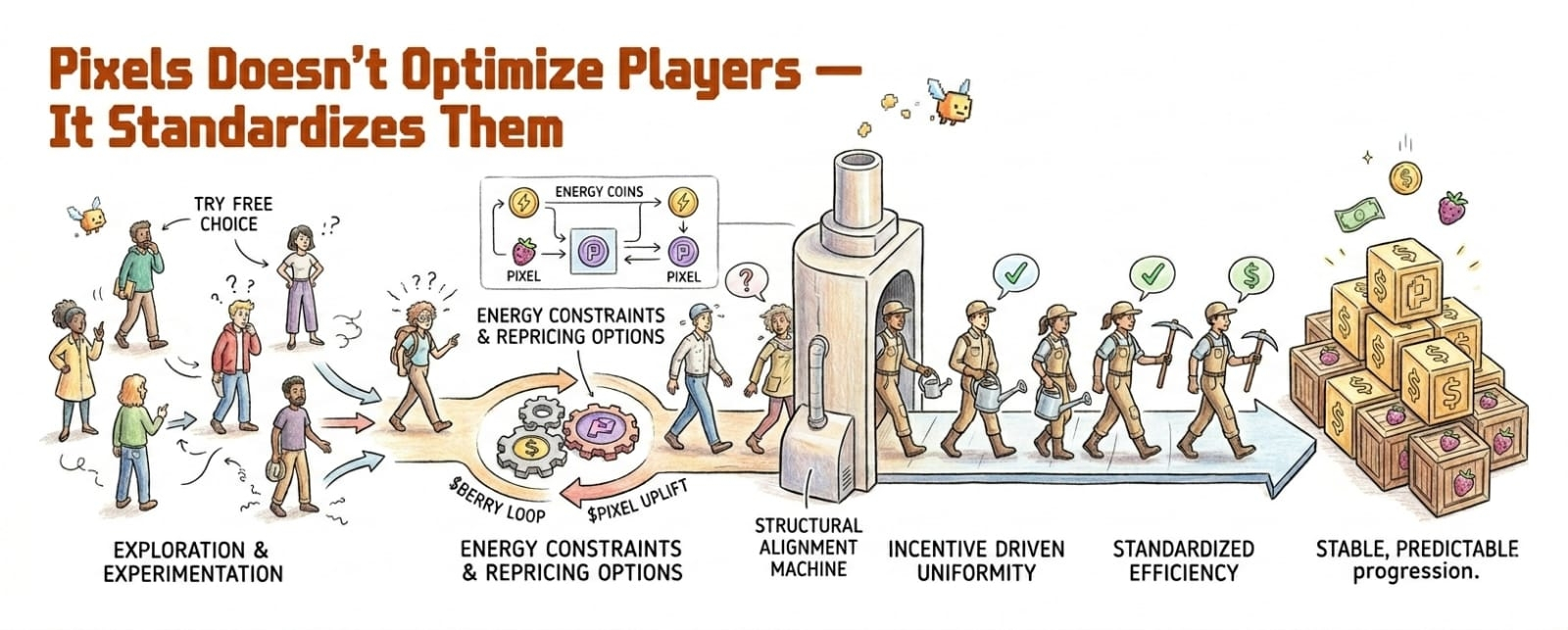
Pixels looks open-ended at first glance. You can farm, craft, move between activities, and shape your own path. Nothing appears restricted, and that flexibility creates the impression that progression is entirely player-driven.
That assumption doesn’t hold for long.
The system doesn’t block choices, but it consistently favors certain outcomes. Over repeated sessions, the same types of actions begin to produce the most reliable results. Not occasionally consistently. That consistency is what shifts the experience from exploration to evaluation.
This isn’t randomness smoothing out over time. It’s structural alignment.
Energy is one of the clearest entry points into that structure. It introduces a hard constraint without presenting itself as one. Once energy becomes a limiting factor, every action competes for efficiency. The question is no longer what you can do, but what justifies the cost of doing it.
That changes behavior immediately.
Players begin prioritizing sequences that maximize return per unit of energy. Low-yield actions don’t disappear they become economically irrational. The system doesn’t remove options; it reprices them.
The economy reinforces that repricing.
$BERRY operates as a high-frequency output tied directly to activity. It rewards consistency and repetition. The more structured the loop, the more stable the accumulation. This naturally favors predictable behavior over experimentation.
$PIXEL introduces a second layer. It’s less frequent, but more consequential. It connects to assets and progression that persist beyond short cycles. That separation creates a hierarchy: activity generates flow, but only certain outputs translate into lasting value.
This is not a neutral distinction.
It directs attention toward actions that bridge the two layers. Anything that remains isolated within the $BERRY loop becomes less relevant over time, regardless of effort.
Market behavior reflects this internal logic.
Price structure tends to stabilize around consistent activity patterns rather than speculative spikes. Volume follows participation density, not narrative momentum. When player behavior converges, liquidity becomes more predictable. When it fragments, volume thins out quickly.
That kind of response isn’t accidental. It’s a byproduct of aligned behavior.
Supply dynamics reinforce it further. When a portion of tokens remains locked while circulating supply expands gradually, value doesn’t distribute evenly. It concentrates around active flows. Unlock schedules don’t just increase supply they redirect attention toward moments where value can be absorbed without destabilizing the system.
This narrows the field of meaningful actions even more.
Wallet concentration adds another layer. When a relatively small number of holders control a significant portion of tokens, their behavior indirectly sets the range within which the market operates. Smaller participants adapt to that range rather than challenge it.
The system doesn’t need to enforce uniformity. It emerges from incentives.
Over time, players stop testing possibilities and start anticipating outcomes. Decisions become predictive. The path that “should” work is identified before it’s taken. This reduces friction, but it also reduces variance.
That’s the tradeoff.
The system gains stability because behavior converges. Resource flows become easier to manage. Progression remains intact across a wide user base. But convergence has a cost: it compresses meaningful choice.
Not by removing options, but by making their outcomes too transparent.
Once the difference between efficient and inefficient actions becomes obvious, deviation carries an implicit penalty. Players don’t need to be told what to avoid. They infer it.
At that point, the system no longer just supports decisions it pre-structures them.
Pixels doesn’t need to force optimization. It defines the conditions under which optimization becomes the only rational response.
And once that happens, the question isn’t whether players are progressing efficiently.
It’s whether the system has already decided what efficiency looks like before they begin.