
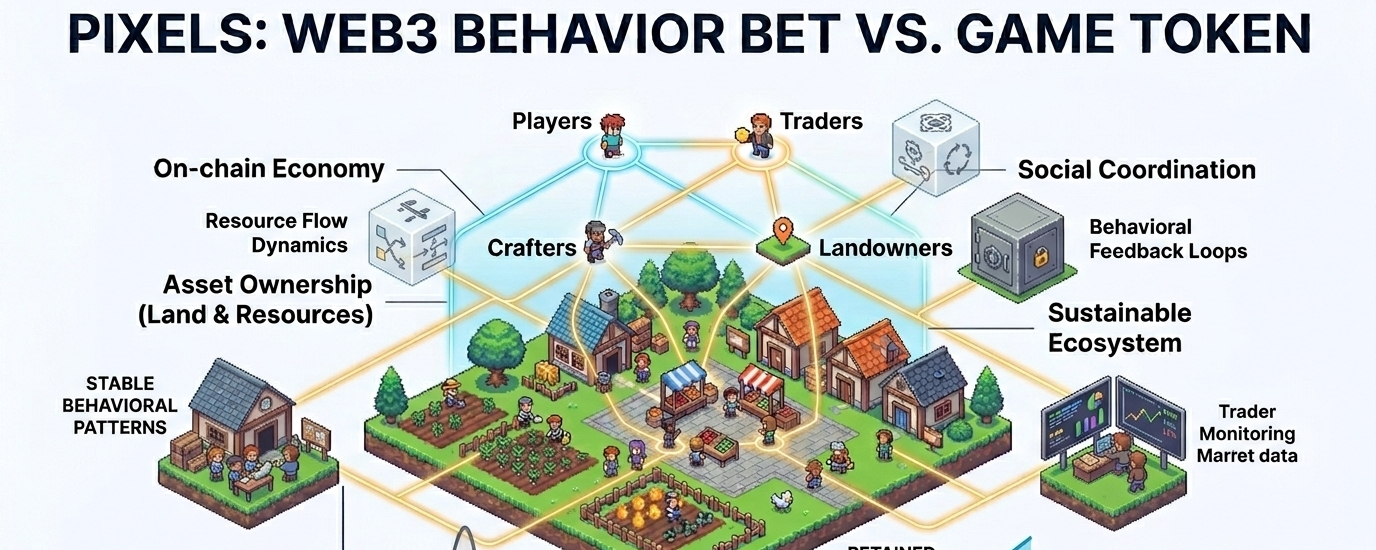
Lately I’ve been paying more attention to where liquidity is drifting when the market gets tired of pure speculation. Every cycle seems to have this moment where capital starts rotating out of abstract promises and into things people actually use. That shift is what made me look closer at Pixels and, honestly, I didn’t expect a farming game to hold my attention this long.
What caught me first was a question I couldn’t shake: why does a simple-looking social game keep showing up in serious Web3 conversations?
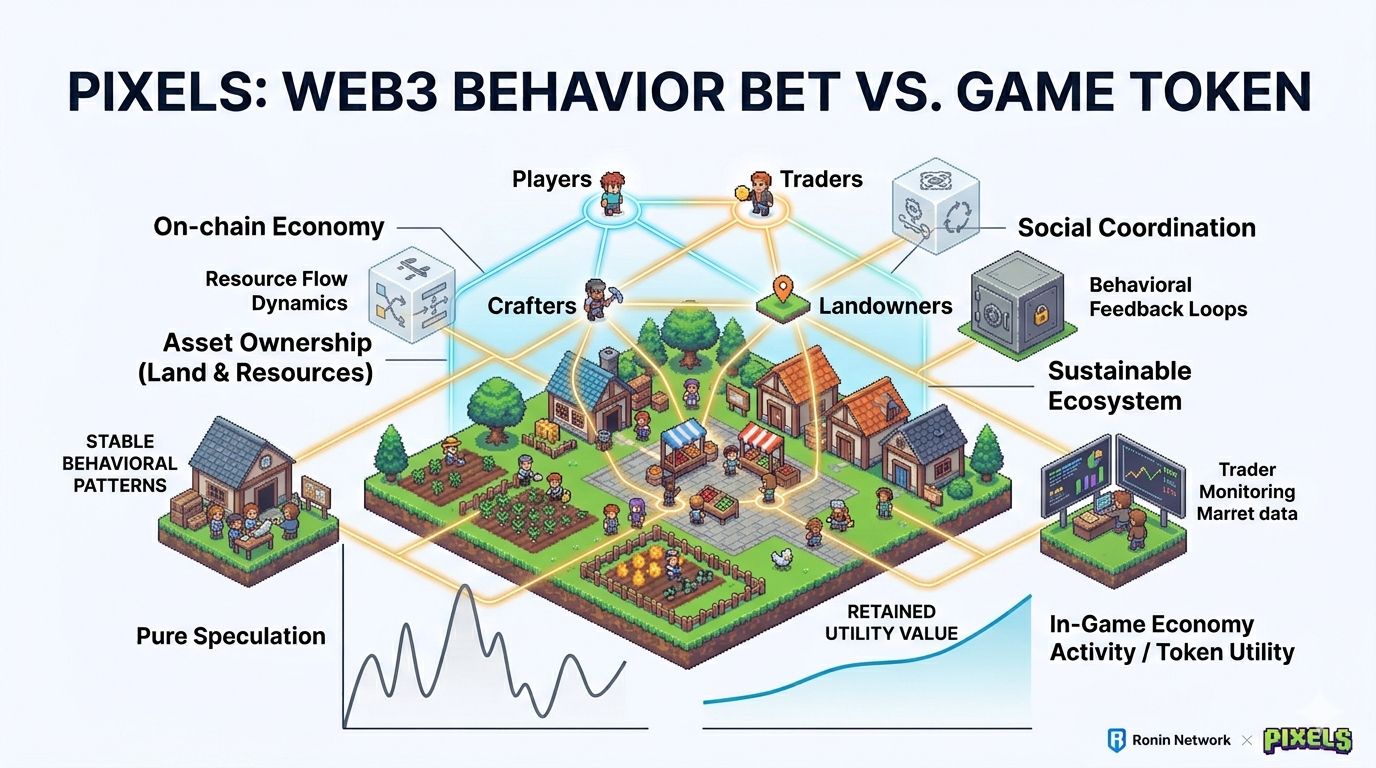
At first, I was confused. On the surface, Ronin Network has already built a reputation through gaming, but I’ve seen “play-to-earn” narratives come and go. Most of them looked exciting until token emissions overwhelmed actual demand. So I approached Pixels with skepticism. Cute pixel art, farming loops, land, resources — it almost looked too familiar.
Then I started realizing I was looking at it through an old framework.
I think Pixels is less about “earning from a game” and more about testing whether on-chain economies can feel alive. That’s very different.
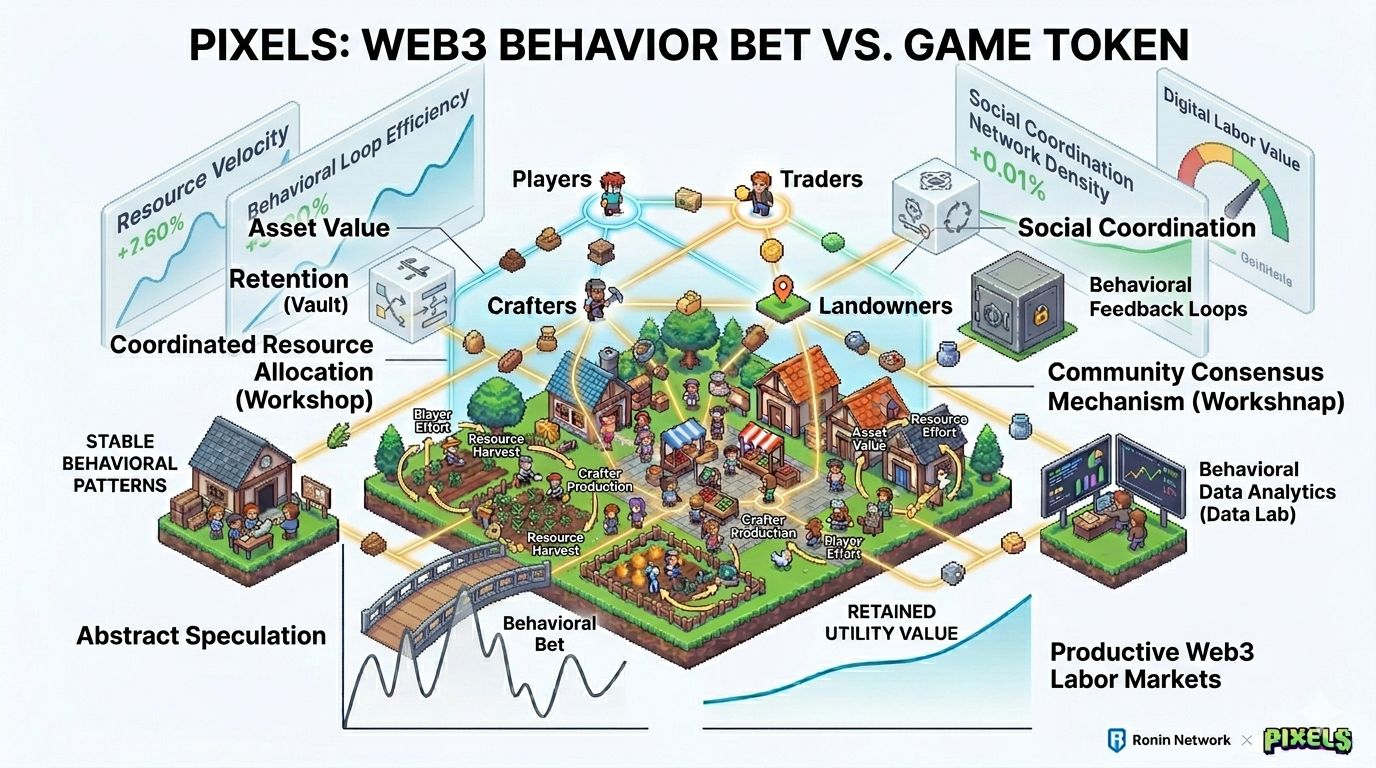
The thing I’ve noticed is the project seems built around social coordination as much as gameplay. Farming isn’t really the story. It’s the excuse. The real layer is what happens when players gather, trade, cooperate, craft, own assets, and spend time inside a persistent economy. That starts looking less like a game economy and more like a miniature digital society.
And that matters right now because I keep seeing Web3 move from infrastructure-first narratives toward consumer retention. We’ve had endless talk about scaling, throughput, modular stacks. But if people don’t stay anywhere, none of it compounds.
Pixels seems to be attacking that problem from the opposite direction.
Instead of asking, “How do we bring users to crypto?” it almost asks, “How do we hide crypto inside something people want to return to?”
That’s subtle, but powerful.
The tech itself became easier for me to understand when I stopped thinking about it as blockchain gaming mechanics. I started seeing it like a village economy running on shared rails. Players generate resources, others transform those resources, others trade or speculate around them, and the token becomes part utility, part incentive layer, part coordination tool. It’s less about one token pumping and more about keeping the in-game economy from breaking.
That’s where decentralization here feels practical, not ideological.
Ownership matters because assets aren’t trapped in a publisher’s database. Incentives matter because participation has economic feedback. Governance matters, at least potentially, because evolving economies usually need player-aligned adjustments. I’ve always thought decentralization makes most sense when users are also stakeholders, and gaming may be one of the cleanest expressions of that.
The move onto Ronin Network also feels underrated to me. People focus on user numbers, but I care about environment. Networks create gravity. Distribution, wallets, gamers, marketplaces — these things reinforce each other. Ecosystems, when they work, reduce friction more than people realize.
Compared with older GameFi projects, what stands out to me is Pixels feels less obsessed with financial engineering and more focused on behavioral loops. That sounds small, but it changes everything. Many competitors designed economies first and games second. Pixels seems closer to flipping that.
Still, I don’t romanticize it.
There are risks everywhere.
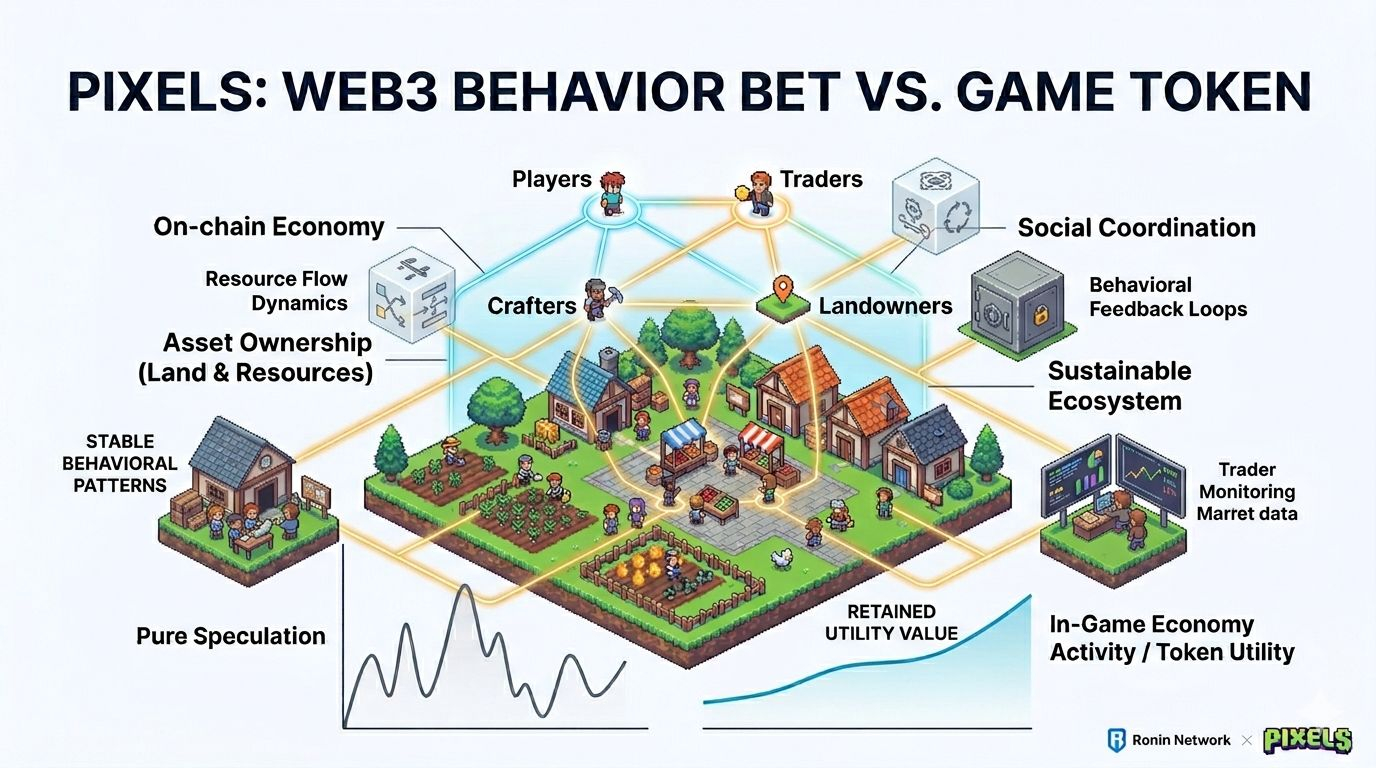
Token unlock pressure is real in this market. Retention can fade fast if incentives cool. Regulation around tokenized game economies is still murky. And execution risk in gaming is brutal because users are unforgiving — if the experience stops being fun, no token model saves it.
Competition worries me too. Web3 gaming is crowded, and traditional studios entering blockchain could reshape the landscape fast.
But here’s an underrated thing I keep coming back to: I think Pixels may be a stronger bet on digital labor markets than people realize.
That sounds strange for a farming game, but hear me out.
When people repeatedly organize around gathering, producing, trading, and optimizing inside shared worlds, they’re rehearsing economic behavior. That could matter far beyond gaming. I’m not sure enough people price in that possibility.
Maybe that’s why this project stayed in my mind.
Not because I think every game token becomes durable, but because Pixels seems to sit at an unusual intersection — gaming, social networks, digital ownership, and economic coordination.
And those intersections are often where new categories quietly form.
I keep asking myself whether projects like Pixels are early glimpses of how consumer crypto finally becomes sticky… or whether this is another elegant experiment the market eventually moves past.
Maybe that’s the real question.
Are we watching a game with tokens, or the early shape of online economies learning how to breathe?
