
At first glance, Pixels looks like a project most people in Web3 have already seen before. A pixel-art farming world, a token economy, social interaction, land ownership, and a promise that players can earn while they play. The formula immediately feels familiar because crypto gaming has spent years repeating the same pattern. A new game launches with strong attention, rewards attract users quickly, activity spikes as people rush to farm value, tokens begin to unlock, selling pressure increases, and eventually interest fades once rewards stop feeling attractive enough. Many projects never survive beyond that cycle.
That initial skepticism feels fair when looking at Pixels. The market has become crowded with projects that present themselves as gaming ecosystems but operate more like temporary reward machines. They often depend heavily on speculation rather than long-term player retention. When the earning opportunity becomes weaker, users disappear because the game itself was never strong enough to keep them there. This is why it is difficult to immediately trust any Web3 title promising sustainable economies and long-term engagement.
Yet Pixels creates curiosity precisely because it does not appear to position itself purely around earning. The project seems to understand that previous GameFi models failed because they treated rewards as the primary attraction instead of gameplay. Rather than presenting itself as an aggressive “play-to-earn” system, Pixels leans more toward a social farming MMO that happens to include blockchain ownership and tokenized layers beneath the surface. That distinction matters more than it may seem at first.
The gameplay loop itself is simple, which is often a strength rather than a weakness. Players farm crops, gather resources, explore areas, complete tasks, interact with other users, and slowly improve their land or account progression. It does not attempt to overwhelm users with complexity immediately. Instead, it builds a rhythm that feels familiar to anyone who has spent time in farming simulators or life-simulation games. The activities are repetitive by design, but repetition is not necessarily negative when paired with progression and social interaction.
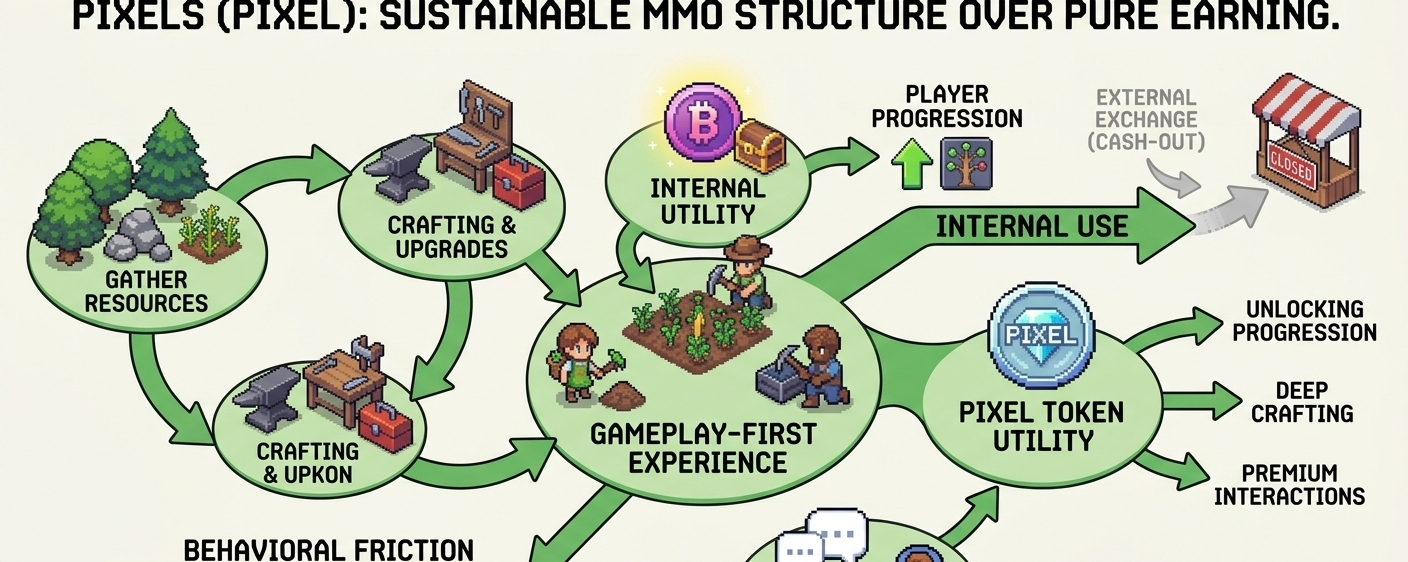
The reward structure is where Pixels becomes more interesting. Players earn through activity, but the system appears designed to encourage reinvestment rather than instant extraction. Resources gained from farming and exploration are not simply meant to be sold. They are used within the game to unlock upgrades, improve efficiency, craft items, support progression, and access additional layers of utility. This creates a more circular economy compared to many earlier Web3 games where the only logical move was to claim rewards and immediately sell them.
That internal circulation may be one of the project’s strongest ideas. In traditional failed crypto games, value leaves the system too quickly. Players earn tokens, transfer them to exchanges, and cash out. The economy becomes dependent on a constant stream of new participants buying in. Once growth slows, the structure collapses because no internal demand exists to balance selling pressure. Pixels appears to be attempting a different path by making rewards useful inside the ecosystem before they become valuable outside of it.
The PIXEL token itself reflects this layered approach. At first glance, it may seem like just another game token attached to gameplay incentives. Many users initially assume that any token integrated into a Web3 game will eventually become dominated by farming behavior. However, PIXEL appears to have broader utility tied to progression, upgrades, crafting systems, premium interactions, and ecosystem participation. Instead of existing purely as an emission asset, it functions more like a key that unlocks parts of the experience.
That distinction changes how the token is perceived. A token built only for rewards often struggles to maintain long-term relevance because users treat it as an output. A token tied to progression becomes something players may actually need. Whether Pixels succeeds in maintaining that balance remains uncertain, but the intent behind the design suggests awareness of earlier failures in crypto gaming economies.
Another aspect worth paying attention to is how the project shapes user behavior. The strongest online games understand that systems influence actions. Pixels appears to create friction deliberately. Players cannot infinitely farm without limits. Energy mechanics, progression requirements, land systems, and time investment all create barriers that slow pure extraction. While these mechanics may frustrate some users seeking maximum efficiency, they also reduce the speed at which value leaves the ecosystem.
The social layer also adds another dimension. Many blockchain games feel isolated despite multiplayer claims. Pixels seems to lean more heavily into community interaction, shared spaces, collaboration, and visible progression. Social attachment can become a stronger retention factor than financial incentives. People often stay in games because they build habits, relationships, and identity within the world. If Pixels succeeds in making players care about their presence inside the ecosystem rather than simply their wallet balance, it may develop more resilience than earlier projects.
Economically, the project appears to aim for a partially closed-loop model. Resources circulate through crafting, upgrading, trading, and progression instead of instantly converting into sell pressure. This approach does not guarantee sustainability, but it creates better conditions than open extraction systems. Sustainable economies typically require multiple sinks where value returns to the system rather than constantly escaping it. Pixels seems to understand this principle and attempts to build mechanics that recycle demand.
Still, there are realistic concerns. Even a well-designed economy can fail if the majority of users arrive for financial reasons rather than entertainment. Web3 audiences often behave differently from traditional gaming audiences. When tokens are involved, every mechanic becomes linked to profitability. Players optimize systems aggressively. They search for loopholes, automate behavior, and focus on efficiency over enjoyment. This creates pressure on developers to constantly balance reward output against inflation and retention.
There is also the challenge of maintaining interest over time. Farming games can feel relaxing and rewarding early on, but repetition eventually becomes a problem if progression lacks depth. Pixels must continuously provide reasons for players to stay beyond token incentives. New mechanics, evolving social systems, economic balancing, and meaningful ownership will likely determine whether the game remains active long term.
The most interesting thing about Pixels is not that it completely reinvents Web3 gaming. It does not. The foundation still includes familiar crypto mechanics, and many risks remain unchanged. What makes it stand out is that it appears to recognize the weaknesses of previous GameFi models and actively tries to reduce dependency on pure speculation. That alone separates it from projects that simply attach tokens to shallow gameplay loops.
Pixels feels less like a finished product and more like an ongoing experiment. It is testing whether farming gameplay, social engagement, ownership systems, and token economics can coexist without collapsing into short-term extraction. That experiment is difficult because crypto markets reward speed and speculation while games require patience and long-term attachment.
The project may still fall into the same trap as many before it. If users prioritize earning above all else, no amount of system design may fully protect the economy. But there is at least an attempt to create internal demand, behavioral friction, and genuine gameplay value. That effort deserves attention, even if it does not guarantee success.
For now, Pixels feels like something worth watching rather than blindly believing in. It sits somewhere between game and economic experiment, between entertainment and financial system. Its future depends less on token price and more on whether people genuinely want to spend time inside the world it has built.
That is ultimately the real test for any Web3 game. Not whether it can attract users quickly, but whether it can give them a reason to stay after the rewards stop feeling new.
