
Honestly… I didn't expect to feel this specific kind of attention when reading about how Pixels structures the upgrade path for the lands owned.
It's not doubt. It's not anxiety. It's more of a vibe that a system, which reads like a straightforward upgrade mechanism, has become one of the key accumulation drivers in the entire gaming economy.
Because there's a pattern in how Web3 games describe land ownership that this space accepts without considering how time actually affects the gap between early and late participants. The standard price comparison frame comes into play. Early participants paid less for their land NFTs. Late participants pay more. The advantage is described as a difference in basis cost, a financial edge that reflects time more than effort.
but in Pixels, the more interesting gap isn't what the first landowners paid. it's what they built while everyone else was still on the sidelines.
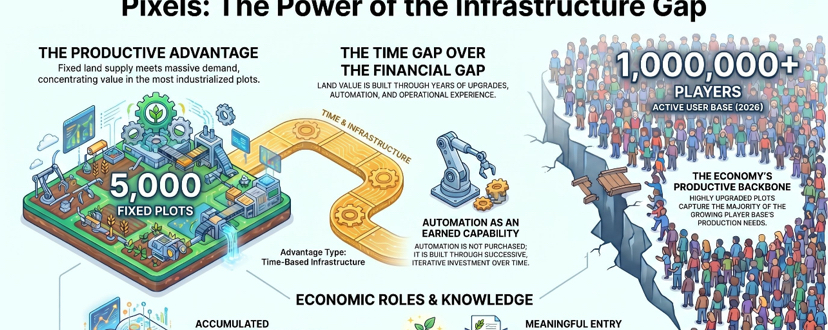
because the system they're describing is real. landowners in Pixels are pumping up the value of their NFTs by working, industrializing, upgrading, automating, and decorating them. industries can be activated, expanded, paused, and restarted. a landowner who has been running industries since 2022 is not just holding an appreciating asset. they have built a production infrastructure on that asset where the production capability reflects years of accumulated investment decisions, upgrade choices, and operational experience in the game economy.
so... the land upgrade system is really exciting.
but the upgrade system has never been the hard part in creating a sustainable advantage in a game economy.
the tricky part is understanding what happens when that advantage compounds over multiple chapter cycles while the number of players is growing faster than the land supply can keep up.
because this is what I always come back to. Pixels has 5,000 plots of land. that number is fixed and will never increase. the game has surpassed one million active users by early 2026. the ratio of active players to available plots is not a static relationship. each new player entering the Pixels economy without owning land is a potential worker, a prospective customer for land production, a potential participant in the crafting economy where inputs mainly come from resource nodes on land.
as the number of active players increases, the demand pressure for land production is not evenly distributed across all 5,000 plots. it focuses on the most industrialized, upgraded, and configured plots for maximum yield. a landowner who has spent four years activating industries and upgrading production capacity isn't just ahead of a new entrant on a linear scale. they're operating at a point on the upgrade curve that a new land buyer in 2026 will need years of continuous investment to reach, no matter how much PIXEL they're willing to drop at the moment.