
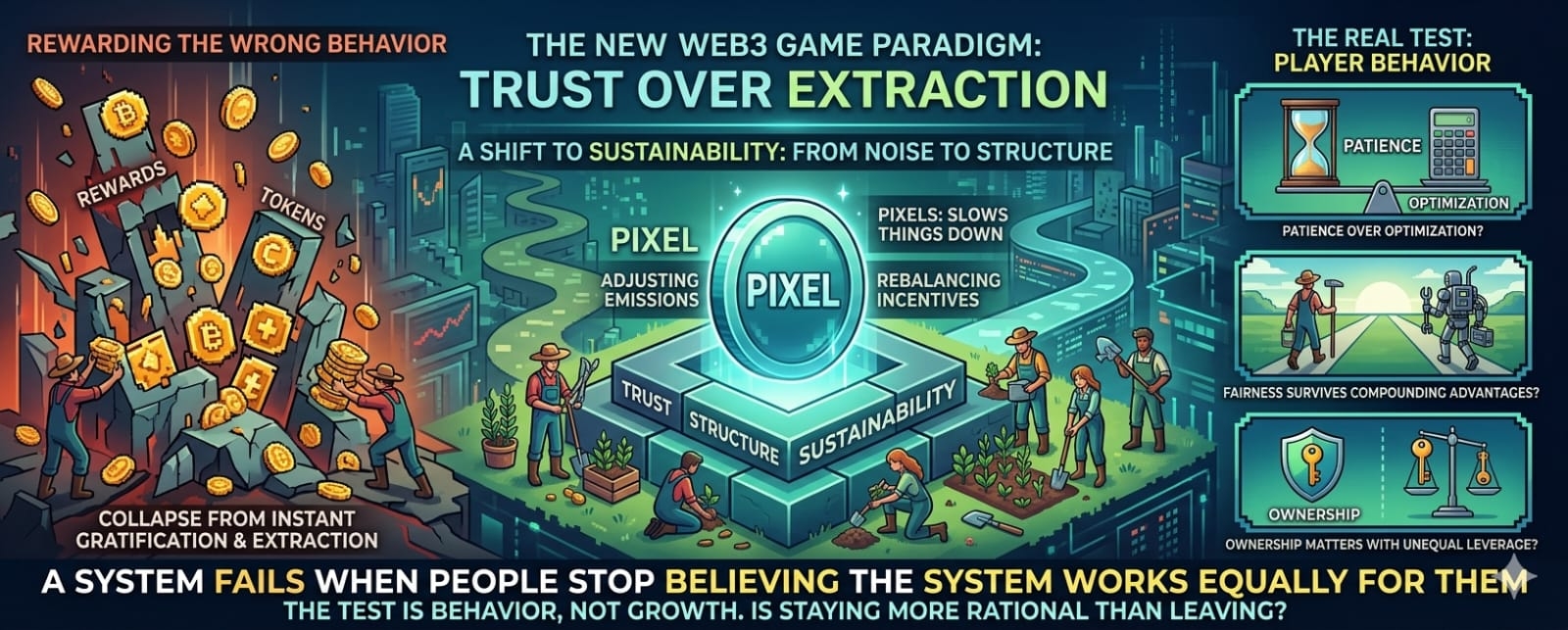
PIXELS: THE HIDDEN LAYER — WHERE STAKING DECIDES WHAT YOU EVEN GET TO PLAY
At first, Pixels just looks like a game.
You log in.
You check the Task Board.
You plant, harvest, repeat.
Simple loops. Familiar rhythm. Nothing unusual.
But the longer you stay inside Pixels, the harder it becomes to ignore a quiet contradiction:
You’re playing…
but you’re not seeing everything.
The Illusion of a Neutral Game
It feels like the Task Board is just there — a neutral list of things to do.
But it isn’t.
Every Task you see has already passed through layers you don’t interact with:
Reward budgets
Validators
RORS constraints
Conversion filters
By the time something appears on your screen, it’s already been: reduced → filtered → approved
So the real question isn’t:
> “What should I play?”
It’s:
> “Why am I only seeing this?”
Staking Was Never Passive
At first glance, staking looks like a side feature — something for holders, not players.
Lock tokens. Earn yield. Done.
But inside Pixels, staking behaves differently.
It’s not just locking value.
It’s directing it.
When players stake into specific validators or games, they’re not just participating in the economy — they’re shaping it:
Which reward flows get priority
Which games receive sustainable budget
Which loops survive RORS filtering
Which Tasks ever make it to the board
That means staking isn’t passive.
It’s pre-game decision making.
RORS: The Invisible Gatekeeper
RORS isn’t just a balancing mechanic.
It’s a filter.
Before rewards ever become visible gameplay, they’re compressed under constraints:
Too much emission? It gets cut.
Unsustainable loop? It never surfaces.
Weak economic pathway? It stays in Coins.
Most gameplay doesn’t fail loudly.
It simply: never appears.
No Tasks.
No visibility.
No escalation into $PIXEL.
Just silent absorption inside lower-value loops.
Why Some Games “Feel Better”
This is where things get uncomfortable.
Because what feels “fun” or “active” might not be about design alone.
It might be about flow.
Games that receive:
More routed reward budget
More validator support
More successful RORS clearance
…naturally look better.
They have:
More Tasks
More visible progression
More conversion into $PIXEL
Of course players go there.
But that creates a loop:
> Visibility → Attention → Staking → More Visibility
Not forced.
Just… reinforced.
Discovery vs Selection
In traditional games, discovery feels open.
In Pixels, it feels… filtered.
For something new to break through, it doesn’t just need to be good.
It needs:
Early reward routing
Enough budget to survive RORS
Consistent Task visibility
Otherwise, it doesn’t compete.
It never even enters the arena.
This isn’t discovery.
It’s:
> Selection under constraint
The Real Game Isn’t the Farm
You’re planting crops.
Completing Tasks.
Optimizing loops.
But that might not be the main layer.
Because underneath it all:
Staking decides direction
Validators shape reward flow
RORS controls visibility
The system filters what survives
By the time you act, most outcomes are already narrowed.
So the system doesn’t need to force behavior.
It just: limits what can exist… and lets players converge on it naturally.
The Shift in Perspective
At some point, the question changes.
Not:
> “What’s the best way to play?”
But:
> “Who decided this was playable in the first place?”
And deeper than that:
> “How much of the game never reached me at all?”
Final Thought
Pixels isn’t just solving the play-to-earn problem by limiting rewards.
It’s solving it earlier:
At reward routing
At validator selection
At RORS filtering
Before gameplay even begins.
Which means what you experience isn’t the full system.
It’s the allowed version of it.
And once you see that…
Staking stops looking like a feature.
It starts looking like the quiet center of everything.