
The longer I watch Pixels, the more I keep coming back to the same uncomfortable version of it.
Actually...
Not the nice one where the game just feels open. Farming, tasks, little loops, Coins landing, everyone doing roughly the same thing on the same board. That version is real. Pixels is good at making the surface legible. You can see what to do. You can do it. It clears.
Fine.
@Pixels gets worse when the loop stops acting neutral and starts splitting understanding.
Because showing the same task board to everyone is one thing.
Letting one group understand what the board is actually worth while the other just plays it is something else.
Still.
Thats not always abuse. Not even close. Sometimes it is just experience. Time inside the system. Paying attention to how reward quality shifts on Pixels. Learning when the same chores are sitting on top of a thicker day and when they are not. Fine.
Still leaves a very old market problem sitting there in better clothes.
Who actually knows how the system pays?
Who is routing with the fuller picture?
Who is being asked to trust the visible loop without ever getting enough context to understand what the loop is really doing to them?
That's where, I think, Pixels stops being just a game loop and starts feeling like bargaining power.
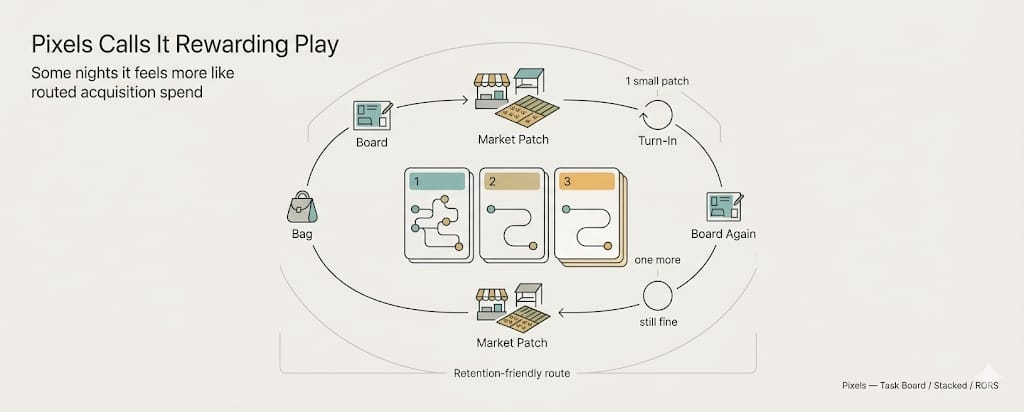
Take a normal day. Same chores. Same energy. Same board most players would recognize. Coins still land. The visible loop clears. Everything looks consistent enough to call it fair.
But the value day underneath that surface is not actually uniform.
Some players are reading things the board never says out loud. RORS shifts. Pixels' Stacked routing. Reputation pressure. Anti-bot thresholds tightening or loosening after the system has seen too much of the wrong behavior. Land access changing baseline efficiency. VIP quietly removing friction. Maybe the Pixels" AI layer is nudging rewards toward the kind of behavior the system currently wants more of. Whatever exact combination is doing the work that day, one player is just clearing the board while another is reading the allocation logic hiding underneath it.
Maybe that is enough. Maybe.
Game economies are not usually that charitable.
Because one player having materially richer context than another is not some abstract discomfort. It changes how they route, when they stop, what they ignore, which loops they only touch under certain conditions, when they bother extracting value, when they let Coins sit, when they decide the day is thin and not worth the inventory pressure, and when they push harder because the system is quietly paying for that exact shape of labor right now.
You do not need the system to announce any of this for it to matter.
You just need one player to know where the value actually sits and another to think it still sits on the board.
Great.
I’ve seen this in other systems in less elegant ways. Pixels just makes it cleaner. That’s the part people skip.
The loop can stay simple.
The understanding of the loop doesn’t.
One player starts thinking in gradients. This route looks normal, but it is thin under current reward logic. That one looks annoying, but pays better if reputation is healthy. That day is safe for Coins but weak for anything that actually has to move later. This one only really works if land, access, or prior account quality are already doing hidden work under the surface. The other player gets something flatter. Board cleared. Coins landed. Day done.
That is not the same thing.
One player sees the near-miss.
The other sees a normal day.
One player knows when the system is tightening.
The other just feels the outcome getting worse and cannot tell whether the problem was the route, the timing, the reward layer, or the fact that the board was never the real economy in the first place.
That is where the asymmetry stops feeling cosmetic.
A player who understands how RORS is shaping distribution, how Stacked on Pixels is routing campaigns, how Pixels' anti-bot logic is narrowing the good exits, or how Coins and $PIXEL are separating routine activity from the more valuable layer, does not just “know more.” They are operating with a different map. They know which days are real, which days are labor, and which days only look productive because the board still says so.
lovely.
Another player is still standing in the visible loop wondering why the same work no longer feels the same.
That is not fraud. Does not have to be.
Still not symmetrical.
And the system will feel that even when nobody can explain it cleanly. One player starts avoiding certain routes without writing a thread about why. Another pushes harder into them because they know the Pixels' reward stack is leaning that way this week. Someone extracts value sooner. Someone else keeps grinding a loop that stopped being worth it two updates ago. Somebody with land, VIP, or better reputation can afford to treat a thin day as temporary noise. Somebody else cannot. The board keeps calling all of them “activity” anyway.
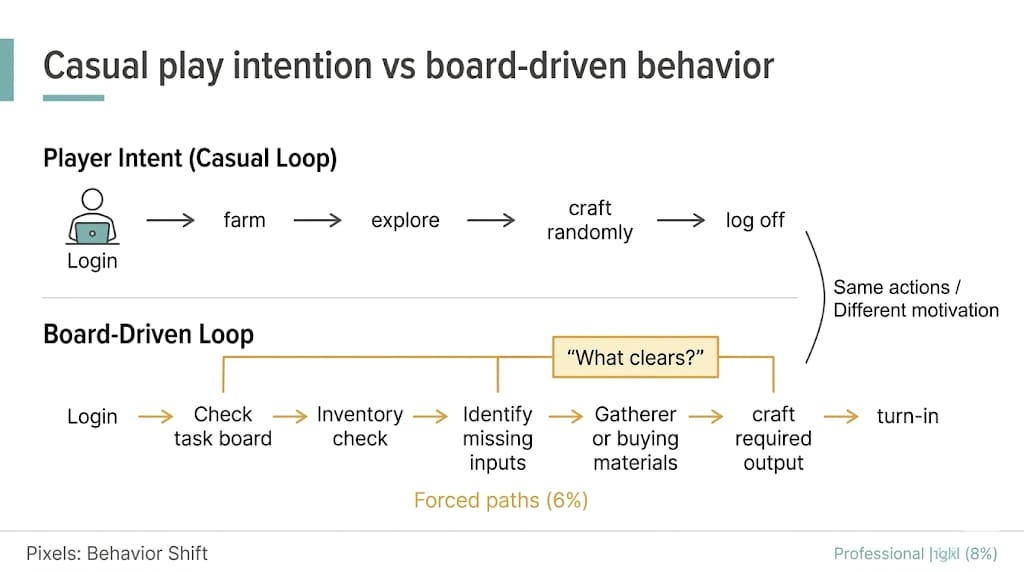
That is where Pixels gets more interesting to me than the usual game-economy talk.
Not whether the loop works.
Whether the understanding of the loop is evenly distributed.
Because once the real allocation logic sits underneath the visible surface, the gap becomes structural. Not a mistake. Not a bug. A property.
The system does not have to hide anything deliberately for this to happen. It just has to keep the visible loop simple while the real reward logic stays layered enough that some players learn to read it and others never quite do. Then the same board starts producing different qualities of day, and the people on the thinner side are left with procedural reassurance. You played correctly. The tasks cleared. The Coins landed. Meanwhile someone else was playing a denser game the whole time.
That is the version that sticks with me.
Not because Pixels failed.
Because it worked.
The task board is clean. The loop runs. The economy keeps assigning value underneath it. And one player still walks away understanding a lot more about why the day paid the way it did than the other one ever will.