
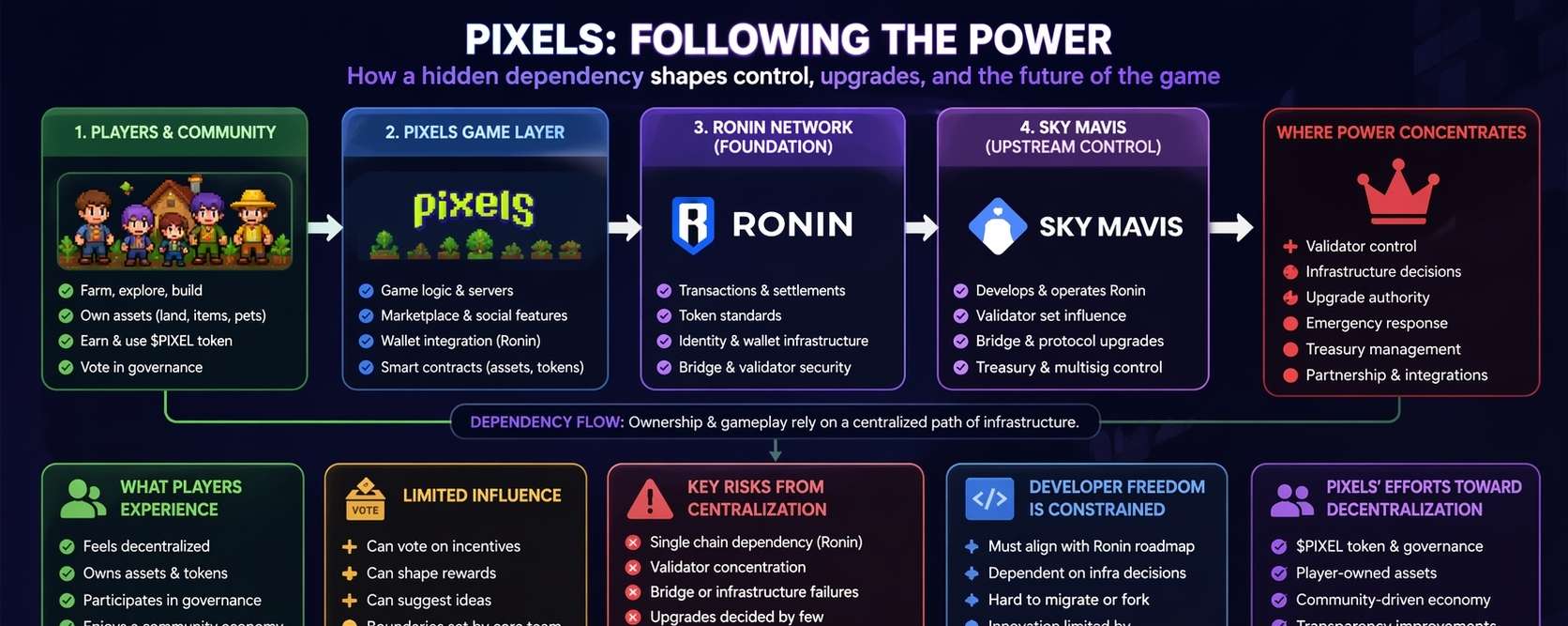
When people first step into Pixels, it feels like the future of gaming has finally arrived. It does not feel like a normal farming game where everything belongs to the company and players are simply visitors. It feels personal. You plant crops, trade resources, build relationships, earn tokens, and slowly create a place that feels like yours. Because Pixels is built as a Web3 game on the Ronin Network, it promises something bigger than entertainment—it promises ownership.
That word changes everything.
Ownership is what separates Web3 from traditional gaming. In ordinary online games, players spend years building progress that can disappear the moment a company shuts down servers or changes the rules. In Pixels, the idea is different. Your assets, your tokens, and your progress are supposed to belong to you, not just to the developers. It creates the feeling that players are no longer guests inside someone else’s world. They are stakeholders.
But the deeper you look, the harder one question becomes: do players really own Pixels, or do they only own access to it?
The answer begins with something most players never think about—the game’s dependence on Ronin and the company behind it, Sky Mavis. Ronin is not just a place where transactions happen. It is the foundation holding the entire economy together. Wallet connections, token transfers, NFTs, marketplace activity, and even the trust behind ownership itself all depend on this one system continuing to work.
That dependency is easy to ignore because infrastructure feels invisible. People notice gameplay, not validator architecture. They notice rewards, not blockchain governance. But in Web3, infrastructure is power. Whoever controls the rails often controls the future.
Pixels may look decentralized because assets exist on-chain, but if the chain itself depends heavily on one ecosystem and one dominant company, then decentralization becomes more fragile than it appears. Players can own land, but that ownership only matters if the network securing it remains stable, trusted, and protected.
We have already seen what happens when that trust breaks.
In 2022, the Ronin Bridge hack exposed one of the biggest weaknesses in blockchain gaming. More than 600 million dollars were stolen because too much authority was concentrated in too few validator nodes. It was a painful reminder that something can be called decentralized while still relying on a very small group of people behind the scenes.
For many people, that moment changed how they looked at Web3. It showed that decentralization is not about branding. It is about who can stop the system, who can save it, and who can change it without asking everyone else first.
That lesson matters for Pixels.
Even if players hold PIXEL tokens and participate in governance, there is still a difference between being included and being in control. Token holders may vote on rewards, incentives, and community decisions, but they do not control validator security, bridge architecture, or the deepest technical decisions that shape the survival of the game itself.
This is where the dream becomes complicated.
Pixels has clearly tried to move toward community ownership. The token economy, player-owned assets, and governance participation all suggest an effort to build something more open than traditional gaming. Compared to normal online games, it is a major step forward. Players are not just spending money—they are part of the economy.
But participation is not the same as power.
Most Web3 projects offer governance in a limited form. Communities can help decide how the garden is managed, but they do not decide who owns the land underneath it. The most important authority usually remains with developers, treasury managers, multisig signers, and infrastructure providers. These are the people who can make emergency decisions, approve upgrades, and respond when things go wrong.
That same structure exists in Pixels.
If Ronin changes its rules, Pixels must respond. If major technical upgrades are needed, the core team decides the path. If there is a crisis, the community does not gather for a perfect democratic vote. A small group acts quickly because they have to.
This is practical reality, but it also reveals where decentralization stops.
The truth is that most players are not governing the future of Pixels. They are participating inside boundaries created by others. They can influence outcomes, but only within a system someone else still has the power to redesign.
That does not make Pixels dishonest. In many ways, it is still far more open than the games that came before it. Traditional games never even pretended to share ownership. Pixels at least tries to distribute value and invite participation.
That matters.
But honesty also requires admitting that ownership without constitutional power is still limited. Holding tokens is not the same as holding authority. Farming inside a digital world is not the same as deciding how that world survives.
So the real question is not whether Pixels is decentralized enough to look different. The real question is whether the community could ever truly control the decisions that matter most.
Could players reject a major infrastructure shift? Could they challenge the people holding upgrade authority? Could they force a future the founders did not want?
In most cases, probably not.
And that leads to the uncomfortable truth at the center of the entire Web3 promise: sometimes we are told we own the game, when what we really own is permission to participate.
Maybe that is still progress. Maybe partial ownership is better than none. But if the deepest decisions remain in the hands of a few, then decentralization is still unfinished.
Pixels lets players plant, build, trade, and dream. It gives them the feeling that this world belongs to them.
But when the rules can still be changed somewhere above them, the question remains painfully simple:
Are we truly the owners of Pixels—
or are we just very invested tenants?