
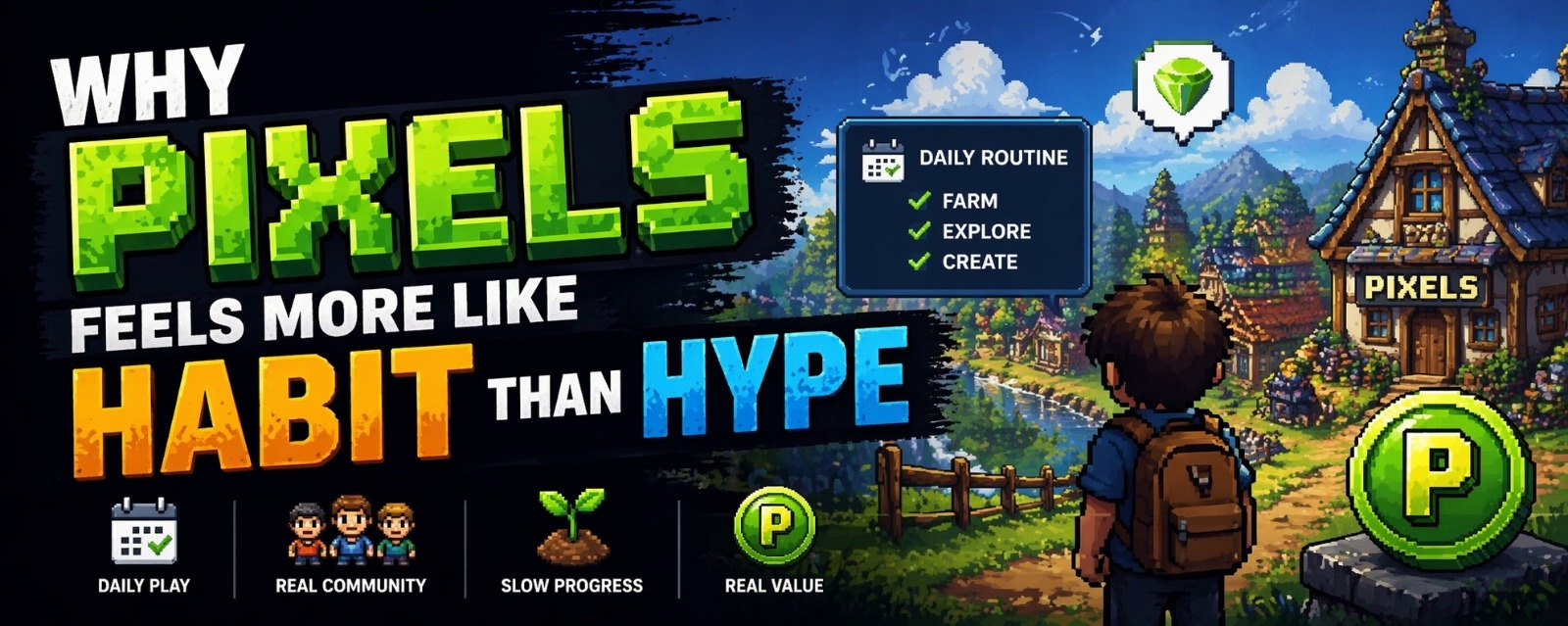
What I find interesting about Pixels right now is not the surface-level narrative that it’s “just another Web3 game,” but the timing of its emergence and the kind of behavior it’s quietly normalizing. After spending enough time watching different cycles of on-chain activity, I’ve noticed that the market tends to swing between two extremes: pure financial abstraction and pure user experience. Pixels sits somewhere in between, and that positioning feels deliberate rather than accidental.
@Pixels exists in a moment where attention has become more valuable than capital, yet most protocols still design around liquidity first. That mismatch is usually where friction appears. In earlier cycles, games tried to financialize engagement too aggressively, turning gameplay into yield extraction. What Pixels seems to be doing instead is slowing that loop down. The farming, exploration, and creation mechanics are not revolutionary on their own, but the way they’re paced changes how value is generated. It doesn’t feel like a system optimized for quick capital rotation. It feels more like a system that rewards consistency and presence.
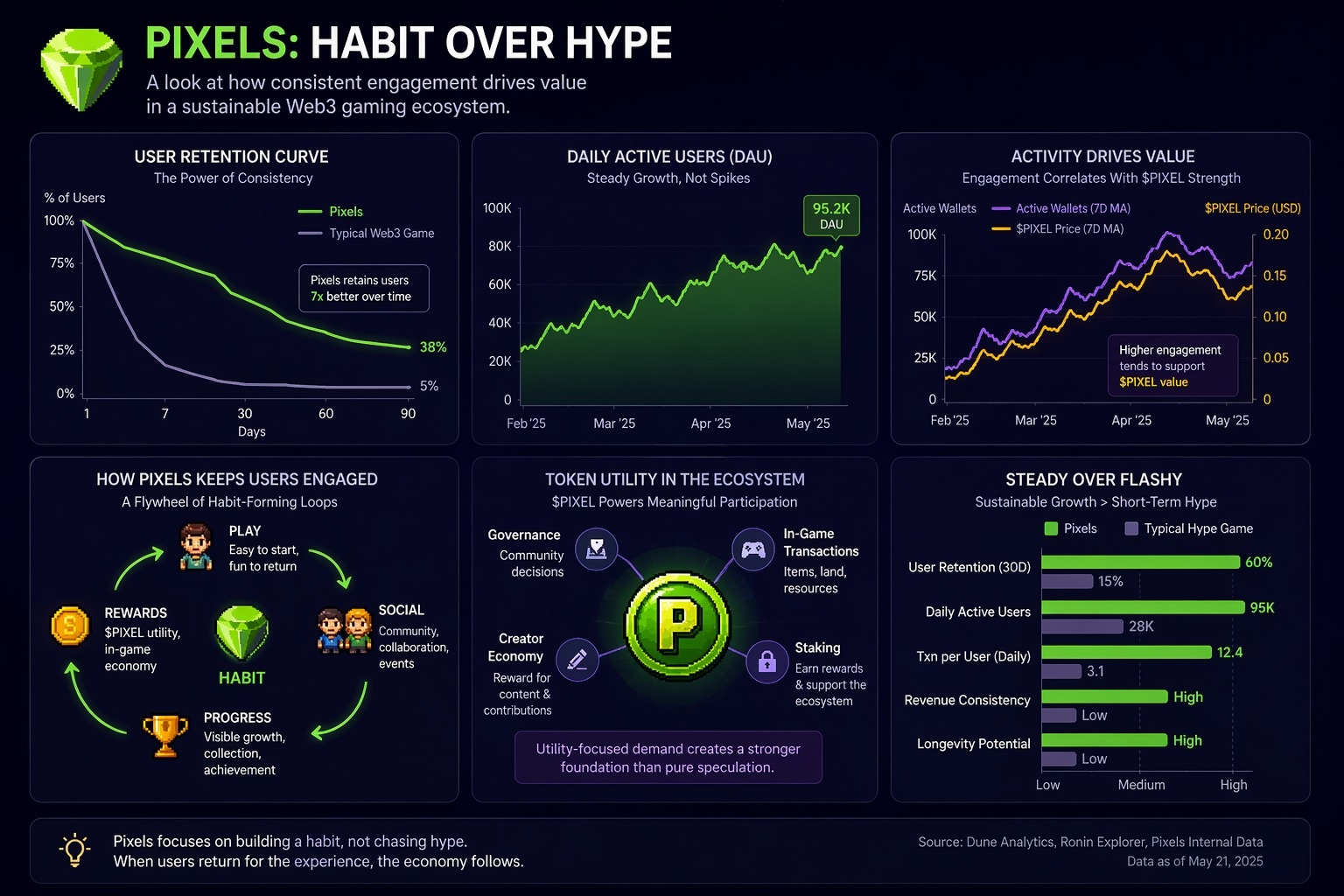
The problem it quietly addresses is something most people overlook: retention without artificial incentives. A lot of Web3 products can attract users temporarily, but very few can keep them without continuously increasing rewards. Pixels leans into social loops and low-pressure participation. That may sound simple, but in practice it changes how users behave. Instead of optimizing for extraction, users begin to optimize for time spent, relationships, and incremental progress. That shift matters more than any single feature.
From an architectural perspective, being powered by the Ronin network is not just a technical choice, it’s a behavioral one. Lower transaction costs and faster confirmations reduce the mental friction of interacting with the game. In traditional DeFi, users think before every transaction because each action has a visible cost. In Pixels, interaction becomes more fluid, almost subconscious. That changes how frequently users engage, and frequency is often more important than transaction size when it comes to building sustainable ecosystems.
When I observe how users interact with Pixels, it doesn’t resemble typical on-chain activity. There’s less emphasis on timing entries and exits, and more emphasis on routine. Logging in, tending to resources, exploring the map, interacting with others. These are simple loops, but they create a kind of behavioral inertia. Once someone is part of that loop, leaving requires more effort than staying. That’s a very different dynamic compared to protocols where users can exit instantly without losing context.
That said, there are trade-offs that shouldn’t be ignored. Slower systems tend to struggle with speculative attention. In a market that still rewards volatility and rapid narratives, Pixels risks being overlooked during high-momentum phases. There’s also the question of whether social engagement alone can sustain long-term value without periodic external catalysts. If the system becomes too stable, it may lose the very attention it initially captured.
The role of $PIXEL in this structure is where things become more nuanced. Tokens in gaming ecosystems often suffer from misalignment between usage and speculation. In Pixels, the token appears to function more as a medium of participation rather than a pure reward instrument. That distinction is subtle but important. If users need the token to meaningfully engage with the ecosystem, demand becomes behavior-driven rather than purely speculative. However, this also means that price action may not respond immediately to external hype. It becomes more tied to actual activity levels within the game.
If I were to think about how on-chain data would reflect this system, I wouldn’t focus on large spikes in volume. Instead, I’d look for consistency. Daily active users, transaction frequency per wallet, and retention curves over time. A healthy Pixels ecosystem would likely show steady, almost uneventful growth rather than sharp bursts. That kind of data is easy to ignore in the short term, but it often signals stronger foundations.
Recently, what stands out is how campaigns and structured participation, like the CreatorPad initiative, are being integrated into the ecosystem. These aren’t just marketing efforts. They’re mechanisms to align user-generated content with platform growth. By encouraging users to write, post, and engage, Pixels is effectively extending its gameplay into the social layer. That blurs the line between playing the game and promoting it, which can be powerful if done carefully. But it also introduces the risk of content becoming mechanical rather than genuine.
In the broader market cycle, Pixels feels like it belongs to a phase where the market is trying to rediscover sustainability. After periods dominated by speculation, there’s usually a shift toward products that can hold attention without constant external input. Pixels doesn’t appear to be chasing dominance in terms of capital or hype. It seems more focused on quietly building a loop that people return to.
I don’t think Pixels is trying to redefine Web3 gaming in a dramatic way. If anything, it’s doing the opposite. It’s simplifying the experience and letting behavior evolve naturally. Whether that approach scales or not is still an open question. Markets don’t always reward patience, and systems built on gradual engagement often take longer to prove themselves.
But when I step back and look at it without the noise, Pixels feels less like a product designed for this week’s trend and more like an experiment in how people choose to spend time on-chain when they’re not being pushed by incentives. And that’s a much harder thing to measure than price.
