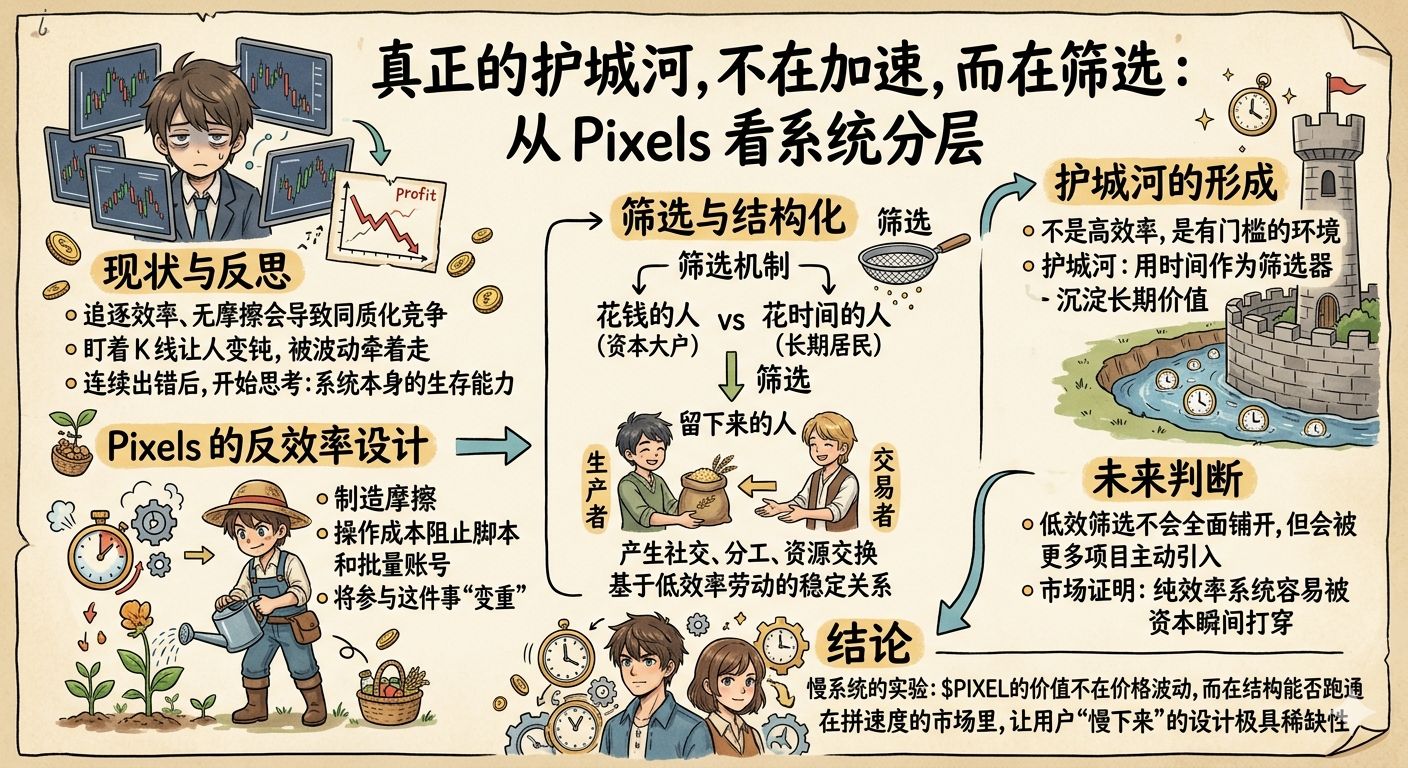
Most folks getting into the market assume one thing: the higher the efficiency, the better the system. Whether it's trade matching, on-chain interactions, or capital turnover, nearly all designs are optimized for speed, smoothness, and lower friction. But the issue is, when everything gets close to frictionless, the system itself gradually loses its filtering capability. Participants no longer stand out, behaviors start to align, and it often evolves into a homogenized competition dominated by funds and tools. After going through this rhythm repeatedly, I've come to realize that maybe what truly determines whether a system can survive long-term isn't how efficient it is, but whether it retains essential resistance. With this perspective, I went back to check Pixels and found that many designs I previously overlooked or even dismissed started to look a bit different.
At first, I thought a lot of its designs were super inefficient—watering crops, waiting for them to grow, moving resources around. These could have been automated with scripts, but they make you do it manually over and over. But after diving in deeper, I realized this seemingly clunky design is actually creating friction, which serves as a filtering mechanism. Without these operational costs, everything would quickly turn into a pure competition of funds and computing power. High-frequency scripts and multiple accounts would drain the reward structure, something we've seen happen in way too many projects.
And @Pixels what it does is make participation weighty. When you have to invest real time and even feel a bit fatigued, those just looking to leverage funds for quick gains will drop out, leaving behind those who are willing to invest time. That’s when the shift happens; when the output isn’t just numbers in your wallet but results earned over several hours, it gains a process attribute, making it inherently stickier and harder to drain. What I see in there are not just players but a group of people who are in it for the long haul. They’re not discussing prices; they’re talking about routes, roles, and resource exchanges. This relationship formed from low-efficiency labor is far more stable than a simple incentive mechanism.
To put it simply, this logic isn’t about creating a high-efficiency system; it’s about building an environment with barriers to entry. Once those barriers are in place, the moat starts to form. So back to the original question: will this method of filtering users by increasing participation costs become mainstream? My take is it won't be universally adopted, but we’ll definitely see more projects intentionally introducing it, because the market has repeatedly shown that purely efficient systems are the easiest to penetrate by capital in an instant.
A system with friction is essentially trading speed of expansion for structural stability. It doesn’t aim to let everyone in; it cares more about who sticks around. From this perspective, Pixels feels like a slow-system experiment, and the value of $PIXEL might not just be in its price fluctuations but in whether this structure can actually work. Right now, I’m less concerned about whether it will continue to pump and more interested in how this mechanism, using time as a filter, will eventually reveal the kind of people who stick around and where they can take this system. In a market where everyone else is racing, a design that encourages you to slow down is already something rare and valuable.