For a long time, I treated time in games as something loose and almost meaningless. You log in, complete a few actions, log out. Nothing carries weight. Unlike real-world systems—where time directly translates into money, output, or missed opportunities—game time usually feels expendable.
At least, that’s how it seems in the beginning.
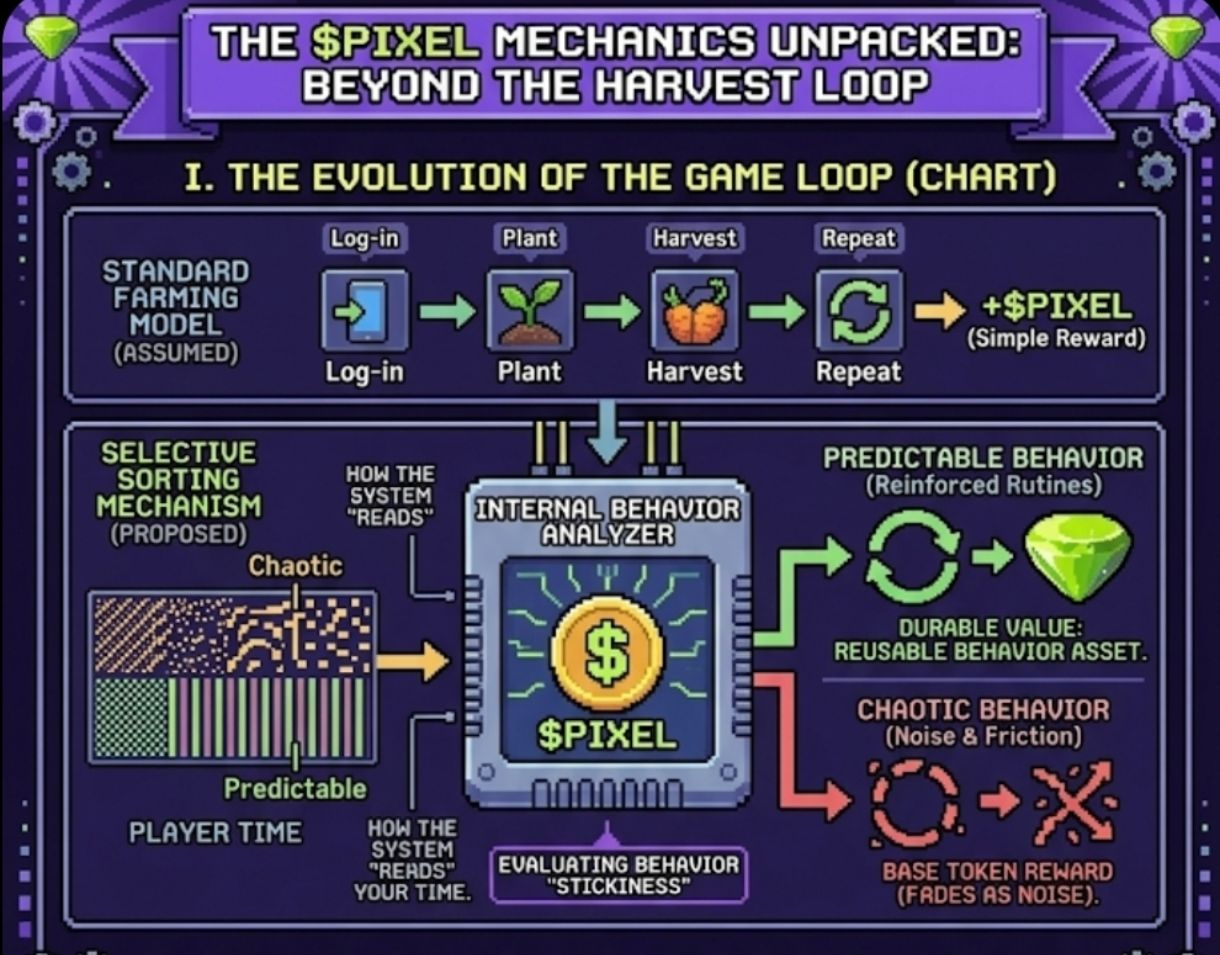
When I first encountered Pixels, it didn’t immediately challenge that assumption. On the surface, it follows a familiar rhythm: plant crops, wait, collect rewards. A loop we’ve all seen before. Nothing about it initially suggests anything deeper.
But over time, something subtle started to stand out.
Different activities within the game began to feel strangely comparable. Not in an obvious, mechanical way—but almost as if they were quietly being evaluated against each other. Farming, crafting, progression tasks… they didn’t feel isolated anymore. Instead, they started to feel like different expressions of the same underlying resource.
That’s when my perspective shifted.
Most games never really unify their systems like this. Each activity exists in its own lane, with its own rewards and pacing. There’s no real attempt to make them equivalent or measurable against one another. The imbalance is simply part of the design.
Pixels, however, seems to lean in the opposite direction. It doesn’t explicitly present itself as a system where time is standardized—but it gradually behaves like one.
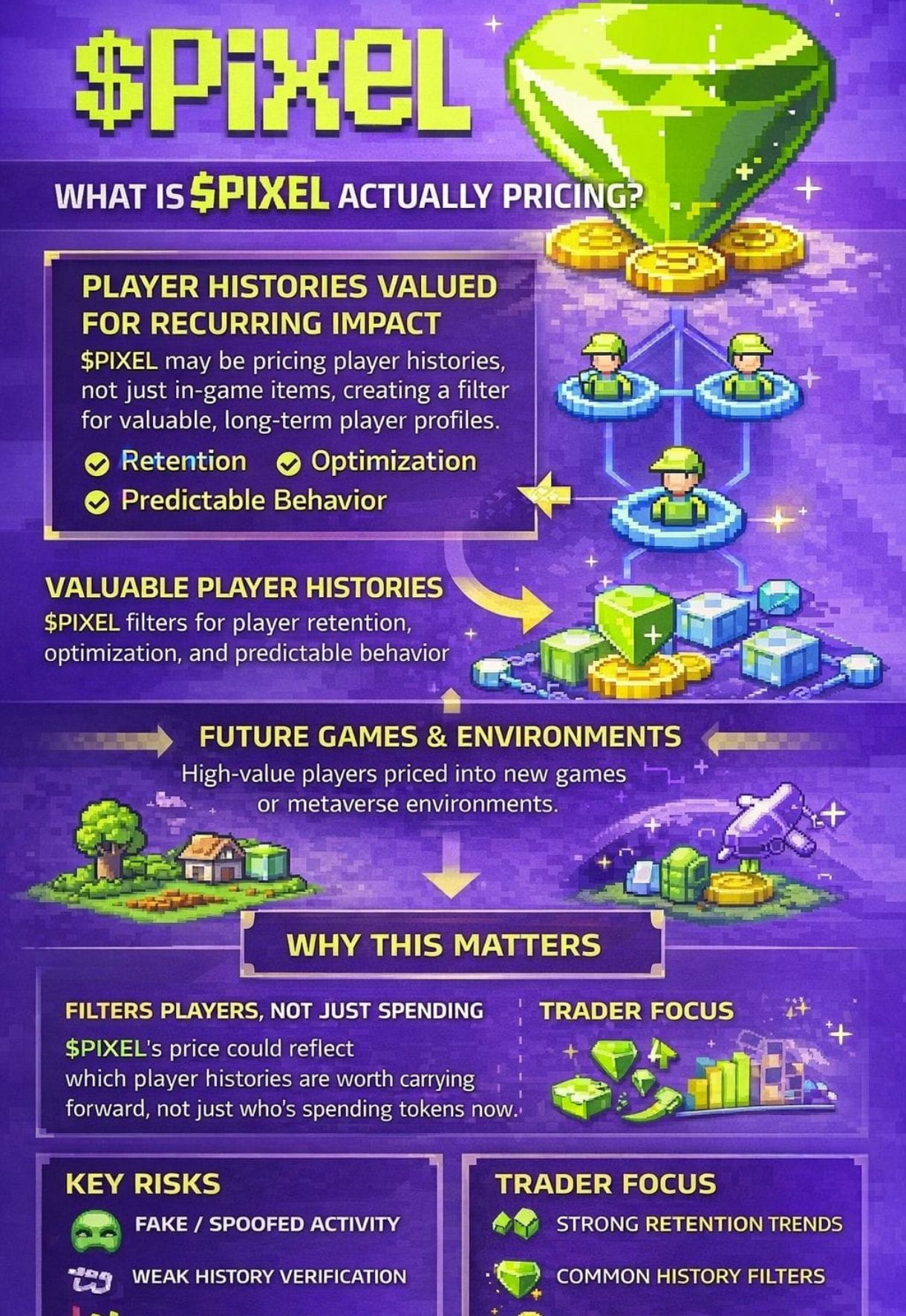
And when that happens, $PIXEL begins to take on a different role.
It’s no longer just something you earn. It starts acting more like a way to assign value to time itself.
I only realized this when I caught myself making small, almost automatic decisions:
Is it worth waiting here?
Should I use $PIXEL to skip this delay?
Where does my time produce the best outcome right now?
These aren’t isolated questions tied to one activity—they stretch across the entire experience. Every choice starts to feel interconnected.
That’s unusual.
Because the focus quietly shifts from what to do… to how your time should be used.
And that changes everything.
There’s also an interesting layer of friction in how this plays out. It’s not aggressive or overwhelming. You’re never forced into spending. But there are enough pauses, enough slowdowns, that you begin to notice them adding up over time.
Individually, they’re insignificant. Together, they create a constant background tension.
You can wait… or you can adjust the speed.
That adjustment is where the token becomes relevant.
In some ways, it feels less like a traditional game economy and more like a system built around efficiency—similar to how certain services let you pay to reduce delays or improve performance. The outcome remains the same, but the time it takes to reach it can vary.
Pixels applies a softer version of that concept, but with a key difference: it revolves around player behavior rather than machines or infrastructure.
And that introduces an interesting dynamic.
Two players can spend identical amounts of time in the game, yet end up in completely different positions. Not because of luck—but because of how they chose to “price” their time through decisions.
Time stops being neutral. It becomes structured.
That structure is where things get both compelling and fragile.
Because once players start optimizing, they rarely stop. They begin searching for the most efficient loops, the highest return per minute, the least resistance for maximum output. Over time, this behavior tends to converge.
When too many players follow the same optimized paths, the sense of an open world can start to narrow. What once felt organic begins to resemble a system of calculated routes.
This isn’t unique to Pixels—it’s something that happens in almost every system where efficiency becomes visible.
Then there’s the question of perception.
Even if everything is technically balanced, players might start to feel like the experience is being subtly guided. That delays aren’t just part of the world—but placed there intentionally. That choices aren’t entirely free—but gently influenced.
These thoughts don’t immediately break the system. But they linger in the background.
And over time, they shape how the game is experienced.
It’s hard to say whether Pixels fully resolves this tension—or if it even intends to. What it does seem to achieve, though, is a level of consistency in how time behaves across its different systems.
Not perfectly equal—but comparable.
That alone changes the nature of the economy.
If that consistency continues to hold, it could point toward something broader. A direction where effort—not just items or assets—can be interpreted in a more unified way, possibly even across multiple systems.
It’s still early to draw firm conclusions.
But one idea keeps resurfacing for me:
Pixels doesn’t primarily feel like a system about earning rewards. It feels like a system about redefining how your time is valued within it.
It’s a subtle shift. Easy to overlook.
Until you realize that you’re no longer just playing a game—
You’re constantly deciding what your time is worth.