
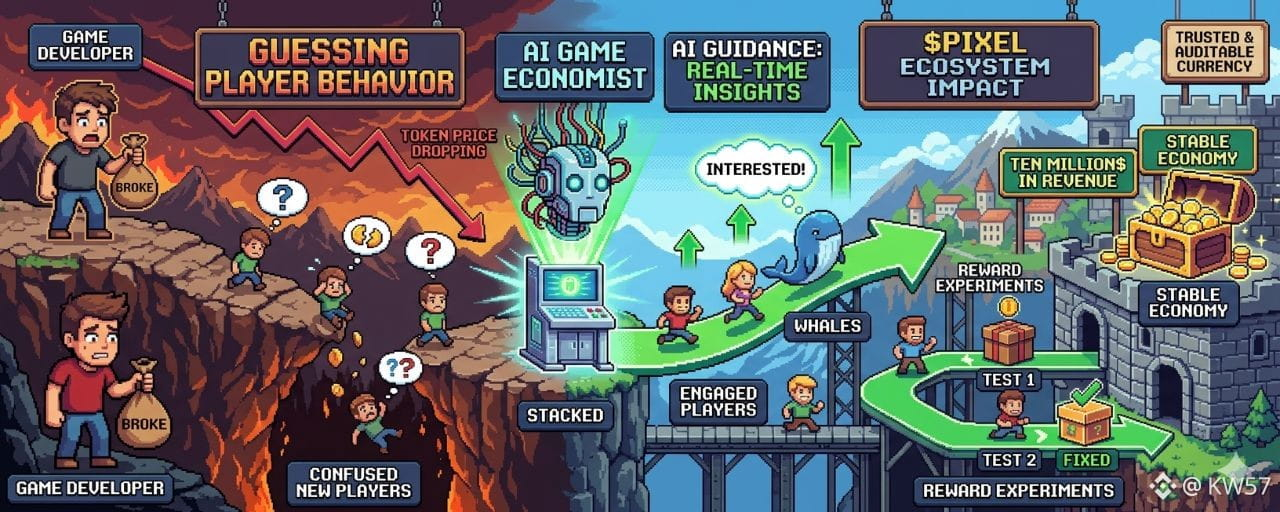
In game development, one of the biggest risks is building features that players don’t even like. Most of the time, developers only realize it after the game starts dying and the token price drops.
That’s exactly why the @Pixels team didn’t want to rely on guesswork. Instead, they built Stacked. Inside it, there’s an AI Game Economist that works like a navigation system, constantly guiding developers in real time on what’s working and what’s not.
This AI isn’t just about numbers, it’s about understanding player psychology. It can tell studios when “whales” (big players) start losing interest because of certain mechanics, or when new players begin to feel confused after a few days.
With data this precise, studios can instantly run reward experiments through Stacked to fix problems right away. It’s insight turned into action, without waiting months for meetings or reports.
That’s what keeps the Pixels economy stable and allows it to generate real revenue in the tens of millions.
For the $PIXEL ecosystem, the impact is massive. We’re no longer holding a token driven purely by speculation or hype. Its value comes from a system that actually works in real conditions.
As more external studios start using this “digital brain” from Stacked, $PIXEL becomes more widely used as a trusted and auditable reward currency.
What we’re seeing now is a new standard, where a game’s success isn’t based on luck, but on data and properly rewarding players in a meaningful way. #pixel