#CHIP暴涨 March 11, 2024: peaked at $1.02
April 2026: about $0.0075 (cumulative drop of about #-99.2%)
If I shorted near $0.95, without leverage, a $10,000 principal could turn into about $20,000.
But what I really want to discuss isn’t this account, but what actually happened during these two years of decline— and why I still haven’t closed all my short positions.
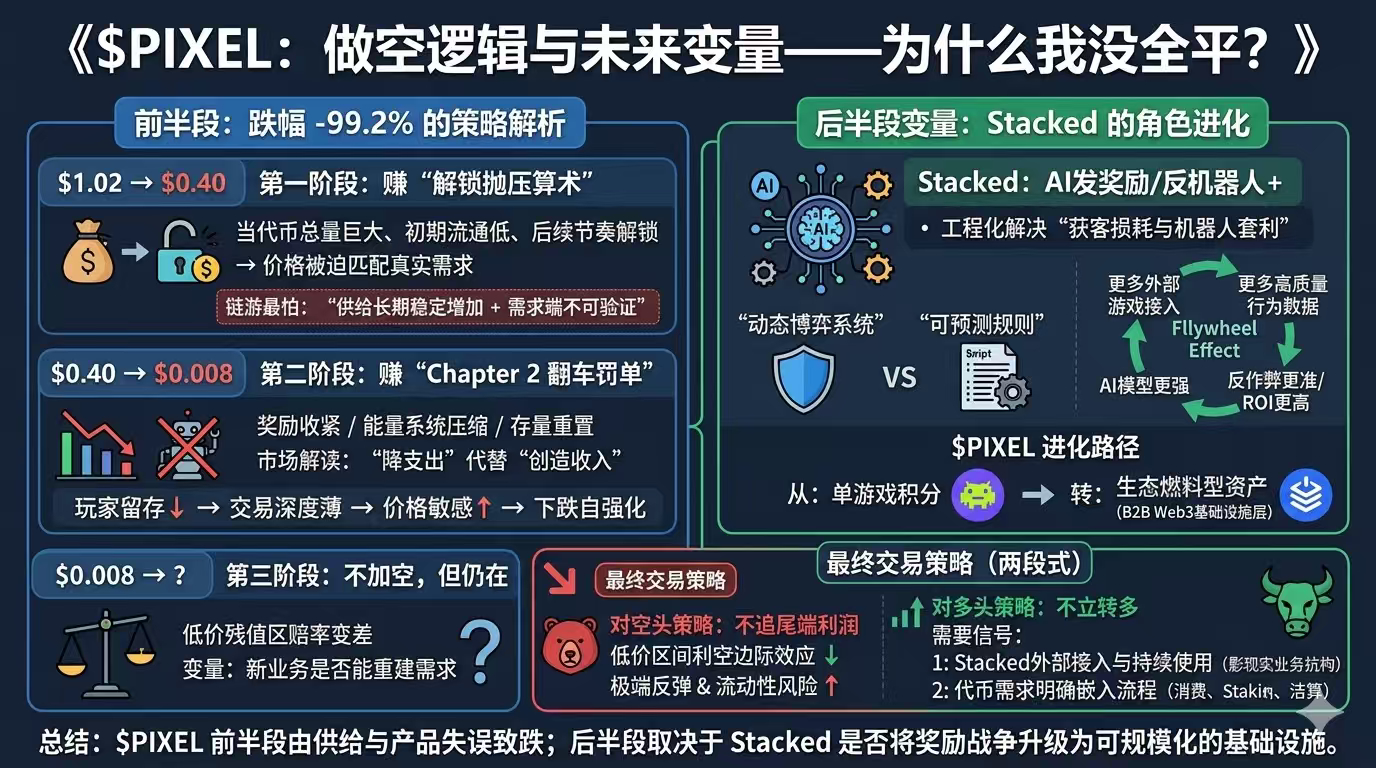
Phase One: $1.02 → $0.40
What I’m profiting from is the 'arithmetic of unlock selling pressure'.
When the total token supply is huge, the initial circulating supply is low, and subsequent unlocks have a rhythmic impact, prices will be forced to match real demand.
What blockchain games fear most isn’t short-term pullbacks, but 'long-term stable supply increases + unverifiable demand'.
Phase Two: $0.40 → $0.008
What I'm profiting from is the 'penalty for Chapter 2's failure'.
When reward rules tighten significantly, energy systems compress experiences, and existing assets are reset (regardless of whether the motivation is anti-bot or economic redo), the market will quickly interpret it as:
The project is substituting 'reducing expenditure' for 'creating income'.
For tokens, this often means: player retention declines → trading depth thins → prices become more sensitive to selling pressure → downturn self-reinforces.
Phase Three: $0.008 → ?
I’m not adding to my position, but my short positions remain. The reason is simple:
When the price approaches the 'narrative collapse residual zone', the odds for continuing to short worsen, and the real variable comes from whether 'new ventures can rebuild demand'.
Stacked: why I call it a 'technical dimensionality reduction strike' 🤖⚙️ (also the reason I haven’t fully closed out my positions)
If Stacked is only understood as 'AI issuing rewards/anti-bot', that indeed underestimates it. What’s more noteworthy is:
It attempts to engineer solutions for the two most fatal issues in blockchain gaming: customer acquisition loss and bot arbitrage.
Traditional blockchain games often have a reward system based on 'predictable rules'—as long as scripts learn the optimal path, they can drain the economic system.
The subtext of Stacked is: after undergoing extensive conflict and iteration internally at Pixels, rewards are no longer just rules, but more like a 'dynamic game system':
① Using behavioral data to differentiate between real users and scripts (reducing certainty of being arbitraged)
② Productizing anti-cheat/reward capabilities (transforming from single-game abilities to replicable modules)
③ Once external access is opened, it could become the B2B layer of Web3 gaming: more games integrate → more high-quality behavioral data → stronger models → more accurate anti-cheat → higher ROI → attracting even more access
This isn’t linear growth, but rather a 'data and distribution flywheel'.
If this flywheel holds, the $PIXEL role may evolve from 'single-game points' to a more universal 'fuel-type asset' within the ecosystem.
That's also why I’m cautious about 'continuing to add shorts': the supply side has been fully priced in by the market, but the demand side may experience structural changes.
Final trading strategy thought: why I’m not fully closing out, nor adding to my shorts 🧩📌
My strategy resembles a 'two-phase' approach:
For the bears:
No longer chasing tail profits. In the low-price, small-cap range, the marginal effect of bad news declines, while extreme rebounds and liquidity risks rise.
For the bulls:
I won’t immediately flip to bullish just because the 'tech is strong'. I need to see two types of signals:
1) Stacked's external integration and continued usage (driven by real business)
2) Token demand is clearly embedded in processes (not just verbal narratives, but verifiable consumption/staking/settlement closed loops) #pixel
In a nutshell: the first half of PIXEL's drop is due to supply and product missteps; the variables in the second half may depend on whether Stacked upgrades the 'reward war' in blockchain gaming to scalable infrastructure.