
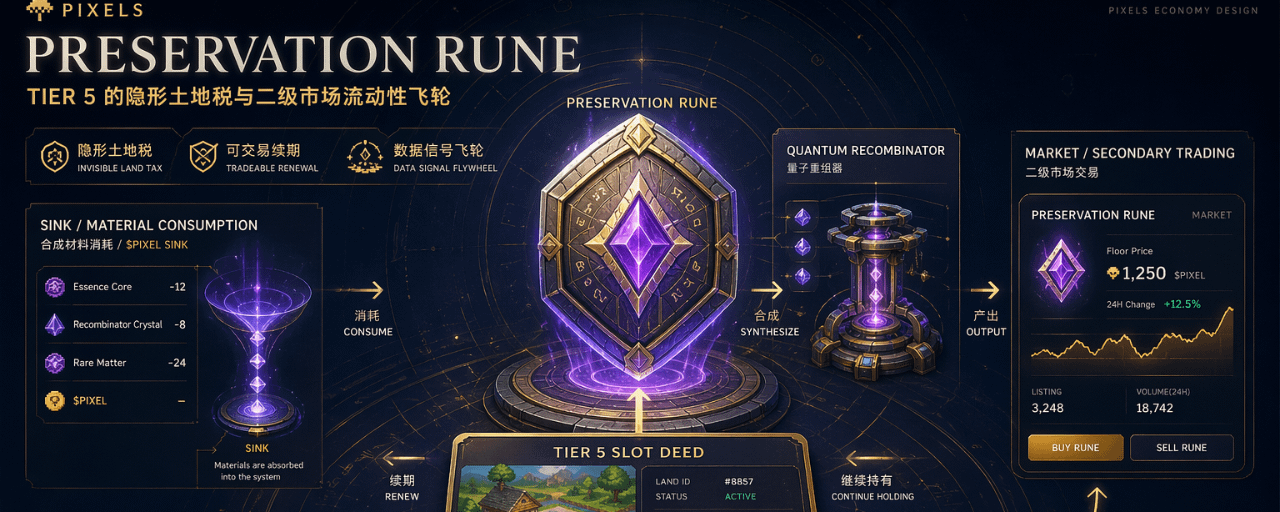
I think the most underrated core innovation in the @Pixels Tier 5 update is not the new 9 industries or 105 recipes, but rather the ‘invisible land tax + secondary market liquidity flywheel’ economic loop built by the Preservation Rune.
It has first achieved predictable and tradable ongoing maintenance fees at the NFT land level, completely transforming the static ownership of traditional Web3 games into a dynamic operating asset.
To put it bluntly, the theoretical breakthrough in mechanism design: converting players' ongoing 'paying for land' behavior into quantifiable high-value signals for Stacked AI economists, which in turn drives the micro sink and liquidity optimization of $PIXEL tokens.
The mechanism design principles of the 'invisible land tax': from one-time ownership to periodic commitment.
It's well-known that traditional blockchain game land economics generally follow a buyout ownership model: players make a one-time purchase of an NFT, gaining permanent capacity bonuses. This design effectively attracted traffic during the early P2E boom but created a fatal flaw—lack of ongoing costs leads to rapid asset devaluation, speculative sell-offs, and economic cannibalization.
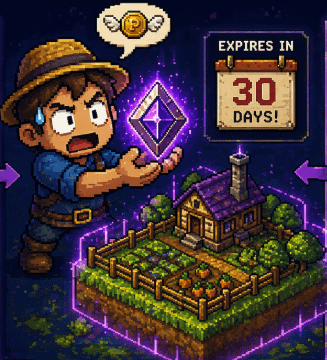
The innovation of the Preservation Rune lies in introducing a predictable 30-day maintenance tax: Tier 5 Slot Deeds must be renewed through a Quantum Recombinator synthesis of Rune after expiration, or else T5 industrial capacity goes to zero.
I would call it the 'invisible land tax', which is essentially a classic application of mechanism design theory.
Here’s a fun fact: Nobel laureates Myerson and Maskin proposed the 'incentive compatibility' principle: renewal is not a forced tax but a voluntary verifiable commitment from players. This theory is precisely implemented here; players must incur real costs to maintain the capacity premium of T5 Slots. This design directly addresses the moral hazard issue in Web3 games—previously, players could sell land after farming rewards; now, the willingness to maintain becomes an unforgeable signal.
It draws from the real estate economic model of 'holding costs'; under the Coase theorem, when transaction costs are zero, property distribution does not affect efficiency; however, in blockchain games, transaction friction always exists.
The Preservation Rune creates friction through periodic costs but inversely enhances overall efficiency; only players who truly value the long-term worth of the land will renew, thus filtering out low-value speculators and selecting high-stickiness cohorts.
This filtering mechanism upgrades land from 'speculative assets' to 'operational assets'.
On the surface, the Rune is just a crafting item; underneath, it dynamically anchors the land's LTV.
Renewing every 30 days equals that players vote with their real actions. I believe this land can still generate positive ROI in the next cycle. This periodic commitment directly enhances the expected cash flow stability of the land, injecting long-term anchored value into the $PIXEL token.
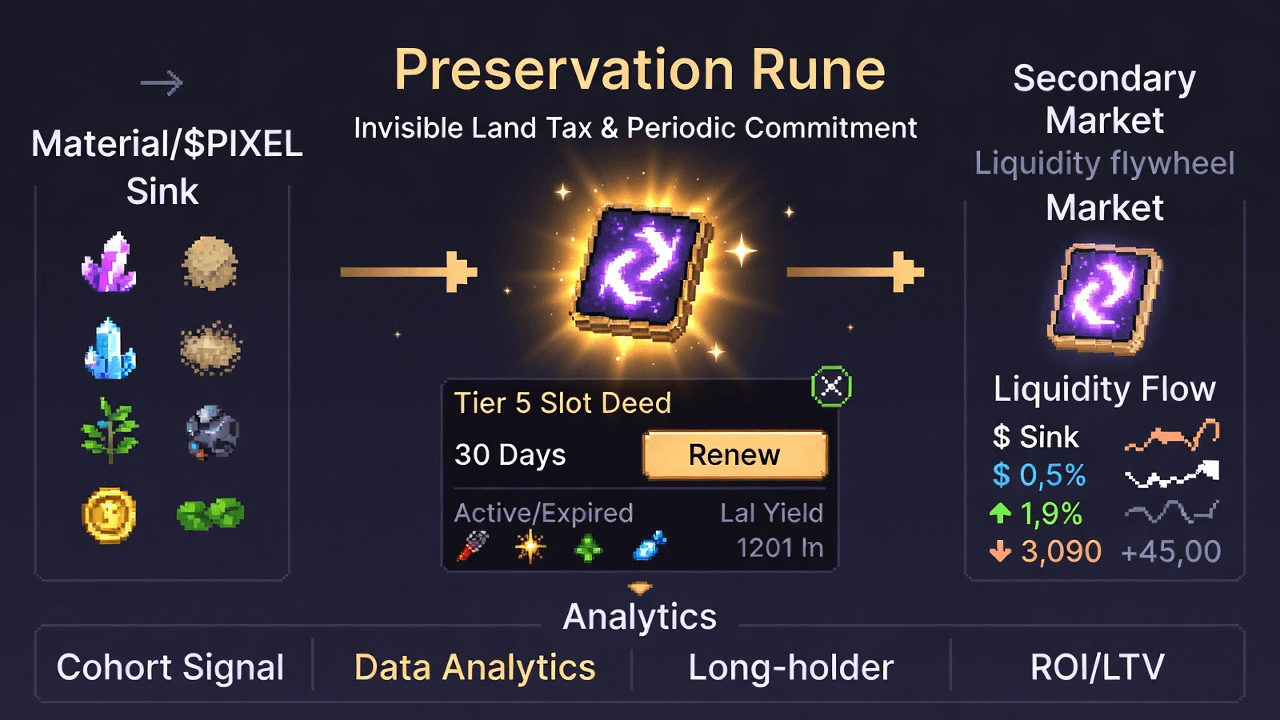
Secondary market liquidity flywheel: micro sinks and the closed-loop theory of trading positive feedback.
The tradable attribute of the Preservation Rune constructs a second core innovation.
Rune circulates as an independent tradable asset—high-level players can cash out after synthesis, while low-level players can directly buy into the T5 economy, merging the internal sink and external trading into a dual cycle.
I think this theoretically aligns with the 'liquidity flywheel' model, commonly found in DeFi protocols like Uniswap: increased trading volume → liquidity provider earnings rise → more capital inflow → slippage decreases → more trades.
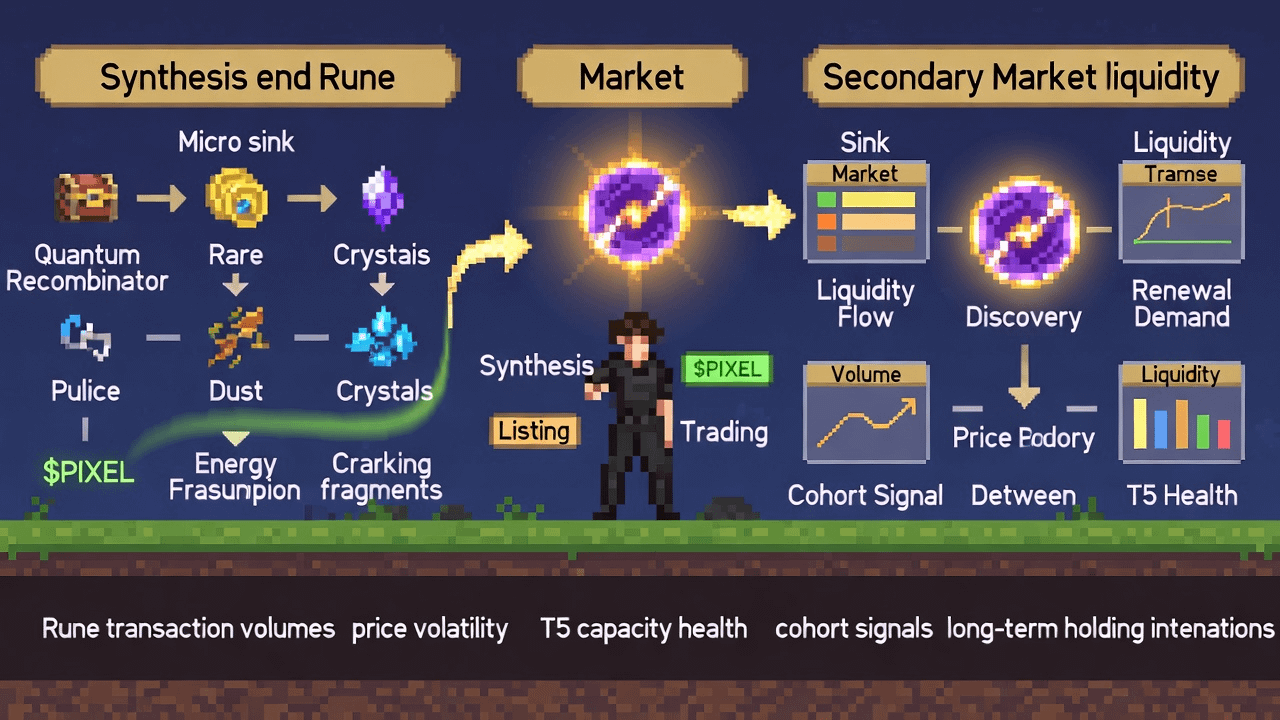
Pixels has miniaturized this model to the Rune level: the synthesis side consumes T5 exclusive materials, while the trading side creates a match between buyers and sellers, forming a price discovery mechanism.
The pricing of Rune in the market itself reflects the immediate supply and demand of T5 capacity—when renewal demand is high, Rune prices rise, further incentivizing high-level players to synthesize and sell, forming a self-reinforcing cycle.
The dual sink effect—synthesizing Rune requires consuming rare materials produced by the deconstruction system, indirectly locking $PIXEL's circulation speed in the crafting chain; secondary market trades incur gas costs and create friction, injecting additional liquidity into the ecosystem rather than solely relying on the team's unlocked sell orders for hedging. More importantly, it reduces unlocked sell pressure, as players trade Rune for renewal, with $PIXEL often being consumed indirectly as a pricing benchmark or bridging asset.
By comparing with the item-binding designs of traditional games, we can see that this flywheel avoids the trap of losing players due to excessive taxation.
Through tradability, the Preservation Rune converts maintenance costs into divisible, circulating value.
Low-willingness landholders can choose not to renew and sell Rune for profit, while high-willingness players can access T5 capacity at low cost.
This divisibility perfectly reflects Hayek's 'dispersed knowledge' theory: the market allocates resources more efficiently than central planners.
Stacked AI only needs to observe Rune trading volume and price volatility to map the health of the entire ecosystem's T5 capacity in real-time.
Renewal behavior as a high-value signal: the practice of game theory and signaling theory.
I believe the players' renewal behavior itself is a high-value signal!!!
In game theory, Michael Spence's signaling theory states that in an information-asymmetric environment, high-quality participants will send unforgeable signals through high-cost actions. The renewal Rune is such an action—Level 30+ threshold + material consumption + 30-day cycle, making for a very high signal cost.
Only cohorts that truly believe in the long-term value of the land will continue to pay. This signal far exceeds traditional 'active duration' or 'task completion rate', which can easily be farmed by bots.
The economists' model of Stacked AI has thus gained unprecedented accuracy. It can capture in real-time:
Cohort stratification: high renewal rate cohort vs low renewal rate cohort. The former shows higher LTV, while the latter gets naturally filtered out.
Behavior prediction: the match between renewal frequency and the $PIXEL reward window. AI can dynamically adjust the next batch of rewards based on this—prioritizing high-signal cohorts for Union boosts, staking perks, or industry buffs, maximizing ROI while minimizing inflation.
Macroeconomic mapping: the overall network's Rune renewal rate becomes a leading indicator of $PIXEL's health. Rising renewal rates → AI predicts rising demand → early optimization of the reward curve to avoid sell pressure peaks.
This signal mechanism addresses the 'principal-agent problem' in Web3 games: teams struggle to monitor players' true intentions.
Now, renewal behavior becomes the perfect proxy variable; the AI can anonymize collection, modeling, and prediction through a line of SDK.
Micro sinks and sell pressure hedging from the perspective of token economics: a practice of sustainable economics.
From the perspective of the $PIXEL token, the Preservation Rune constructs multiple points of reflection on token economics.
Micro sink: synthesizing materials indirectly consumes $PIXEL, locking the circulation speed.
Sell pressure hedging: Rune trading creates buy pressure, as players renew rather than sell tokens.
Demand anchoring: T5 capacity relies on Rune, and landholders continuously create underlying demand for $PIXEL.
This design practices the core theory of 'sustainable tokenomics'—supply-side control must dynamically match with demand-side.
In the past, we relied on external marketing; now, an internal closed loop can balance things out.
The scaling effect of the Rune flywheel will further reduce the team's reliance on the treasury, achieving true decentralized governance.
In the pixel world's land, the Preservation Rune is no longer just an item but a manifestation of mechanism design philosophy.
It reminds us—sustainable economics is never about eliminating costs but about making costs speak, letting signals flow, and letting AI guard, as players are willing to continuously pay for really valuable assets, and AI can transform this willingness into the eternal drive of the ecosystem.
*Disclaimer: This article is personal analysis and does not constitute investment advice. DYOR.