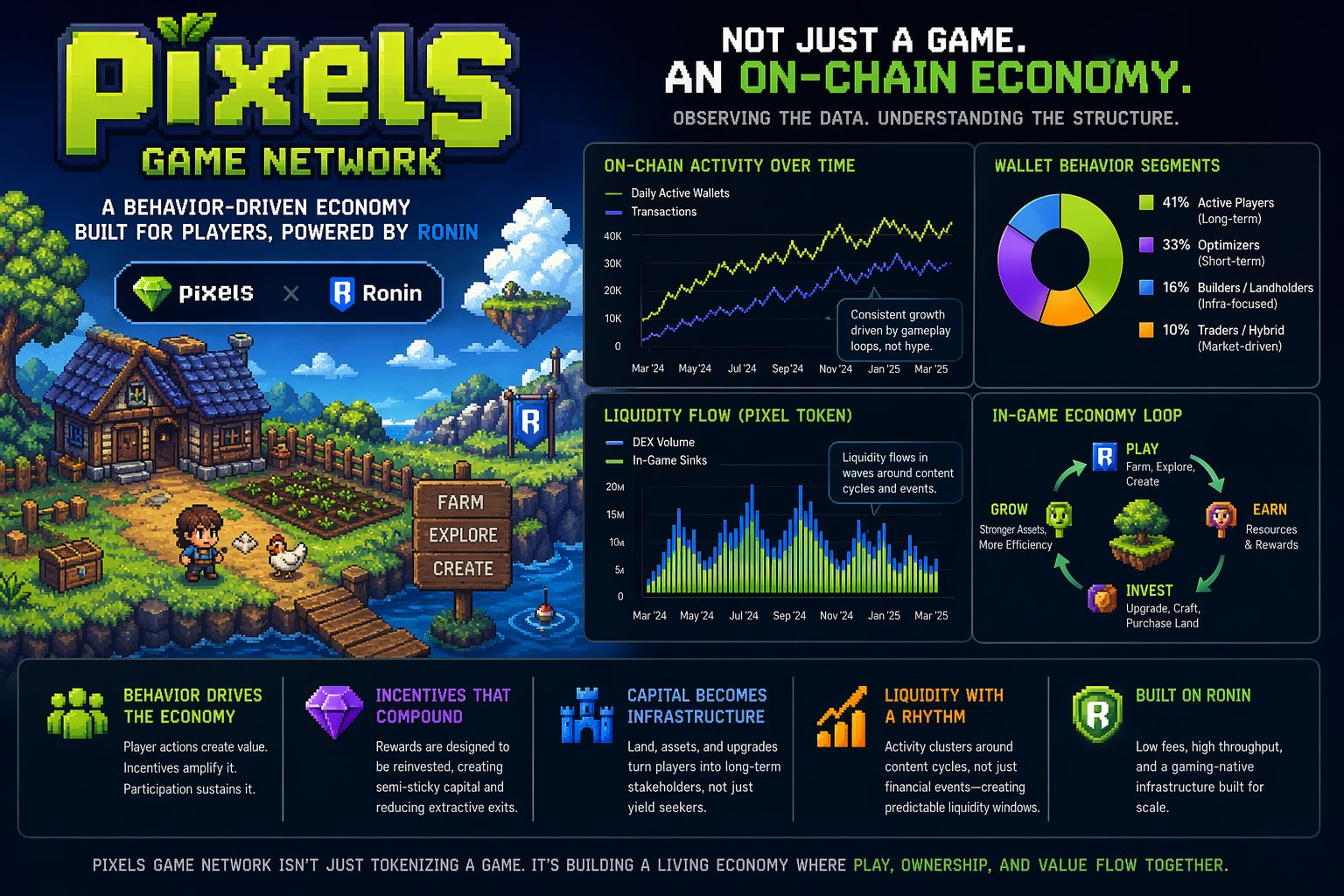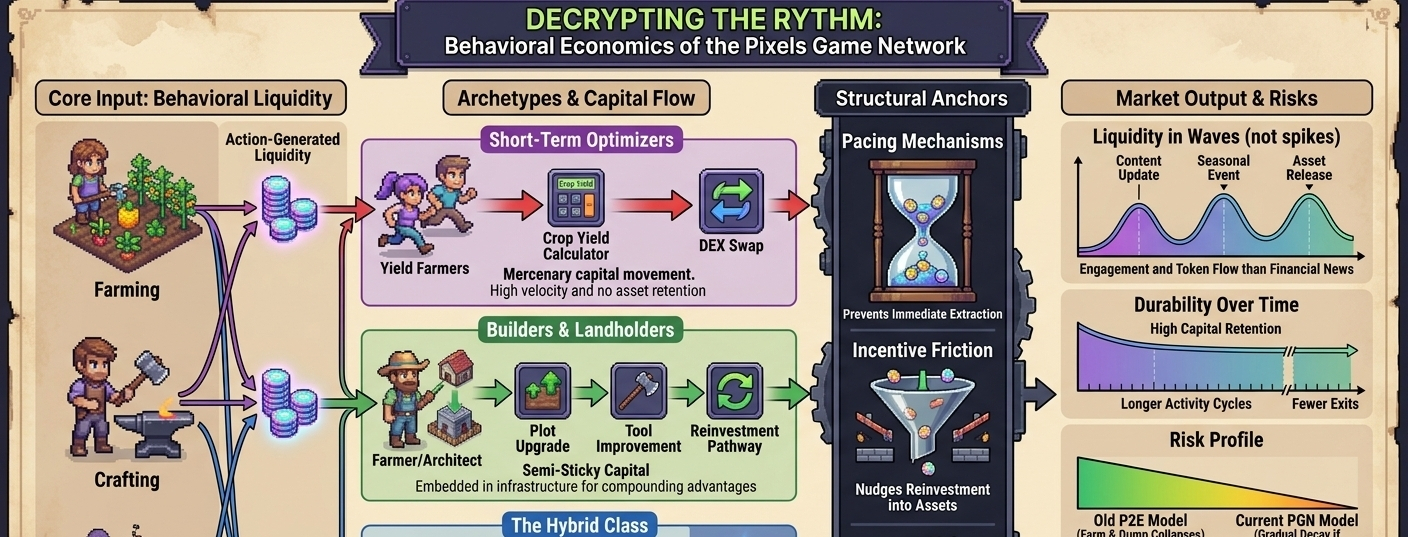
The first thing I noticed when I started tracking activity around the Pixels Game Network wasn’t raw volume or token velocityit was the rhythm. Not the kind you see in speculative ecosystems where activity spikes around listings or macro news, but something more cyclical, almost behavioral. Wallet interactions weren’t random; they clustered around ingame loopsfarming, crafting, land managementand then expanded outward into token movement. That distinction matters. It tells me immediately that liquidity here isn’t just reacting to priceit’s being generated by participation.
When you watch this long enough, patterns begin to separate participants into clear archetypes. You have the short-term optimizersplayers who behave like yield farmers, rotating time and capital toward whatever in-game activity maximizes output. They’re efficient, but not loyal. Then there are the builders and landholders, who treat the system more like infrastructure. Their capital isn’t just deployedit’s embedded. They upgrade assets, reinvest earnings, and accept slower returns in exchange for compounding advantages. And then there’s a hybrid class I find particularly interesting: players who gradually become traders, and traders who slowly become players. That overlap is where most of the meaningful liquidity sits.
What this reveals is that the Pixels Game Network isn’t purely financialized, but it’s not insulated from markets either. It exists in a middle layer where behavior drives economics. That’s a subtle but powerful distinction. In most token ecosystems, usage follows incentives. Here, incentives are wrapped inside usage itself. You don’t just allocate capitalyou perform actions that create economic output. That changes how people think about participation. It slows things down.
The incentive design is doing more work than it initially appears. At a surface level, it looks like a typical play-toearn loopresources in, rewards out. But when you break it down, the pacing of rewards and the reinvestment pathways introduce friction. That friction is critical. It prevents immediate extraction. Players are constantly nudged to convert earnings into assetsland, tools, upgradeswhich effectively recycles liquidity back into the system.
This creates a form of semisticky capital. Not fully locked, but not freely mobile either. In traditional DeFi, capital moves at the speed of APY changes. Here, it moves at the speed of player decisions. That’s slower, more deliberate, and often less reactive to market noise. It also means liquidity durability increasesnot because of hard locks, but because exiting the system requires giving up productive capacity.
From a structural standpoint, this shifts the balance between mercenary and committed capital. The network doesn’t eliminate mercenary behavior, but it dilutes its impact. Fast capital can enter, optimize, and leavebut it doesn’t dominate the system unless incentives are heavily skewed. The baseline activity remains anchored by participants who are economically intertwined with the game loop.
When I look at the microstructure, I see liquidity moving in waves rather than spikes. Activity tends to cluster around in-game eventsupdates, seasonal mechanics, or new asset releasesrather than purely financial triggers. That creates predictable windows where both engagement and token flow increase simultaneously. It’s not the same as unlock-driven volatility or governance-driven speculation. It’s closer to an internal economy expanding and contracting based on content cycles.
This has implications for traders. If you’re only watching price charts, you miss the lead indicators. The real signals show up in player behavior firstwallet activity tied to crafting loops, resource accumulation rates, asset upgrades. By the time that translates into token movement, the opportunity is already partially priced in. It’s a different kind of edgeone that comes from understanding how people play, not just how they trade.
Comparing this to previous cycles, most play-to-earn systems failed because they optimized for extraction. Emissions were high, friction was low, and users behaved exactly as expectedfarm and dump. The Pixels Game Network takes a different approach by embedding economic value inside time and effort. That doesn’t guarantee sustainability, but it does change the failure mode. Instead of collapsing quickly under sell pressure, the system risks gradual decay if participation slows.
That brings me to the long-term question: does this design create a durable economic layer, or is it still dependent on continuous incentive expansion?
Right now, I’d say it sits somewhere in between. The internal economy has enough depth to sustain activity beyond pure speculation, but it’s still sensitive to reward compression. If emissions decrease or returns diminish, the system will be tested. The key variable will be whether players continue to engage without immediate financial upside. If they do, the network transitions from incentive-driven to behavior-driven. If they don’t, liquidity will slowly bleed out rather than exit all at once.
What I find underappreciated is how the network conditions user behavior over time. It subtly shifts participants from extractive mindsets to constructive ones. Not completely, but enough to change aggregate outcomes. That’s not something you can easily model, but you can observe it in how wallets evolveless frequent exits, more reinvestment, longer activity cycles.
From a market perspective, this creates a different kind of risk profile. It’s less about sudden collapses and more about momentum loss. Liquidity doesn’t disappear overnightit fades as engagement declines. That makes it harder to trade, but easier to analyze if you’re paying attention to the right metrics.
If there’s one thing I think the market is underestimating, it’s how powerful behavioral liquidity can be when it’s properly structured. Most systems try to attract capital. The Pixels Game Network, whether intentionally or not, is shaping how that capital behaves once it arrives. And in the long run, that might matter more than the size of the capital itself