
Here’s a fresh take on the same idea—different tone, tighter framing, and a slightly more direct angle:
---
Most games treat time like it doesn’t really matter.
You log in, do something repetitive, log out. Tomorrow you do it again. Nothing carries real weight. Time spent in one activity doesn’t translate cleanly into another, so everything exists in its own little bubble.
That’s normal.
What’s not normal is when a game quietly starts connecting those bubbles.
That’s the feeling I kept getting while playing Pixels.
At first, it looks familiar—basic loops, predictable progression, nothing that stands out. But after a while, something shifts. You start comparing things that usually aren’t comparable. Waiting versus crafting. Farming versus progressing. Skipping versus grinding.
And without realizing it, you begin assigning value to your time.
Not emotionally—mechanically.
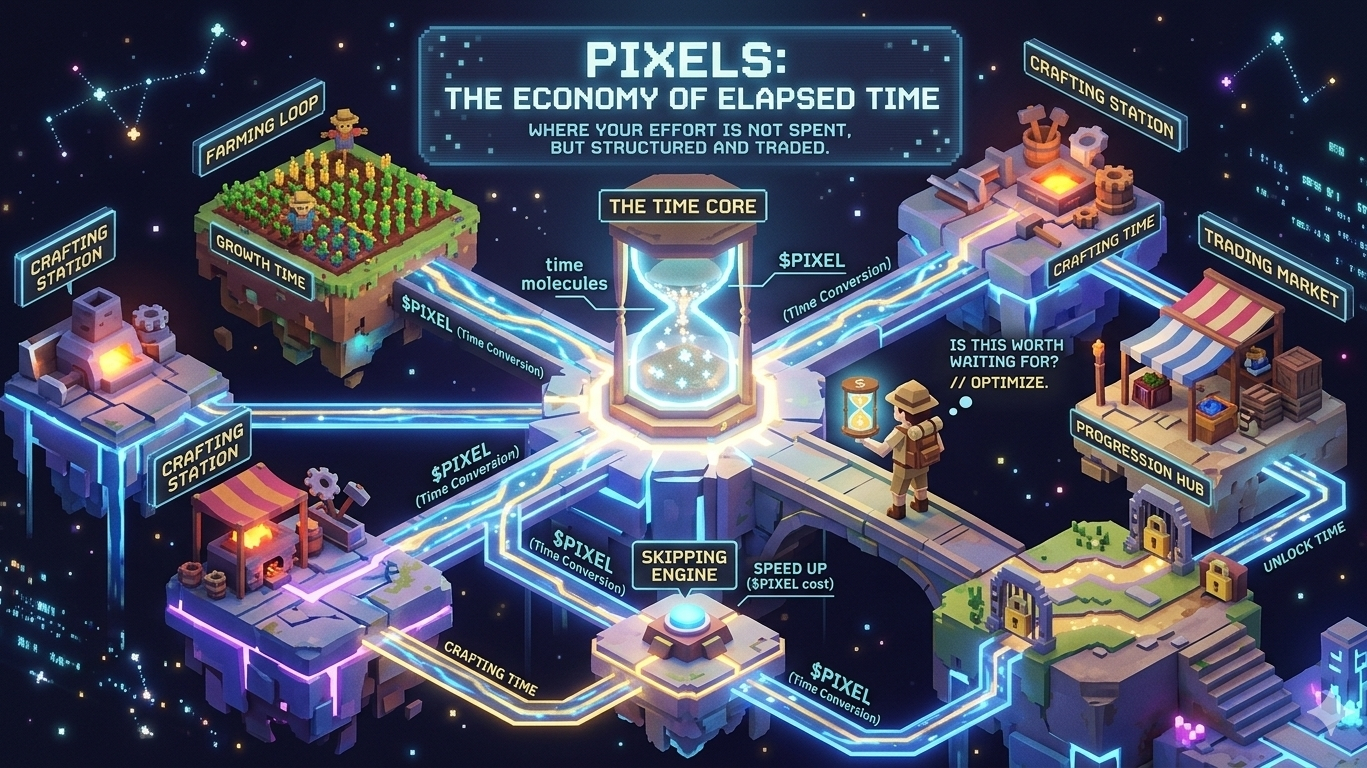
That’s where $PIXEL becomes more than just a reward token. It starts acting like a conversion layer. A way to translate time across different parts of the game.
“Is this worth waiting for?”
“Should I speed this up?”
“Am I using my time efficiently?”
Those questions don’t belong to traditional gameplay. They belong to systems where time is structured, not just spent.
$PIXEL doesn’t force that mindset. It nudges you into it.
Small delays. Minor friction. Nothing overwhelming. But enough that you start noticing patterns. Enough that doing nothing has a cost, even if it’s invisible.
And once that clicks, the game changes.
You’re no longer just choosing what to do—you’re choosing how to allocate your time.
That creates a different kind of economy.
Two players can spend the same number of hours, but end up with completely different outcomes depending on how they navigate those decisions. Not because one worked harder, but because one “priced” their time differently.
That’s a subtle but important shift.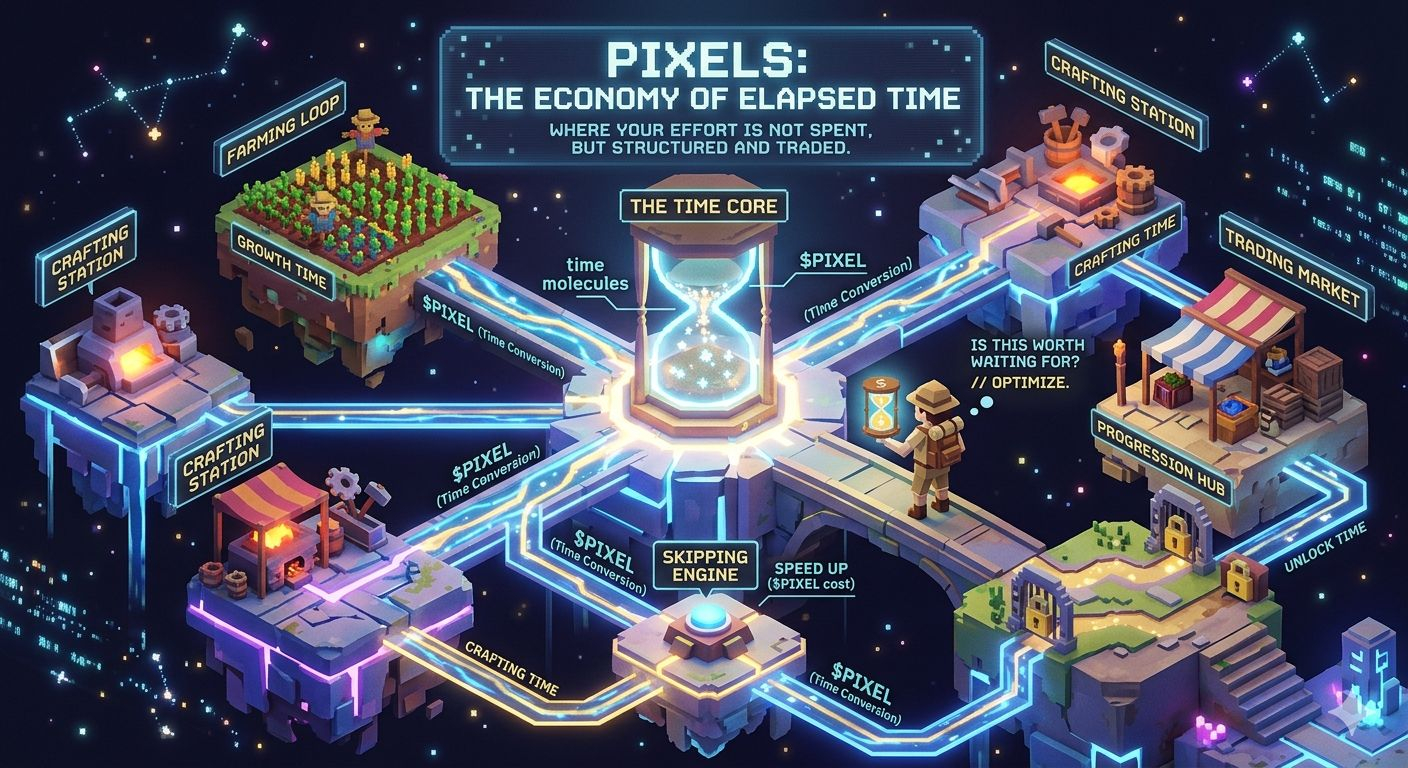
It also introduces risk.
Because when time becomes measurable, players will optimize it. They’ll find the fastest loops, the best returns, the least resistance. Over time, variety shrinks and efficiency takes over.
We’ve seen that pattern everywhere—games, markets, even real-world systems.
And then comes the bigger question:
Is the friction part of the world… or part of the design?
Players might not ask it immediately. But once they start seeing time as something shaped rather than natural, the question sticks.
Pixels sits right in that tension.
It’s not just building a game loop. It’s experimenting with how time behaves inside a system—and how players respond when that time becomes comparable, tradable, and adjustable.
That’s the interesting part.
Because if this model holds, it’s not just about one game. It’s about a broader idea: what if effort itself could move across systems, the same way assets do?
That’s still uncertain.
But one thing feels clear—
Pixels isn’t really chan
ging what you earn.
It’s changing how your time gets interpreted.
