
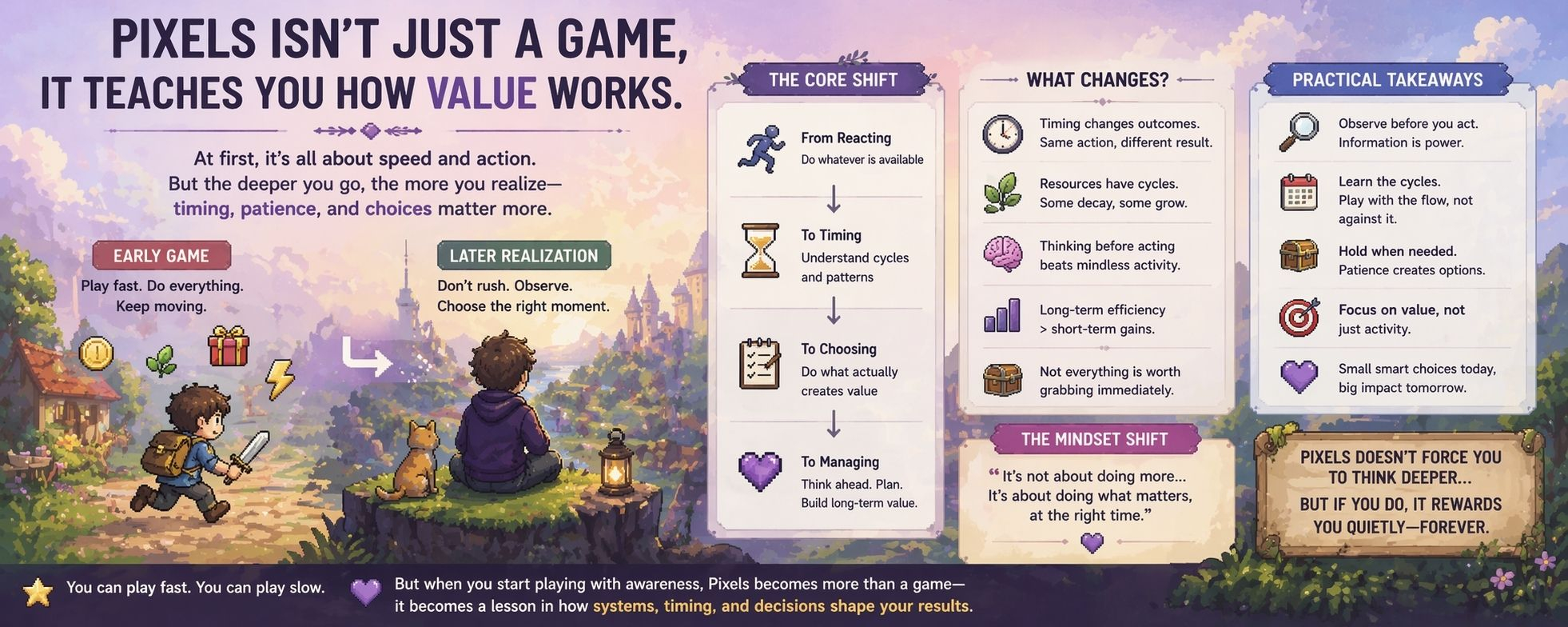
@Pixels At the beginning, I thought the best way to play Pixels was to stay as active as possible. The more I clicked, the more I completed, the more I used everything felt like progress. It created this constant sense of movement, like I was always getting somewhere. Logging in meant doing things quickly, clearing whatever was available, and making sure nothing stayed idle for too long. It felt efficient, and for a while, I didn’t question it.
But slowly, that idea started to feel incomplete. Not wrong just not enough. I began to notice small moments where being fast didn’t actually give me the best outcome. I would use something immediately, thinking I was being productive, only to realize later that waiting could have made it more valuable. These weren’t big mistakes, just quiet realizations that started to repeat themselves.
That’s when my focus shifted, almost without me deciding it. I stopped measuring my gameplay by how much I could do in one go. Instead, I started paying attention to what my actions were actually leading to. It wasn’t about finishing everything anymore—it was about whether those actions made sense in the bigger flow of the game.
Pixels doesn’t openly tell you this, and that’s what makes it interesting. It doesn’t force you to slow down or think deeper. You can keep playing quickly and still feel like you’re progressing. But if you spend enough time, you begin to see patterns. You realize that resources aren’t just meant to be used they’re meant to be timed. That some decisions close off better options later, even if they feel right in the moment.
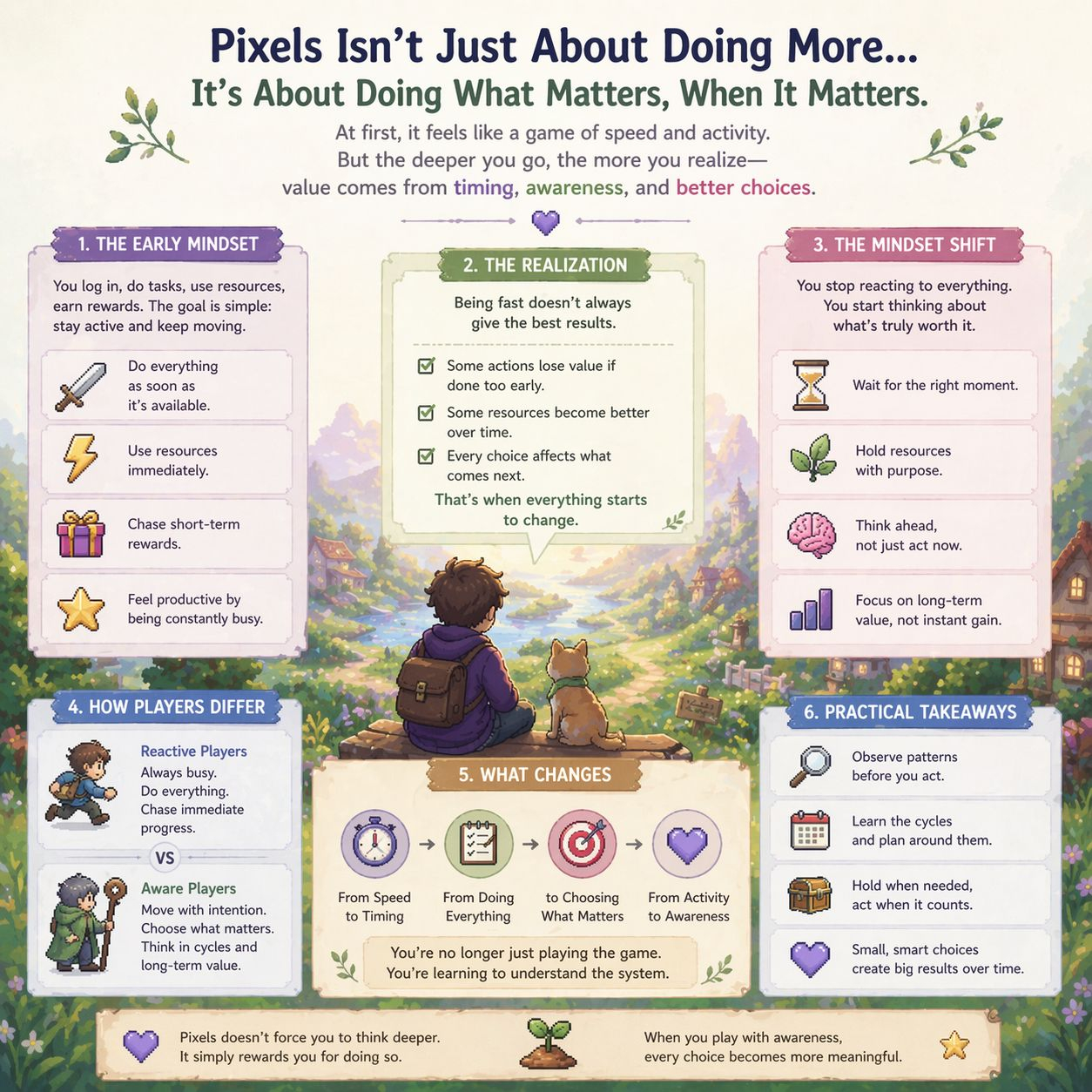
This is where the experience starts to change. You’re no longer just reacting to what’s in front of you. You’re thinking about what comes next. You start leaving things unfinished on purpose. You hold onto resources, not because you forgot, but because you’re waiting for the right moment. Even skipping something starts to feel like a smart decision instead of a missed opportunity.
Watching other players made this even clearer to me. Some continue to move quickly, doing everything they can as soon as it appears. It looks active, productive, and satisfying. But others move differently. They’re slower, more deliberate, almost selective. They don’t treat every action as necessary. Instead, they treat each one as a choice.
That difference isn’t about who is playing more it’s about who is understanding more. #Pixels quietly shifts from being a game of activity to a game of awareness. It doesn’t remove the option to play casually, but it adds a layer where thinking becomes more valuable than speed.
And that’s where it starts to feel different from most games. Because instead of pushing you to do more, it slowly teaches you to do less but with intention. It introduces the idea that timing can be more important than effort, and that not every opportunity needs to be taken immediately.
At that point, playing doesn’t feel as automatic anymore. There’s space between actions. Small pauses where you think, reconsider, and sometimes decide to wait. It’s subtle, but it changes everything. The game is still the same on the surface, but your relationship with it isn’t.
And maybe that’s the real shift. Not in the mechanics, not in the system but in how you start seeing it. Pixels doesn’t suddenly become complex. You just stop playing it blindly and start understanding how it works.
And once that happens, it’s hard to go back to just playing without thinking.