
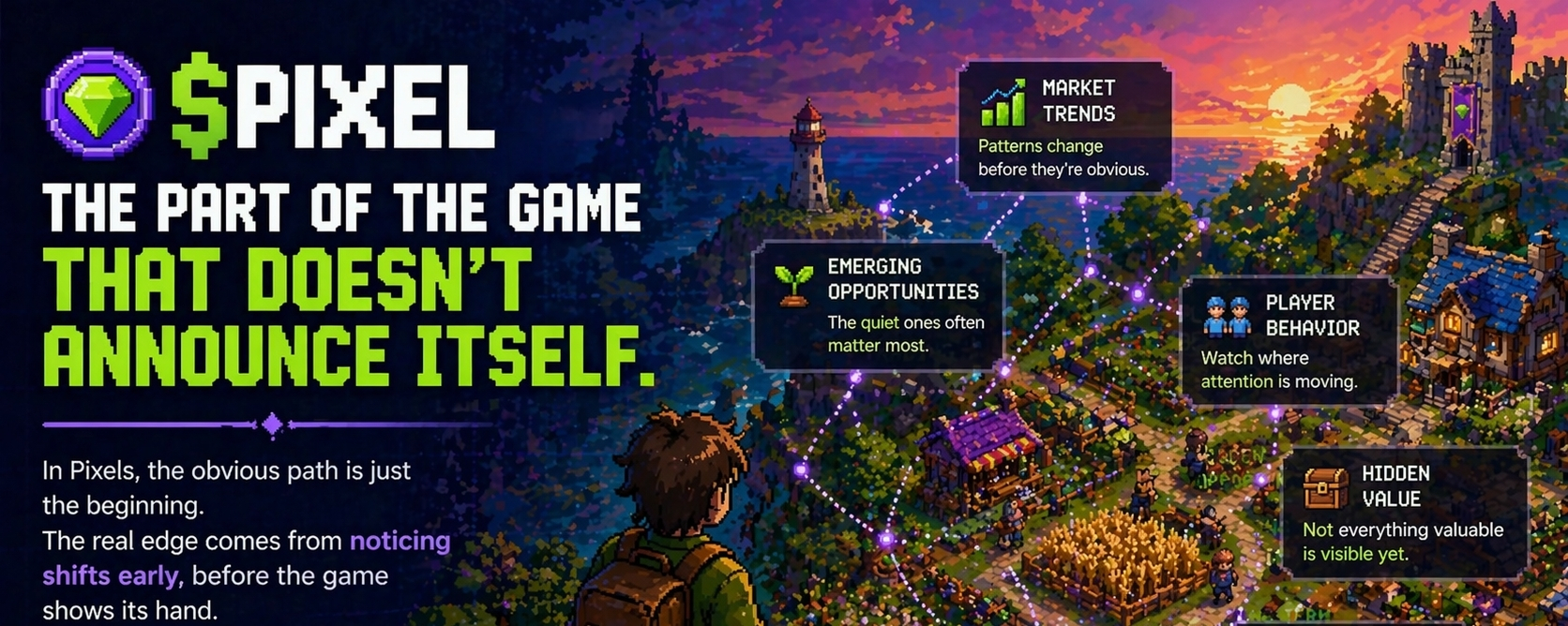
There’s a point in Pixels where things stop being obvious.
In the beginning, it feels simple. You follow the loops, stay consistent, and see results. It gives you that familiar sense that progress is something you can control directly. Do the work, get the reward. It’s clean, predictable, and easy to trust.
But that clarity doesn’t last forever.
After some time, you start noticing small inconsistencies. Nothing dramatic, just enough to feel like the system isn’t as straightforward as it first appeared. You repeat something that worked before, and it feels slightly weaker. You try something new, and it doesn’t immediately pay off—but it doesn’t feel wrong either.
That’s usually when the game begins to reveal a different layer.
Because beneath the visible loops, there’s something quieter happening. The system is shifting in small ways, shaped by player behavior, timing, and attention. And those shifts don’t come with announcements. They don’t tell you what matters now or what’s starting to lose relevance. You only feel it indirectly, through outcomes that don’t quite match your expectations.
That’s where $PIXEL starts to feel less like a simple reward and more like a kind of feedback.
Not immediate feedback, but delayed. Subtle. Sometimes even unclear.
You make a decision today, but its importance might not show up until much later. And when it does, it doesn’t always point back to a single action. It reflects a series of choices, a direction you leaned into without fully knowing where it would lead.
That delay can be frustrating at first.
It removes the comfort of certainty. You can’t always tell if you’re on the right path. You can’t rely entirely on what worked yesterday. And there’s no clear signal telling you when to switch or stay.
But over time, something changes.
You stop looking for immediate confirmation and start paying attention differently. You notice patterns in how players move, what becomes crowded, what quietly fades, and what begins to attract interest before it’s obvious. You start asking questions that don’t have clean answers, but still shape your decisions.
And slowly, the game begins to feel less like repetition and more like awareness.
You’re not just playing through systems anymore. You’re reading them.
That’s a different kind of skill.
It’s less about speed or output, and more about timing. Less about doing more, and more about noticing sooner. You begin to understand that being slightly early often matters more than being perfectly efficient.
And that’s where things become interesting.
Because when enough players recognize the same opportunity, it changes. What once felt open becomes competitive. What looked promising becomes average. The system adapts—not instantly, but enough that you can feel the shift if you’re paying attention.
So progress starts to feel uneven, not because it’s random, but because it’s tied to alignment.
Sometimes you move forward quickly, and sometimes you stall. Not always because of effort, but because of when you made certain choices and how they fit into what the system was becoming.
In that sense, $PIXEL doesn’t just measure what you’ve done.
It reflects how well you moved with something that was already changing.
And maybe that’s why the most important part of the game isn’t clearly visible.
It doesn’t sit in the mechanics or the loops themselves.
It sits in the space between them.
In the moments where you decide whether to follow what’s obvious or trust something that hasn’t fully revealed itself yet.
That part doesn’t announce itself.
But once you notice it, you start playing differently.
