
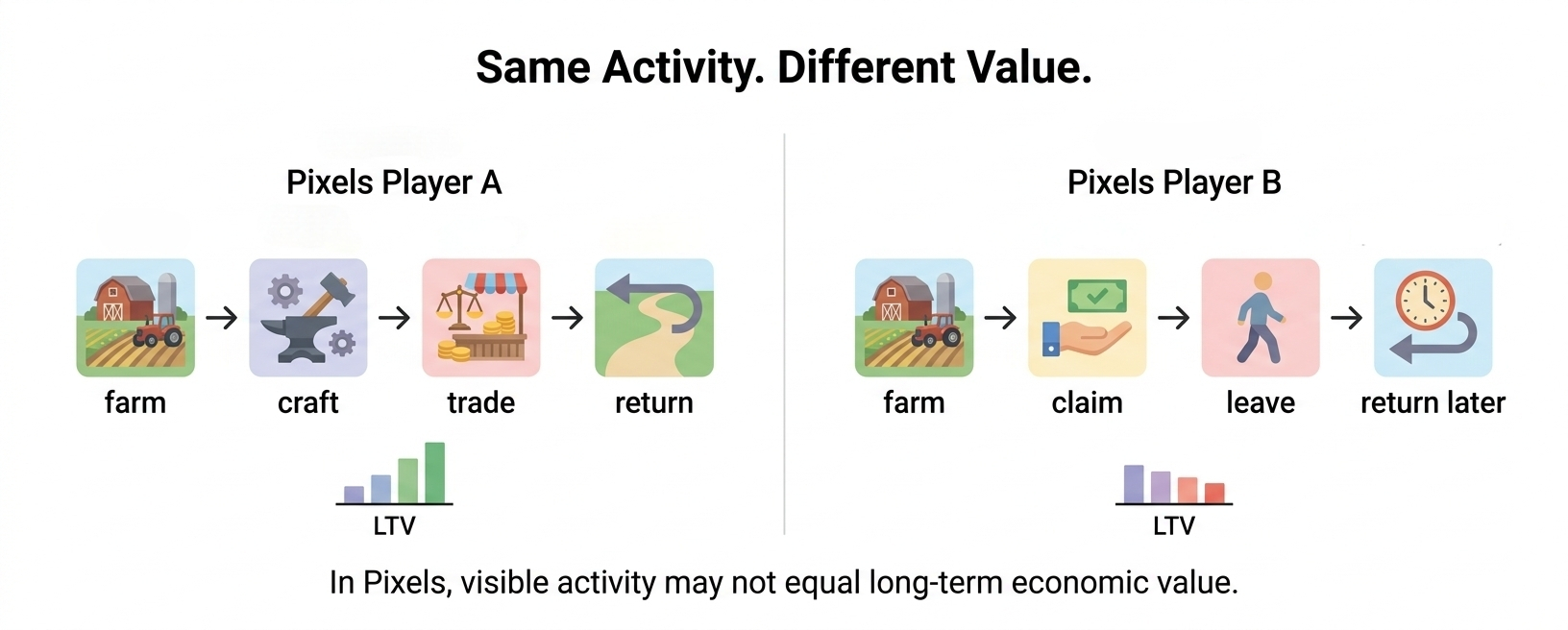

Two players I watched in Pixels were hitting almost the same loops.
Same kind of farming routes.
Same time around the Task Board.
Same session frequency, at least from what I could see.
But the outcomes never felt the same.
One kept finding decent $PIXEL windows.
The other looked busy constantly, yet seemed to connect less and less over time.
I noticed it once and ignored it.
Then again.
Then enough times that “random luck” stopped explaining much.
Something seemed to separate them.
Not loudly.
Quietly. Repeatedly.
I kept coming back to one word from the Stacked material that most people skim past.
LTV.
Lifetime value.
Not just retention.
Not just activity.
Not just showing up every day.
Value over time.
Two players can log in equally often and still mean very different things to an economy.
One farms, crafts, trades, creates demand for items other players make, and keeps participating when rewards look average.
Another farms only the best windows, extracts, disappears, then returns when conditions improve.
From the outside, both can look active.
Underneath, they may not be building the same thing at all.
If Stacked is measuring LTV, and its public descriptions place it beside retention and revenue, then the system may not only care that you returned.
It may care how you return.
What you contribute when margins are thin.
Whether you participate only when conditions are ideal.
Whether you help keep the loop alive when nothing flashy is happening.
Not because anyone is being punished.
Because treating every footprint the same probably breaks the economy eventually.
A player who repeatedly extracts leaves a different mark than one who compounds inside the system for months.
Reward both identically forever, and one side usually drains more than it builds.
That’s where the idea changed how I look at Pixels.
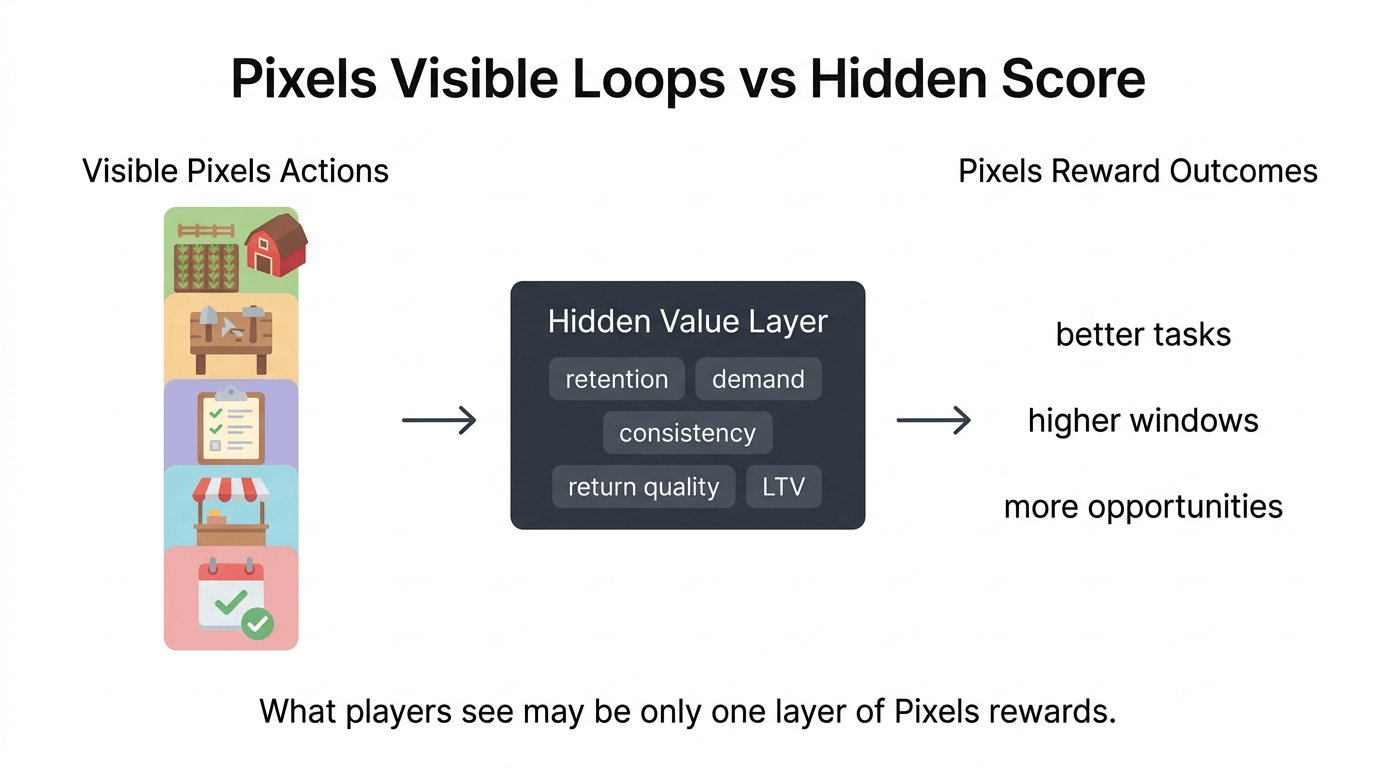
Two players doing the same loop today may not be standing inside the same economic version of the game.
One may keep seeing better Task Board opportunities.
One may reach stronger reward windows more often.
One may simply be carrying more trust built from older sessions.
Not because they played better today.
Because previous behavior may still be echoing underneath today’s session.
I can’t confirm that’s exactly how it works.
But it explains more than most session-by-session theories I’ve heard.
And it changes what optimization might really mean.
Maybe the most important sessions aren’t the profitable ones.
Maybe they’re the forgettable ones.
The nights you still log in when rewards look thin.
The sessions where you craft anyway.
The days you add demand instead of only taking value.
None of that looks impressive once.
Across months, it may look very different.
I keep thinking of that as the LTV gap.
The invisible distance between players who look similar today, but may be worth very different things tomorrow.
$PIXEL sits differently inside that frame.
If durable demand comes from players who stay, build, trade, and keep participating, not just farm and leave, then token health isn't only emissions.
It's also allocation.
Who receives rewards.
And what they do after.
$PIXEL only matters long term if rewards keep reaching players who strengthen the economy after touching them.
Not just the loudest accounts.
Not just the busiest wallets.
The part I still can’t answer is whether players can ever see their own LTV profile.
Or whether the system knows long before they do.
That possibility changed how I judge certain sessions.
Usually the quiet ones.
Usually the ones that looked pointless.
Those ones.