
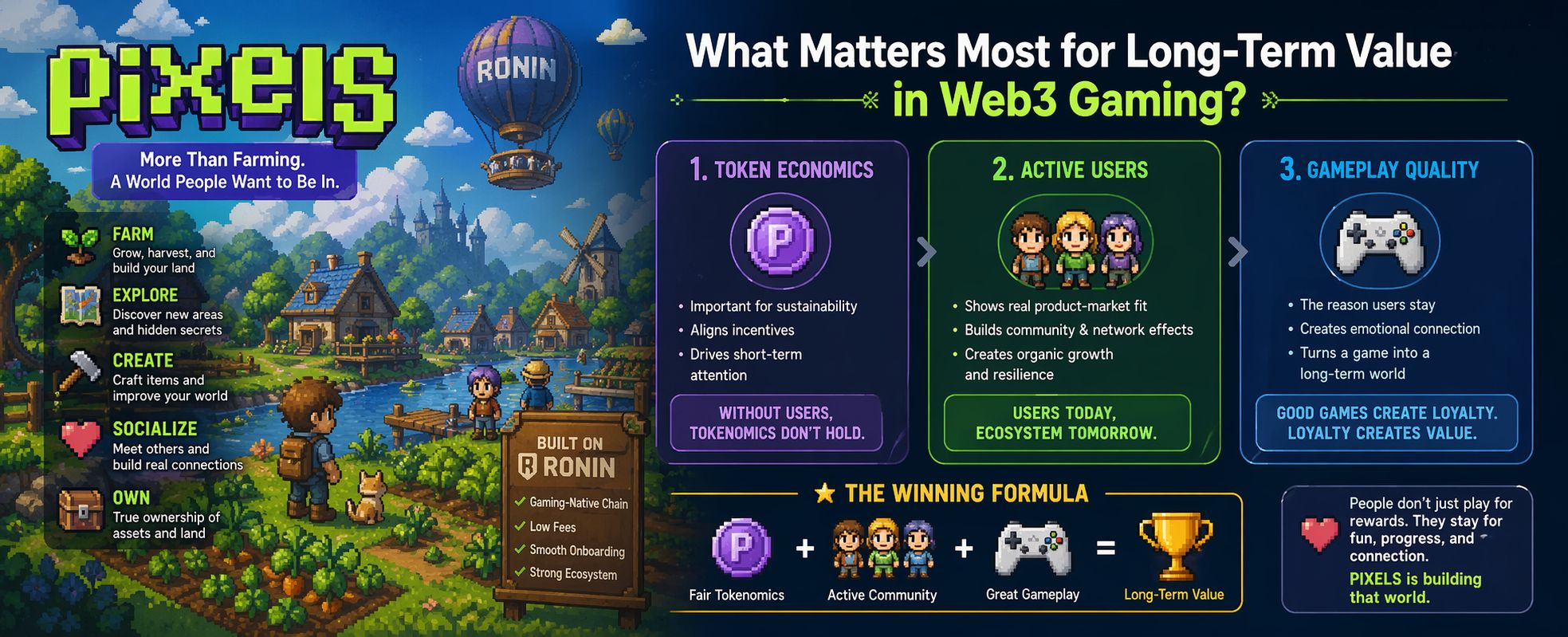

@Pixels They ask one question only: Can the token pump?
But sometimes the more important question is: Can people actually enjoy spending time there even when price is quiet?
That’s where I think many are missing the bigger picture with #Pixels .
Pixels is often introduced as a farming game on the Ronin Network, but reducing it to that misses what makes it interesting. It is an open-world social game built around farming, exploration, resource gathering, and creation. That sounds simple on paper. But in crypto, simple products that people return to daily can become stronger than complicated products nobody uses.
I’ve watched many Web3 projects launch with huge promises, deep tokenomics charts, and aggressive marketing. They trend for a few weeks, then activity fades because users came for speculation, not for experience. That cycle is common now. Attention comes fast, then disappears faster.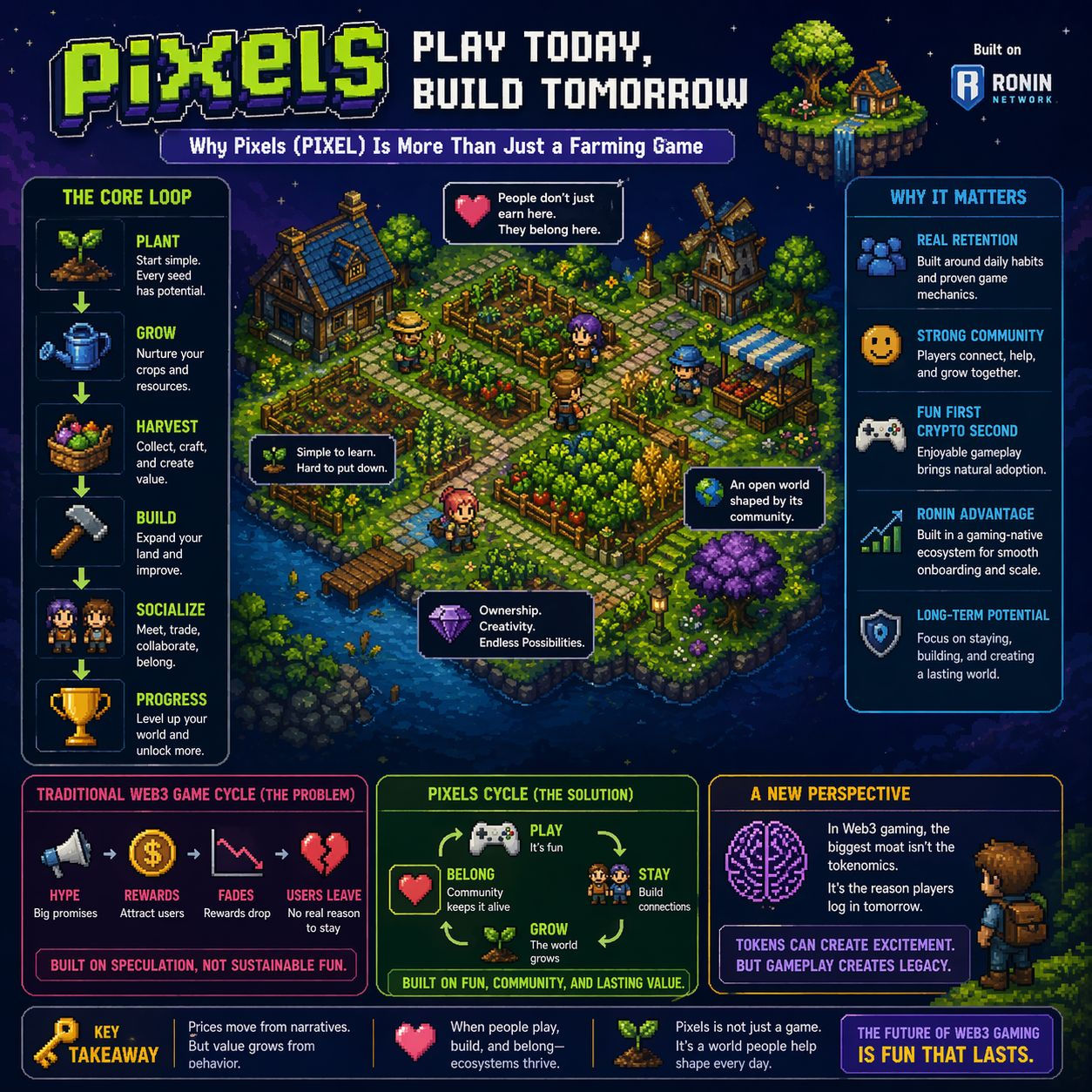
Pixels feels different because it leans into behavior that already works in traditional gaming: routine, progression, social interaction, and ownership layered into gameplay.
That matters more than many realize.
A lot of traders underestimate daily habit loops. If a user opens a platform every day to plant crops, collect resources, build, meet others, or improve land, they are not just “using an app.” They are building emotional connection and time investment. In markets, time spent often becomes loyalty. Loyalty can become community. Community can become resilience during weak sentiment periods.
That is where many average participants get it wrong.
The average crowd waits until charts go vertical, then starts asking what the project does. By then, attention is crowded and risk is higher. Smarter users usually spend time earlier understanding where real user activity comes from. They watch retention, community behavior, game loops, ecosystem fit, and whether users return voluntarily.
Price can move from narratives.
But durable ecosystems usually grow from repeat behavior.
Pixels being on Ronin is another detail worth paying attention to.
Ronin already built a reputation around gaming infrastructure. In crypto, distribution and environment matter. A decent project in the wrong ecosystem can struggle. A strong project in a gaming-native environment often gets better user alignment, better wallet familiarity, and smoother onboarding. That reduces friction, and friction is one of the biggest killers of Web3 adoption.
Many outsiders think onboarding is just making an account. It’s not.
Onboarding is:
Can users understand the product quickly?
Can they start without confusion?
Can they enjoy the first session?
Do they want to return tomorrow?
If those answers are weak, token incentives usually become temporary glue.
Pixels seems to understand that games need reasons to come back beyond rewards. Farming systems, land interaction, exploration, crafting-style progression, and social layers are proven mechanics because they tap into something basic: people like building things over time.
That’s why casual games can become powerful. They don’t need everyone to become a hardcore gamer. They only need consistent participation from normal users.
And honestly, that model may fit Web3 better than many expected.
Not every crypto user wants complex DeFi dashboards or advanced trading tools. Some users simply want entertainment with ownership upside attached. If the experience is fun first and crypto second, adoption becomes more natural.
I’ve noticed something across markets: products that hide complexity often outperform products that advertise complexity.
People say they want innovation, but behavior shows they want ease.
Pixels has a chance in that area because farming, collecting, upgrading, and social progression are instantly understandable. You don’t need a whitepaper to know why growing something, expanding something, or improving something feels rewarding.
That creates another subtle advantage: shareability.
Games with visible progress often spread through communities faster because users naturally show achievements, land setups, strategies, rare items, or progress milestones. That creates organic marketing. Organic attention is usually stronger than paid noise because it carries social proof.
Now, does that mean every gaming token automatically wins? Of course not.
Web3 gaming remains competitive. Retention must stay strong. Content must evolve. Economies need balance. Rewards systems must avoid becoming extraction-only models. If players feel like workers instead of players, interest can drop fast.
That’s why Pixels should be judged less by short-term token excitement and more by whether players genuinely enjoy being there months later.
Maybe I’m wrong, but I think too many market participants still underestimate entertainment value as an economic moat.
We often overrate complexity and underrate fun.
A protocol with ten technical layers may impress analysts.
A game people open daily may quietly outperform expectations.
That’s especially relevant in current market conditions where attention rotates quickly. Tokens with no user base depend heavily on sentiment cycles. Projects with communities doing something inside the ecosystem have another support layer: active participants.
Even from a trader perspective, this matters.
When sentiment returns, capital often looks for narratives with recognizable communities, accessible products, and visible usage. Gaming tokens with active ecosystems can benefit because they are easier for new users to understand than niche infrastructure plays.
“People play it” is a simpler story than many realize.
Personally, I also think Pixels represents something bigger than one game. It reflects a shift from first-generation Web3 gaming ideas focused mainly on earning, toward second-generation models focused more on staying, building, socializing, and enjoying.
That shift is healthy.
Because if users only come to extract value, they leave when rewards slow down.
If users come because they like the environment, the ecosystem has stronger foundations.
So when I look at PIXEL, I don’t only think about token price. I think about behavior loops, retention quality, network fit, and whether casual gaming could onboard the next wave of crypto users more effectively than complex finance apps.
Sometimes the strongest signals are not loud candles on a chart.
Sometimes it’s thousands of people logging in again tomorrow.
What do you think matters more for long-term value in Web3 gaming now: token economics, active users, or actual gameplay quality?
