
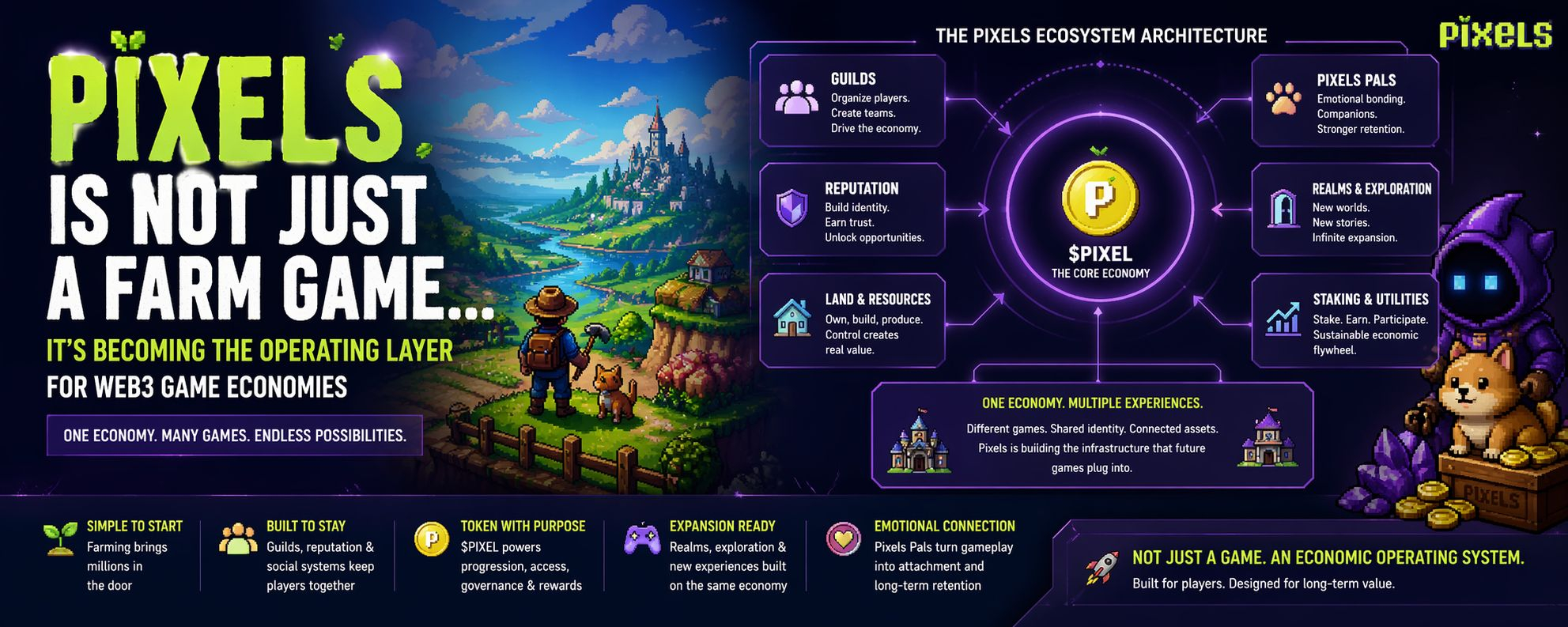
@Pixels doesn’t feel like a “normal” blockchain game anymore. At least not if you spend enough time looking past the farm loop.
On the surface, it still looks simple. Plant. Harvest. Upgrade. Repeat. A cozy MMO on Ronin. But that surface is starting to feel thin… almost like a cover for something much larger underneath.
And this is where it gets interesting.
Because Pixels is not just stacking features. It’s stacking systems.
Guilds. Land. Reputation. Staking. Exploration. Pixels Pals. Realms. Social progression. None of this feels random when you look at the official Pixels roadmap and documentation. It looks more like a design pattern. A structure being built step by step.
The farming game is just the entry point.
A controlled entry point.
Most Web3 games try to solve everything inside one loop. One economy. One token sink. One progression path. And they burn out fast. We’ve seen it across the industry. Even major blockchain gaming reports from platforms like DappRadar keep showing the same trend—short spikes in activity, then heavy drop-offs when incentives weaken.
Pixels seems to be reacting to that pattern differently.
Instead of betting everything on one loop, it is building layers.
Start with farming. Easy onboarding. No friction. Then slowly introduce deeper systems that change how players behave inside the world.
Guilds are the first real shift. Not just social groups… but coordination layers. They push players into organized production, shared goals, internal economies. Suddenly it’s not solo farming anymore. It’s structured participation.
Then comes reputation. This part is easy to underestimate, but it changes everything. Because reputation turns activity into identity. Your past actions matter. Your contribution sticks. That is closer to real online society behavior than most Web3 games ever reach.
Land systems add another layer. Ownership. Productivity. Hierarchy. Some players generate more influence just through positioning and control of resources. That mirrors real economic behavior more than gaming behavior.
And then there’s PIXEL token integration. Not just as a reward. More like a circulation layer. It moves through staking, progression, access systems, and ecosystem incentives. If you read Pixels’ official litepaper carefully, the direction is clear—the token is not meant to sit outside the game. It sits inside every loop.
That’s a big difference.
Then you see Pixels Pals. At first it looks like a side feature. But it isn’t. It’s retention design. Emotional attachment. A soft system that keeps users engaged even when grinding slows down. Most strong games eventually realize this—pure economics don’t retain users forever. Emotion does.
Realms and exploration systems push even further. This is where expansion happens without breaking the core economy. Instead of launching completely separate games, Pixels expands into new spaces connected to the same underlying system. Same identity. Same token. Same social graph.
This is where the bigger picture starts forming.
Pixels is not trying to become “a game with economy.”
It’s trying to become an economy that hosts multiple games.
That’s the shift.
If you look at current Web3 gaming trends, especially on ecosystems like Ronin (home to Axie Infinity’s expansion strategy), the direction is similar across successful projects: build retention through layered ecosystems, not single loops. Pixels fits directly into that evolution, but with its own structure.
The interesting part is how all of this connects.
Farming is the surface activity. Guilds organize people. Reputation tracks value. Land controls output. Tokens circulate incentives. Pals build attachment. Realms expand space. Each layer feeds the next one.
It starts to feel less like a game… and more like an operating system for behavior inside a digital world.
That’s the real angle most people miss.
Pixels is not competing only with other blockchain games. It is quietly positioning itself closer to infrastructure-level design. Something that future games could plug into instead of building from zero.
If that direction holds, then Pixels is not just scaling content.
It is scaling structure.
And that’s a very different type of growth.
Because content can fade.
But systems… once adopted, they tend to stay.#pixel