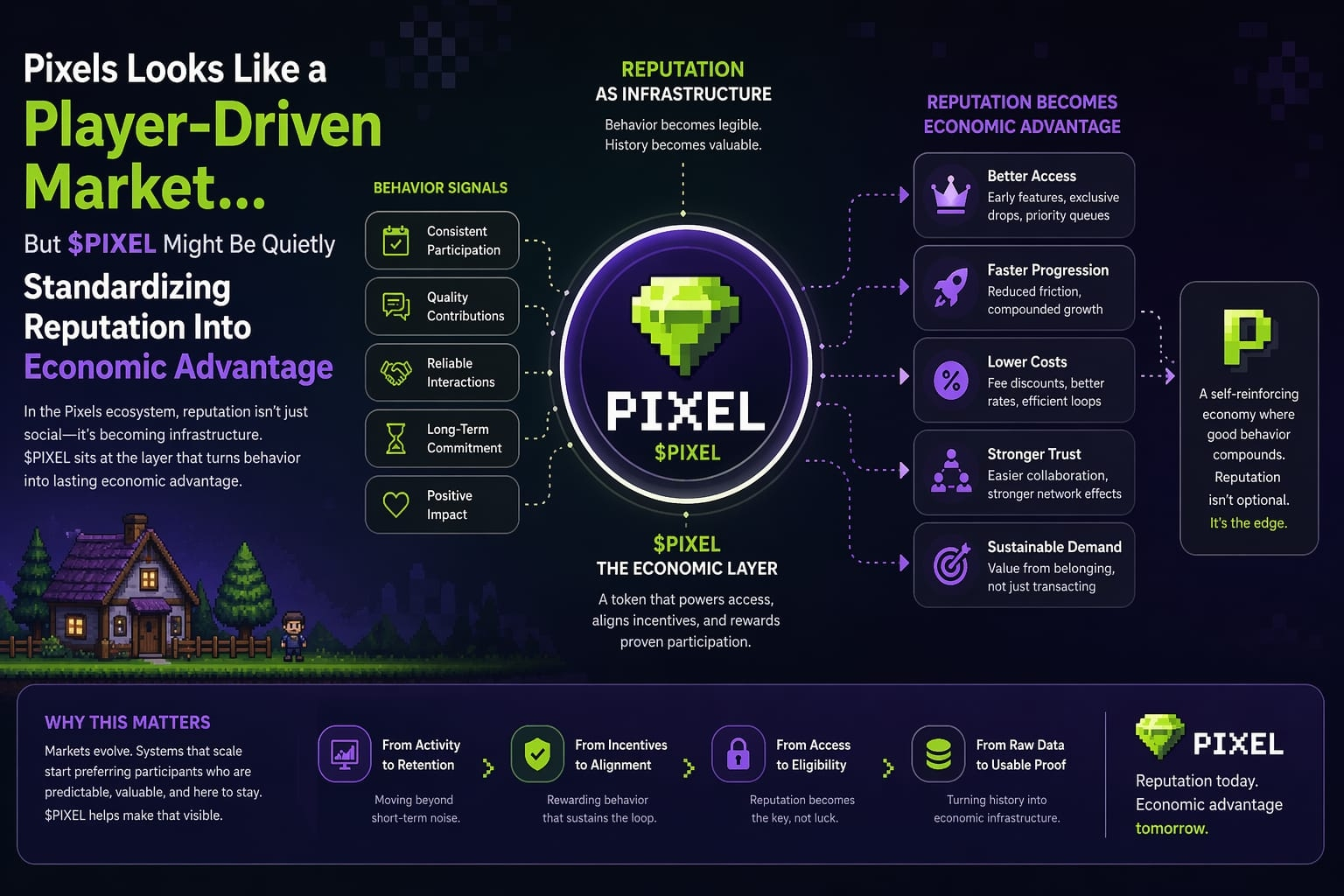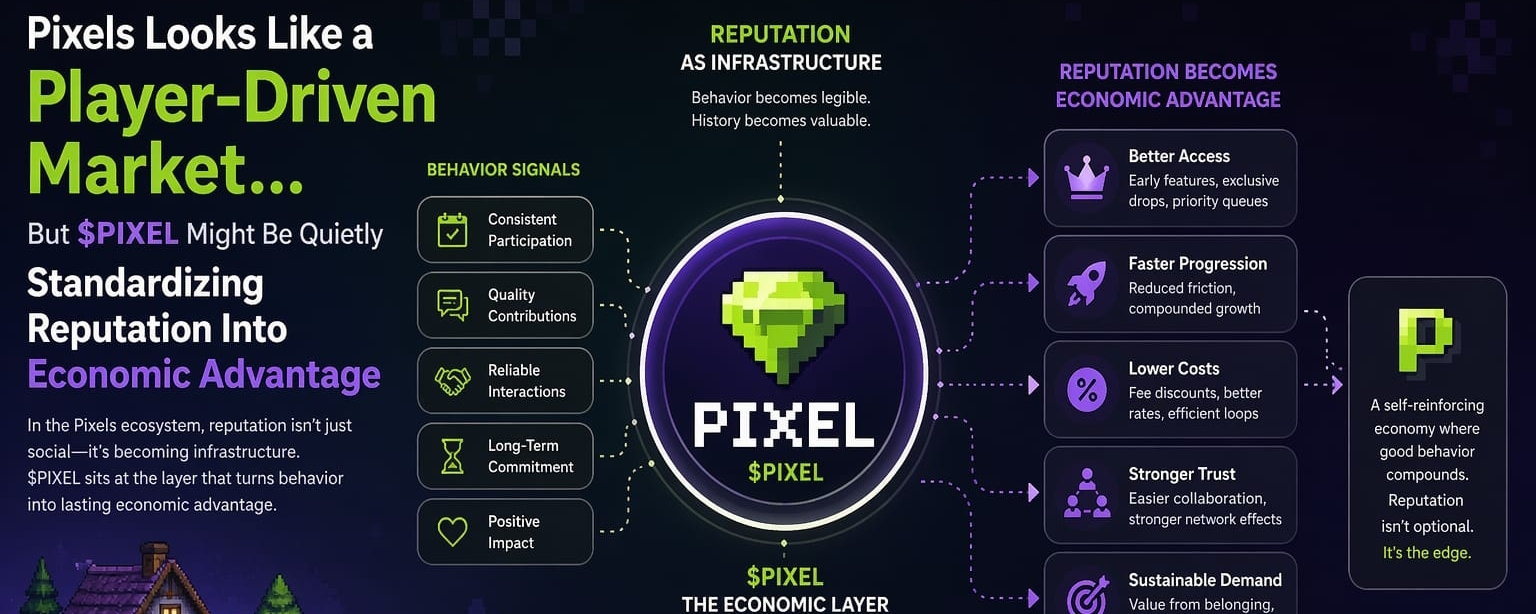
I have a habit of watching how people behave in systems long after the excitement wears off. Not charts first. Not token price. Just the way people settle into routines once they stop trying to impress each other. In games, especially ones with open economies, that part usually tells me more than the flashy launch phase ever does. At first, Pixels can look like a player-driven market in the purest sense. People farm, trade, optimize, speculate, and create their own little loops. It feels open. Loose. A bit messy in a healthy way. But the longer I sit with $PIXEL, the less I think the real story is just about player freedom. I keep coming back to something quieter. The system may be taking reputation, which looks social on the surface, and slowly turning it into an economic input.
That shift matters more than it sounds. Reputation in a game usually begins as something informal. Who is consistent, who knows the loops, who gets trusted in trades, who understands timing, who sticks around after rewards get thinner. Normally that remains soft information. People feel it, but the system does not fully absorb it. What seems different here is the possibility that repeated behavior stops being merely observed by other players and starts becoming legible to the economy itself. In simpler terms, the market may no longer care only about what you own or what you do once. It may start caring about whether your pattern is recognizable, reusable, and low-risk to build around.
That is where $PIXEL gets more interesting to me. A token in a game economy is often treated as spending power, reward fuel, or a governance prop that sounds important but rarely shapes daily behavior. But sometimes a token does something less visible. It becomes part of the filtering layer. Not just who can buy, but who can access better loops, better timing, better economic conditions. If that happens, then reputation stops being just a social advantage and becomes a structured economic advantage. The player who looks reliable is not only respected. They may gradually become easier for the system to serve, easier to reward, easier to retain.
I do not mean reputation in the influencer sense. I mean it in the infrastructural sense. A stable behavioral record. A usable history. Something closer to an eligibility layer than a popularity score. Eligibility logic is just a system deciding who qualifies for something and under what conditions. That logic can be crude, like wallet balance thresholds, or more behavioral, like repeated activity over time, low-friction participation, or signs that a player is likely to keep contributing to the loop. Once a system starts making those distinctions, a supposedly player-driven economy begins to feel a bit more curated than open.
This is where the difference between activity and retention becomes important. A lot of game economies look strong when activity is high, but activity can be noisy. It can come from tourists, mercenaries, short-term farmers, or pure extraction behavior. Retention is different. Retention means the system has found a reason for someone to return without restarting the relationship from zero each time. That usually requires memory. Not memory in a sentimental sense. Structured memory. A record of behavior the system can use. And once that record exists, reputation stops floating around socially and starts hardening into infrastructure.
I think that changes how we should read demand too. There is token usage, and then there is real demand. Usage can be forced. You need the token for this action, that fee, this upgrade. Fine. But real demand appears when the token becomes tied to a durable advantage people do not want to lose. If PIXEL ends up sitting near the layer that translates repeated good standing into better access, faster progression, or smoother participation, then demand may come less from play itself and more from the desire to remain economically legible inside the system. That is a different kind of pressure. Less visible, maybe. More persistent.
The uncomfortable part is that this can happen while the market still describes the system as open and player-led. On the surface, everyone is participating. In practice, some histories become more economically valuable than others. Some behaviors start compounding while others remain disposable. And once compounding begins, reputation is no longer just an outcome of playing well. It becomes a form of capital. Not fully owned, either. More like rented credibility that the system may keep recognizing as long as you continue behaving in ways it can measure and reward.
That is why I keep thinking about standardization. Standardization sounds boring, but markets love it. The moment a system can turn messy human behavior into a cleaner record, it can route incentives more efficiently. It can predict who is worth keeping close. It can reduce waste. It can reward fewer unknowns. In crypto terms, that starts to resemble a lightweight proof layer. Not proof in the zero-knowledge sense, where you prove something without revealing everything, but proof in the broader sense of reducing uncertainty. A player no longer arrives as a stranger each day. Their behavior speaks before they do.
And maybe that is the real shift. A player-driven market can tolerate chaos for a while, but an economy trying to scale usually cannot. Eventually it starts preferring participants whose reputation can be read quickly and priced quietly. If $PIXEL is moving in that direction, then the token may matter less as a simple medium of exchange and more as part of the mechanism that converts behavioral history into economic privilege. That does not make the system fake. It makes it more structured than it first appears.
I am not fully convinced this is already happening in a strong form. It may still be early, still loose, still too uneven to say with confidence. But the pattern is hard to ignore once you notice it. What begins as a game economy often ends up revealing what kind of behavior it wants to keep closest. And when reputation stops being social fog and starts becoming machine-readable advantage, the market is no longer just reacting to players. It is learning which players are easier to build the future around. That is where the system starts feeling less like a crowd and more like a filter.