
I’ve been around long enough to recognize how most GameFi projects lose their pulse. It’s almost never dramatic. There’s no big collapse, no single moment where everything breaks. It’s slower than that. You just start noticing fewer familiar names, thinner markets, longer gaps between meaningful activity. One day it feels alive, and a few weeks later it feels like everyone quietly moved on without saying it out loud.
And the uncomfortable part is it’s predictable.
A lot of these systems are built like they’re expecting a sprint. They front-load rewards, pull in attention, and create this early sense of momentum that feels real at the time. But underneath, there’s not much holding it together. Once that initial wave of incentives weakens, there’s no deeper structure to fall back on. Players don’t stick around because they’re invested they stick around because it’s still profitable. The moment that equation changes, so does their behavior.
That’s why I find Pixels interesting, not because it promises something radically new, but because it feels like it’s trying to solve a more boring, more difficult problem: how do you keep something going when the excitement wears off?
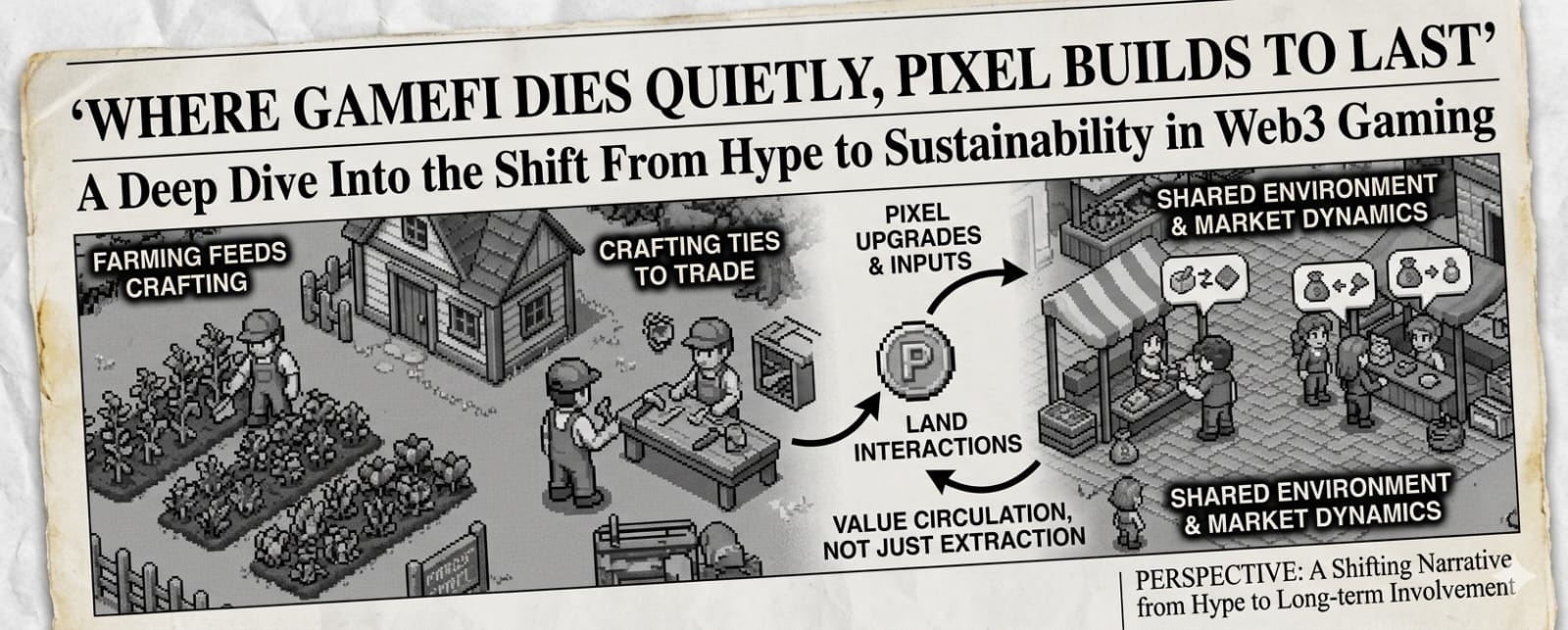
It doesn’t feel like it’s chasing peaks. If anything, it almost avoids them. The pace is slower, more layered. Progression isn’t instant, and systems don’t exist in isolation. What you do in one part of the game tends to carry weight somewhere else. Farming isn’t just farming it feeds into crafting. Crafting isn’t just output it ties into trade. And all of that connects back to land, which itself isn’t passive. It requires attention, decisions, consistency.
What that creates, at least in theory, is a kind of accumulation not just of assets, but of involvement. You don’t just log in to “do a task” and leave. You’re stepping back into something that was already in motion before you got there.
And that matters more than it sounds.
Because in most GameFi systems, actions feel isolated. You complete something, collect a reward, and move on. There’s very little sense that your activity meaningfully overlaps with anyone else’s. In Pixels, that overlap is more visible. Markets shift depending on what people produce. Resources become scarce or abundant based on collective behavior. Even if indirectly, players start affecting each other.
It starts to feel less like a series of transactions and more like a shared environment.
The PIXEL token sits right in the middle of that, but it’s not positioned as a simple payout. You earn it, sure but you’re also expected to use it. Upgrades, crafting inputs, land interactions… they all pull value back into the system. It’s a constant back and forth. And while that doesn’t magically fix economic issues, it does at least slow down the kind of one-way extraction that kills most token-driven games.
Still, I don’t think any of this guarantees that Pixels “compounds” in the way people might hope. That word gets thrown around too easily. Compounding only works if the underlying system stays balanced, and that’s where things usually get messy. If players figure out ways to optimize too aggressively, or if incentives drift even slightly out of alignment, the same patterns we’ve seen before can resurface.
Nothing here is immune to that.
But structurally, Pixels feels like it’s leaning in a different direction. It’s not trying to manufacture excitement it’s trying to sustain activity. And those are two very different goals.
In a space where most things burn bright and disappear just as quickly, building something that people return to quietly, consistently that might be the harder path.