
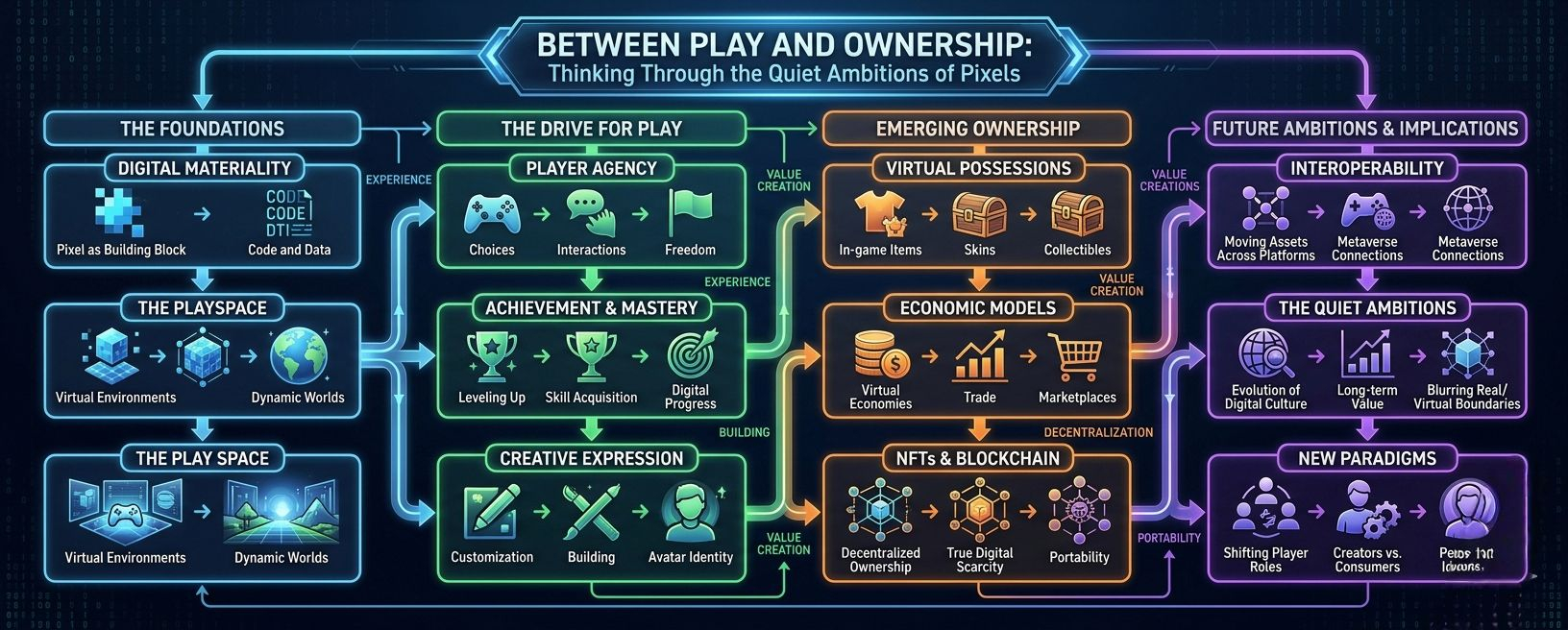
I keep coming back to the same quiet question whenever I look at Web3 games: what actually makes someone stay? Not the token, not the promise of ownership, but the simple, familiar feeling of wanting to log back in tomorrow. That’s usually where most projects start to unravel for me, or at least where the tension becomes visible. And that’s the lens I find myself using as I think through Pixels.
At its surface, Pixels presents itself as something disarmingly simple. A farming and exploration game, built around a pixelated open world, where players gather resources, build, and interact. None of that is new in isolation. Farming loops have been refined for decades, and open-world crafting isn’t exactly unexplored territory either. But what Pixels seems to be attempting is not just another iteration of those mechanics, but a reframing of how they sit within a blockchain-based system. It’s less about introducing novelty in gameplay, and more about trying to normalize Web3 within something that already feels familiar.
That choice feels deliberate. Instead of leaning into complexity or financial abstraction, the game leans toward accessibility. The world is meant to feel alive in a casual, almost slow-paced way. You plant crops, you wait, you harvest. You move through spaces that don’t demand urgency. There’s something almost intentional about how unambitious that sounds, at least on paper. It’s not trying to overwhelm. It’s trying to settle in.
But that’s also where the deeper question starts forming for me. If the gameplay loop is intentionally simple, then where does the long-term engagement come from? In traditional games, repetition is sustained by progression systems, narrative hooks, or social dynamics. In Web3, there’s often an added layer of economic incentive. Pixels sits somewhere in the middle of that. It has an economy, clearly, but it doesn’t present itself as purely financial. At the same time, it doesn’t rely heavily on narrative either. So what’s left is the structure of the world itself, and the interactions within it.
The use of the Ronin Network is another interesting piece of this puzzle. Ronin has already established itself as infrastructure designed specifically for games, which suggests that Pixels is building on a foundation optimized for scalability and low friction. That matters, especially for something aiming to be casual. If the experience is interrupted by high costs or slow transactions, the entire illusion breaks. So in that sense, the choice of network aligns with the broader philosophy of the game: reduce friction, keep things smooth, let the player stay in the loop without thinking too much about the underlying system.
Still, the presence of blockchain introduces a different kind of weight. Ownership, assets, tokens—these aren’t neutral elements. They shape behavior, sometimes in subtle ways. I find myself wondering how much of the player base engages with Pixels as a game first, and how much sees it as an economic environment. The design seems to encourage the former, but the structure inevitably allows for the latter. That duality isn’t necessarily a flaw, but it does create tension. If too many players approach it purely from an extractive mindset, the balance of the ecosystem could shift. And if the economic layer isn’t meaningful enough, then the Web3 component risks feeling unnecessary.
There’s also something worth considering about the social layer. Games like this often live or die based on how players interact with each other. Not just trading or competing, but coexisting in a shared space. Pixels hints at that with its open-world design, but it’s not immediately clear how deep those interactions go. Are players forming communities, or just passing by each other? Is the world reactive, or mostly static? These are the kinds of details that don’t show up in a feature list, but end up defining the experience over time.
What I do find compelling is the restraint. Pixels doesn’t try to position itself as a revolution. It feels more like an experiment in integration. Can a Web3 game feel like a normal game first, and a blockchain product second? That seems to be the underlying hypothesis. And if that’s the case, then success wouldn’t necessarily look like explosive growth or speculation-driven activity. It would look quieter. Steady retention, consistent engagement, a player base that isn’t constantly thinking about tokens.
But that kind of success is also harder to measure, and probably harder to achieve. It requires a level of design discipline that goes against some of the incentives in the space. It means prioritizing experience over extraction, even when the latter might offer faster results. I’m not entirely sure yet whether Pixels fully resolves that tension, or just manages it for now.
As I sit with it, I don’t see Pixels as something that needs to prove a bold new idea. It feels more like it’s testing whether a softer approach can work—whether familiarity, simplicity, and a low-pressure environment can carry a Web3 game further than complexity and hype. I can see the appeal in that, but I can also see the uncertainty. A calm experience still needs depth, and a stable economy still needs careful balance.
Where I land, at least for now, is somewhere in the middle. I don’t find myself dismissing Pixels, but I’m also not fully convinced by it yet. It feels thoughtful in its design, maybe even intentionally understated, but there are still open questions about how its systems hold up over time. I suppose that’s what makes it interesting to watch. Not because it promises something dramatic, but because it’s trying to answer a quieter, more difficult question about what Web3 games can realistically become.
