It started with something so small I almost ignored it.
I logged in, did my usual routine—plant, harvest, craft, move. Nothing new, nothing surprising. The loop felt familiar, almost comforting. But somewhere in the middle of it, there was a slight hesitation. Not confusion exactly, just a faint sense that I wasn’t choosing my actions as much as I was following them. I might be wrong, but it started to feel like the system already knew what I would do next.
That’s when I began paying closer attention.
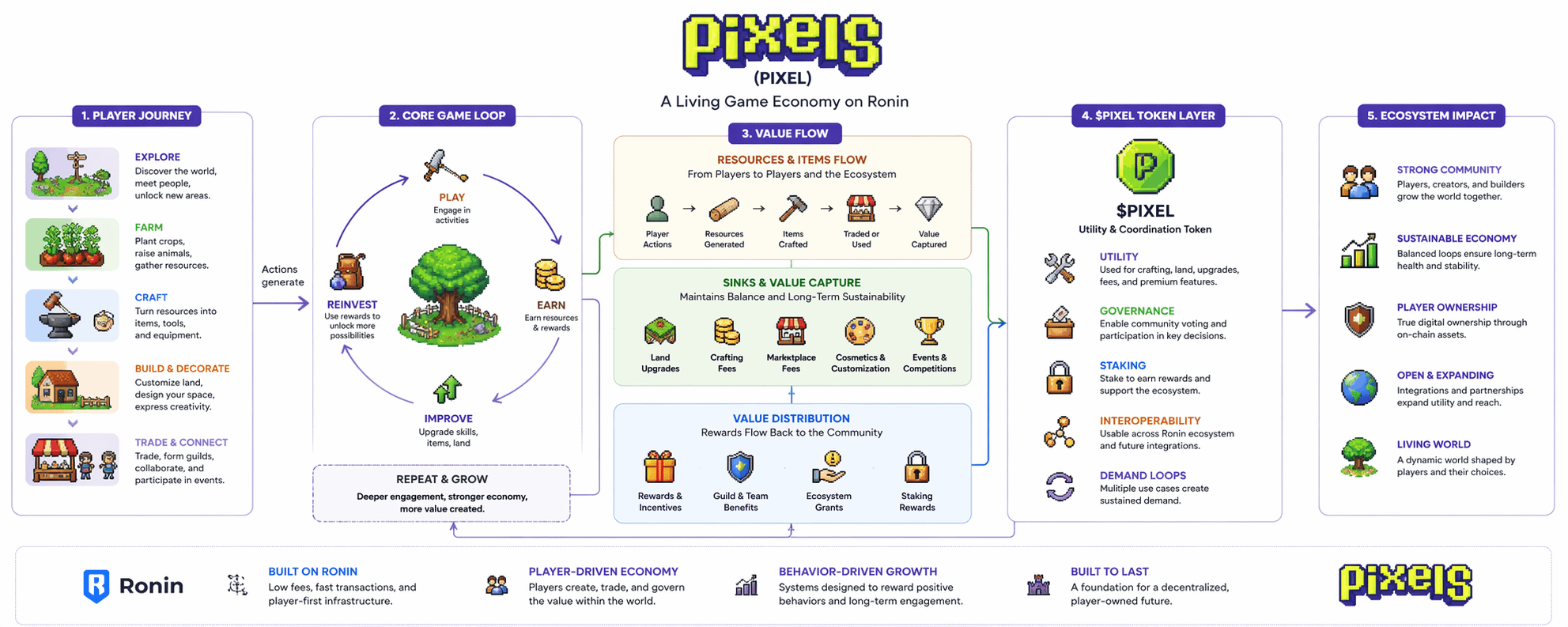
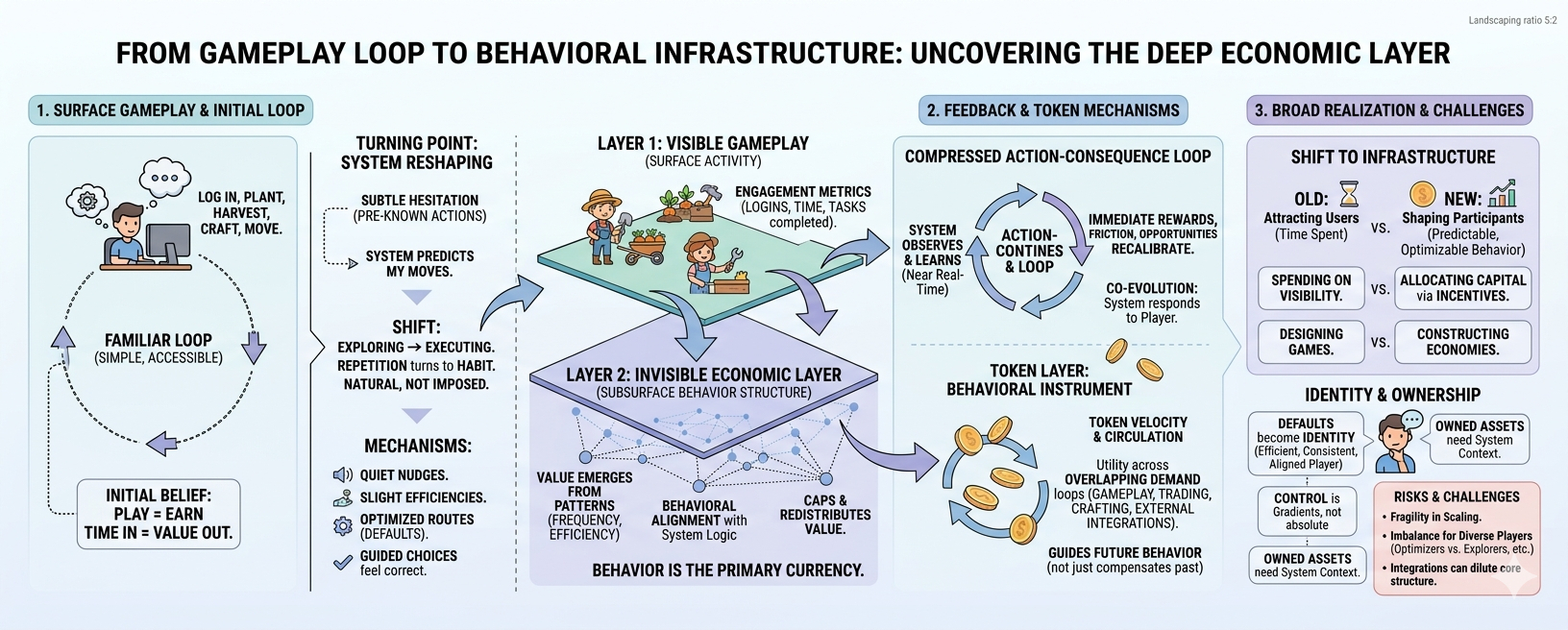
On the surface, it’s simple. You play, you earn, you repeat. The loop is clean, accessible, and easy to step into. Farming leads to resources, resources lead to crafting, crafting feeds back into progression. It feels like participation is the source of value. Time in, value out.
But the more I stayed inside that loop, the more I noticed that not all actions were equal. Some movements carried more weight than others. Some decisions quietly shaped outcomes beyond what the interface made visible. And slowly, the idea that “playing equals earning” began to feel incomplete.
It started to feel like value wasn’t being created where I thought it was.
Instead, it seemed to emerge from patterns—how often I returned, how efficiently I moved, how closely my behavior aligned with the system’s preferred paths. The visible loop was just the entry point. Underneath it, there was a quieter layer organizing everything.
Systems don’t change loudly—they reshape behavior quietly.
And here, that reshaping didn’t come through force or restriction. It came through suggestion. Subtle nudges. Slight efficiencies. The kind that don’t interrupt you, but gradually redirect you. I found myself optimizing routes without thinking about why. Choosing actions not because they were interesting, but because they felt correct.
Repetition turned into refinement. Refinement turned into habit.
At some point, I wasn’t exploring anymore. I was executing.
That shift didn’t feel imposed. It felt natural. Which is exactly what made it difficult to notice.
What stood out more, over time, was how quickly feedback seemed to travel. Small adjustments in behavior led to immediate changes in outcomes. It was almost as if the system was observing, learning, and responding in near real-time. Not in a visible, explicit way—but in how rewards, friction, and opportunities subtly recalibrated.
It created a compressed loop between action and consequence.
I would try something slightly different, and the system would answer back—not with words, but with results. Over time, those results shaped future decisions. It wasn’t just a game reacting to players; it felt like a system co-evolving with them.
That’s where it started to feel less like a static design and more like a living structure.
And in that structure, behavior became the primary currency.
Engagement metrics—logins, time spent, tasks completed—were easy to see. But they didn’t fully explain where real value was forming. It seemed more likely that value emerged when behavior aligned with specific economic pathways. When actions contributed to flows that extended beyond the individual player.
I started thinking less about what I was earning, and more about where that earning came from.
Who needed the outputs of my actions? Where did they go? What loops did they feed into?
It became clearer that not all activity translated into meaningful economic contribution. Some actions sustained the system’s surface. Others fed into deeper layers where value was actually captured and redistributed.
That distinction wasn’t obvious at first. But once I noticed it, it was hard to ignore.
Even the token layer began to look different through that lens.
At first glance, it behaves like a reward. Something you accumulate through participation. But over time, it started to feel less like a prize and more like an instrument—something that directs behavior rather than simply compensates it.
Its movement matters more than its presence.
Velocity, for example, began to stand out. How quickly tokens circulate, where they flow, and what they unlock seemed more important than how many I held. Utility wasn’t confined to a single loop either—it extended across different activities, sometimes even across environments, creating overlapping demand that wasn’t always immediately visible.
It suggested that the token wasn’t just measuring activity—it was shaping it.
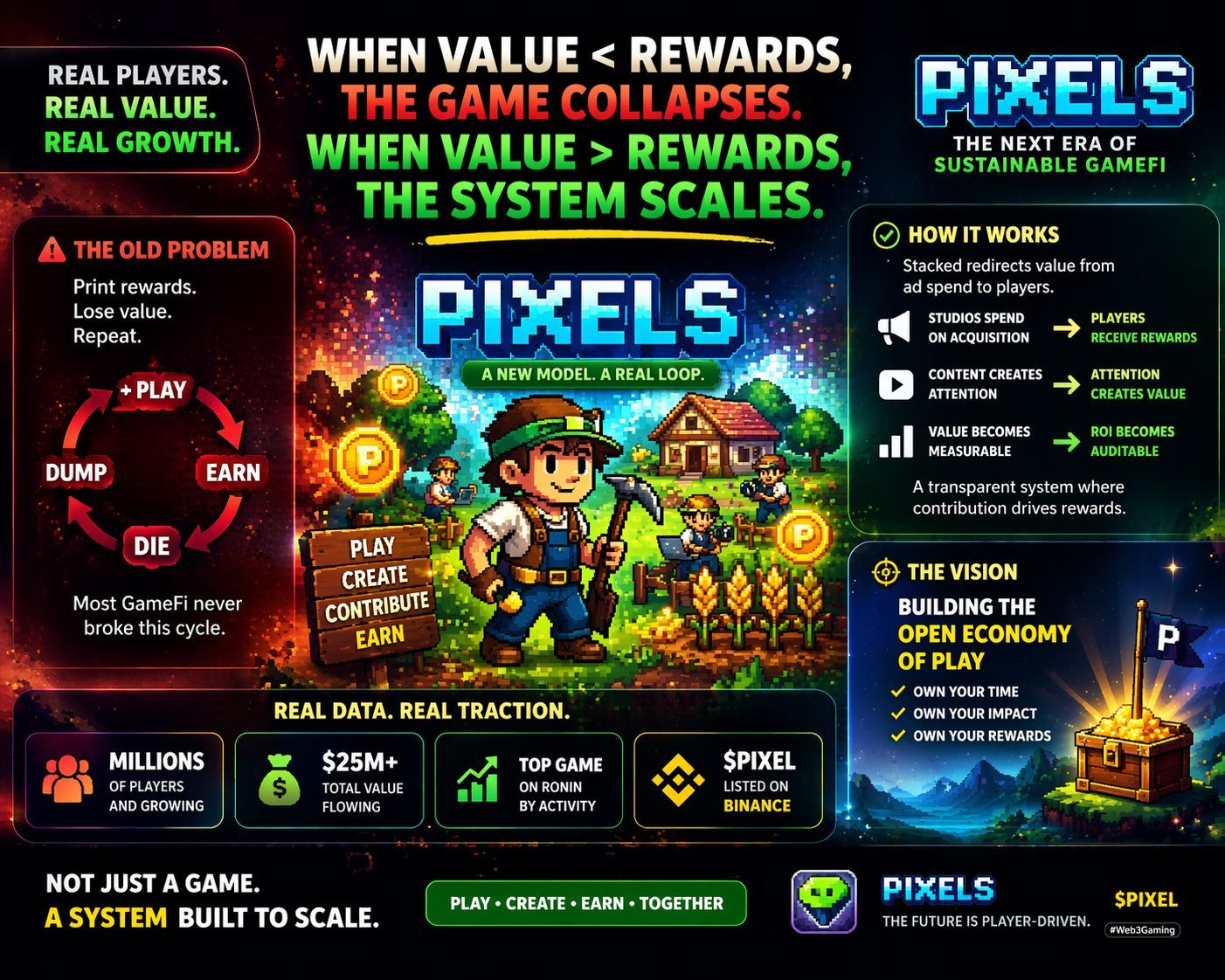
I might be overstating it, but it felt like the system used incentives not to reward past behavior, but to guide future behavior. And when multiple loops intersect—gameplay, trading, crafting, external integrations—the token becomes a connector between them.
That’s where things get more complex.
Because as these loops expand, they introduce fragility.
Scaling becomes a question, not a guarantee. What works in a tightly controlled environment doesn’t always hold when new participants enter with different intentions. Efficiency for one group can create imbalance for another. And integrations, while expanding utility, can dilute focus if they aren’t aligned with the core behavioral structure.
There’s also the question of player diversity.
Not everyone engages the same way. Some optimize aggressively. Others explore slowly. Some are here for extraction, others for experience. Holding all of that within a single economic system without breaking coherence is difficult. It requires constant adjustment—sometimes subtle, sometimes structural.

And those adjustments, if done quietly enough, might go unnoticed.
But their effects don’t.
Over time, small shifts accumulate. A change in reward distribution here, a tweak in resource flow there—and suddenly the system feels different, even if nothing obvious has changed.
That’s the nature of these environments. They don’t rely on dramatic updates to evolve. They move through gradual recalibration.
Which brings me to a broader realization.
This doesn’t feel like a game in the traditional sense anymore. Not entirely.
It feels closer to infrastructure—an environment where behavior is organized, measured, and redirected in service of an evolving economic system. The play layer is still there, but it sits on top of something deeper.
And that deeper layer isn’t about attention. It’s about behavior.
For a long time, digital systems competed for time. The more you stayed, the more valuable you were. But here, time alone doesn’t seem sufficient. What matters is what you do with that time—how predictable it is, how optimizable it becomes, how well it fits into the system’s internal logic.
It’s a shift from attracting users to shaping participants.
From spending on visibility to allocating capital through incentives.
From designing games to constructing economies.
I don’t think this transition is fully understood yet. I’m not even sure I understand it completely. But I can feel it.
In small moments. In repeated actions. In the quiet realization that what feels like freedom might actually be guided efficiency.
And that raises a question I keep coming back to.
How much of what I’m doing is chosen, and how much is suggested?
The system doesn’t force me. It doesn’t restrict me. It simply makes certain paths easier, smoother, more rewarding. Over time, those paths become defaults. And defaults, when repeated enough, begin to feel like identity.
I start to think of myself as a certain type of player. Efficient. Consistent. Aligned.
But I wonder if that identity is emerging from me—or from the system.
Maybe it’s both.
Ownership, in this context, also starts to feel more complicated. Yes, assets can be held, transferred, used across spaces. But ownership without context doesn’t fully capture what’s happening. The value of what I own depends on the system it belongs to—the rules, the flows, the behaviors it supports.
Without that context, ownership feels incomplete.
And then there’s control.
Or at least the idea of it.
I can choose when to log in, what to do, how to engage. But within those choices, there are gradients—paths that feel more efficient, more logical, more aligned. Over time, those gradients shape decisions before they’re even consciously made.
So where does control actually sit?
With the player who acts, or the system that guides?
I don’t have a clear answer.
But I’ve started to notice that the most powerful systems aren’t the ones that demand attention. They’re the ones that quietly organize behavior—so smoothly that participation feels natural, even when it’s being shaped.
And once you see that, it’s hard to go back to seeing just a game