
I didn’t think much of it at first.
PIXEL just looked like another casual Web3 game. Farming, exploring, building stuff, hanging out in an open world. The kind of thing you open once out of curiosity, play for a bit, and forget about later.
Nothing special on the surface.
But something felt slightly off.
Not in a dramatic way. More like the kind of feeling you get when something is too smooth. Too easy to understand at first glance, yet somehow you keep coming back anyway.
Because on paper, PIXEL is simple. You farm, you collect, you upgrade, you move around a social world powered by the Ronin Network. It looks like relaxation. Light entertainment. A digital place to pass time.
But the longer you sit with it, the more it stops feeling like “just a game.”
It starts feeling like a system that quietly learns you.
Most people won’t notice this at first, but games like this rarely stay “just games” once you spend enough time inside them. The interesting part isn’t what you can do. It’s what you end up doing repeatedly without thinking about it.
That’s where things get strange.
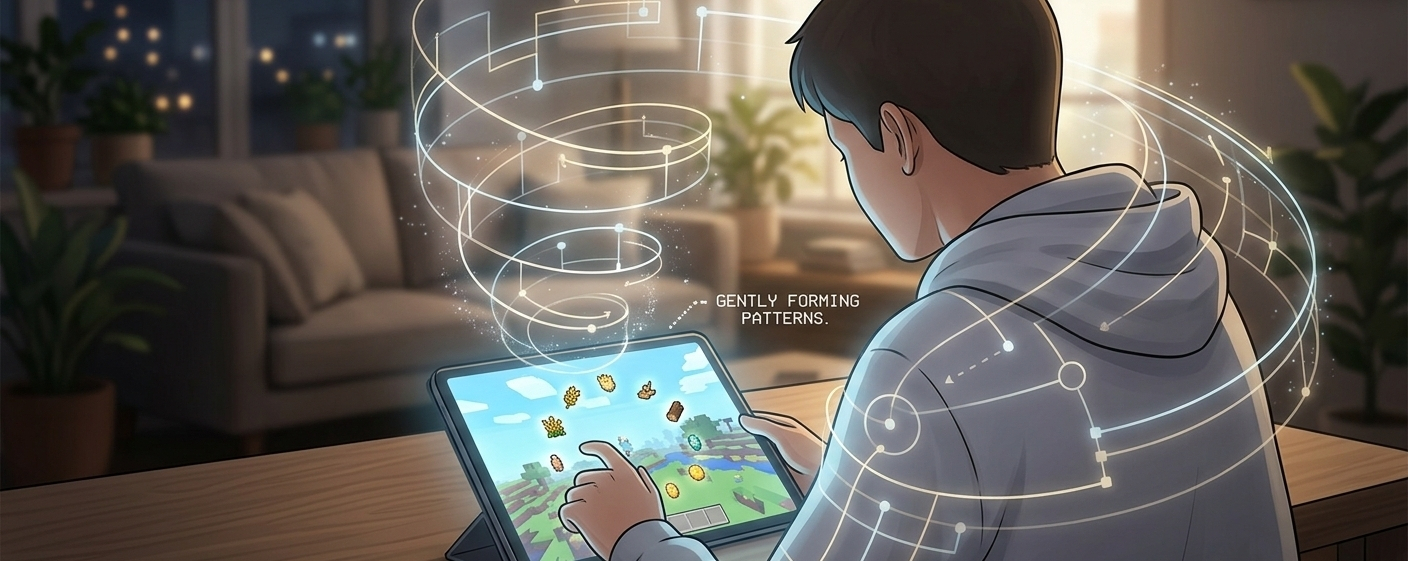
At the beginning, players usually explore freely. They try things. They wander. It feels playful. But slowly, patterns start forming. You notice people returning at specific times. Doing the same cycles. Optimizing small actions. Checking in even when nothing urgent is happening.
And without anyone telling them to, they start organizing their behavior around the game.
It doesn’t announce this. It just happens.
That’s the subtle shift.
What looks like a relaxing farming loop is actually something closer to a rhythm machine. It gently rewards consistency over randomness. It rewards presence over intensity. It rewards showing up again… and again… even when nothing big changes.
And that changes how people behave.
At first, someone plays for fun. Then they play to not “fall behind.” Then they play because they’ve already invested time. Then it becomes part of the day without needing a reason.
It doesn’t force anything. It just makes staying slightly more rewarding than leaving.
That’s the quiet design most people don’t notice.
Because underneath all the farming, exploration, and social interaction, there’s another layer running in the background: attention shaping. Not in a manipulative way that people usually imagine, but in a gradual, almost invisible way.
The system learns what keeps you engaged.
And you learn what the system rewards.
Over time, those two things start syncing.
That’s where the behavior shift happens.
People begin to optimize without realizing they’re optimizing. They start valuing efficiency in a space that was supposed to be casual. They start caring about progress loops, timing, resource flow, and social positioning. Not because they were told to—but because the system quietly makes those things matter more than they initially seemed.
And honestly, that’s the part most users feel but can’t explain.
Something feels structured under the surface. Like there’s an invisible logic guiding what feels “worth doing.”
The interesting twist is that the token and economy layer don’t sit on top of the game—they blend into this behavior loop. Rewards don’t just represent value; they reinforce patterns. They make certain habits feel more meaningful than others. Even small actions start carrying weight because they connect to progression, scarcity, or timing.
So the real product isn’t just the game world.
It’s the repetition of decisions inside that world.
And repetition is where behavior gets rewritten.
Over time, what starts as casual play becomes a kind of soft discipline. Not forced, not stressful—just structured enough that your attention begins to settle into predictable paths.
That’s why these systems feel “sticky” even when they look simple.
And that’s also where the uncomfortable thought shows up:
Maybe the value isn’t only in what players get out of the game… but in what kind of players the game slowly produces.
More consistent. More engaged. More reactive to incentives. More aware of timing and reward cycles. Less random in behavior, more patterned.
Not in a dystopian sense. Just in a quiet, human sense.
Because that’s what systems do when they stabilize—they shape behavior around themselves.
And PIXEL sits right in that space where it feels like play on the surface, but underneath, it’s quietly organizing attention into something more structured.
Most people won’t describe it that way. They’ll just say it’s “fun” or “addictive” or “relaxing.”
But you can feel the tension if you spend enough time inside it.
Like the system is gently asking:
“Will you come back tomorrow?”
And the surprising part is how often the answer becomes yes… without a clear reason.
Not because you have to.
But because the pattern is already forming.
And maybe that’s the real shift.
When a game stops being something you play…
and starts becoming something you return to almost automatically.
Not loud. Not obvious.
Just slowly built into your behavior until it feels normal.
