
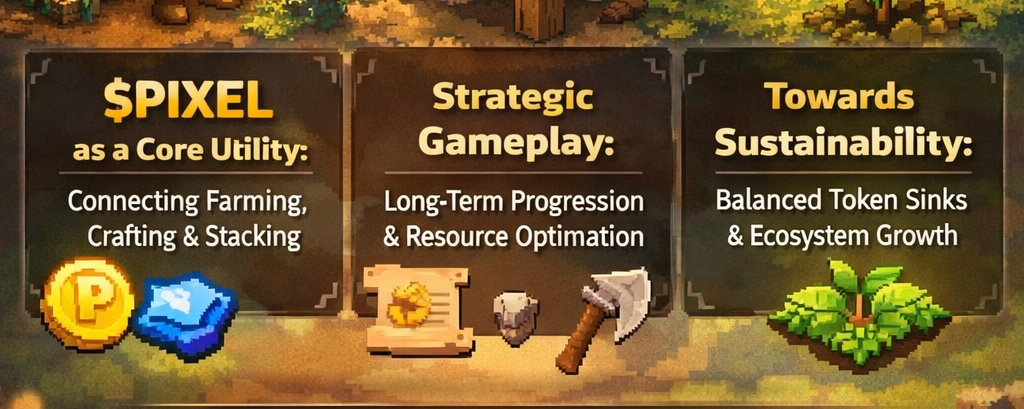
One reason I keep coming back to @Pixels is that it treats gameplay as the core product and the on-chain layer as the engine room—not the other way around. Pixels doesn’t need to shout “web3” every minute to prove it’s real. It earns attention by delivering a loop that players actually want to repeat: routines, optimization, coordination with others, and long-term progression that feels earned.
Where things get even more interesting is the broader Stacked ecosystem around Pixels. Stacked is best understood as the ecosystem layer that helps turn “time spent playing” into something composable—across activities, features, and community participation. It’s the difference between a standalone game and a world where different systems reinforce each other: crafting and resource management feed progression, social coordination creates emergent goals, and community-driven experimentation helps the meta evolve without forcing constant resets.
That’s also why the token narrative matters. $PIXEL isn’t just a chart to watch; it’s a coordination mechanism for an ecosystem that rewards participation and supports continued development. When token utility is aligned with what players already do—progress, contribute, create, collaborate—it becomes an amplifier of engagement rather than a distraction from the game.
The biggest question I’m watching next: how far can Pixels expand Stacked integrations so the ecosystem rewards skill, consistency, and community contribution—not just early arrival? If Pixels keeps pushing in that direction, it can set a standard for what “sustainable on-chain gaming” should look like.
What do you think is the most important next step for Pixels: deeper Stacked utility, new gameplay modes, or more community-led content? #pixel