
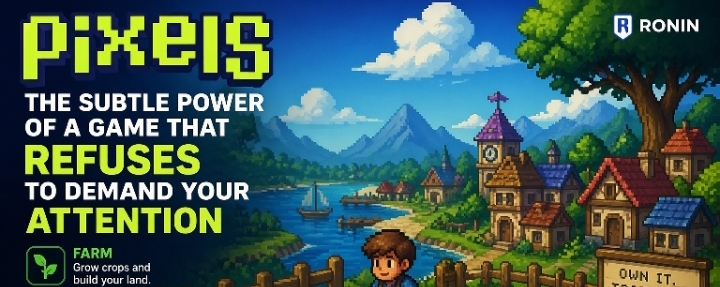
There’s a strange kind of silence in Pixels. Not literal silence—there’s movement, there are players, things grow and change—but the kind of silence you notice when something isn’t demanding anything from you. No flashing alerts. No countdown timers screaming for attention. No subtle guilt nudging you to log back in before you “fall behind.” The first time I spent an hour inside it, I actually checked the time twice. Not because I was bored. Because I wasn’t sure where the hour had gone.
That feeling is rare now. Almost suspiciously rare.
Most games today feel like negotiations. You give them time, they give you stimulation. Faster, louder, brighter. There’s always a trade happening under the surface, even if it’s disguised well. Pixels doesn’t really play that game. It just… exists. And you’re free to exist inside it, or not.
It’s built on the Ronin Network, which, depending on your level of interest in Web3, either sounds exciting or vaguely exhausting. Blockchain gaming has made a lot of promises over the past few years, most of them tied to ownership, earning, or some version of “this time it’s different.” And if you’ve been around long enough, you develop a bit of skepticism. Not the loud, dismissive kind. The quieter kind. The kind that watches from a distance and waits for something to feel real.
Pixels doesn’t try very hard to convince you of anything. That might be why it works.
You start with something small. A patch of land. A few seeds. Maybe you wander off before they even grow. Nothing punishes you for that. When you come back, things are still there, still waiting. It’s almost unsettling how little urgency there is. We’re so used to systems that punish absence that a system that doesn’t feels… unfinished, at first.
But then you notice something. You’re not optimizing. You’re not calculating efficiency ratios or thinking in terms of maximum yield per minute. You’re just doing things. Planting, harvesting, walking, occasionally talking to someone who happens to be nearby. It feels closer to routine than to gameplay, and I don’t mean that as a criticism.
Routine gets a bad reputation. People hear it and think of boredom, repetition, lack of imagination. But there’s another side to it—the kind that quietly structures your day without draining it. Pixels leans into that version. It doesn’t try to be the highlight of your day. It slips into the background and stays there, steady.
There’s something almost old-fashioned about that approach. It reminds me a bit of early online games, before everything became optimized for retention metrics. Back when wandering around without a clear objective wasn’t considered bad design. Back when not knowing what you were doing was part of the experience, not a flaw to be corrected.
Of course, Pixels isn’t naive. Underneath that simplicity, there’s a system doing real work. The idea of ownership—actual ownership—is baked into it. The land you have, the items you collect, the things you craft… they’re not just entries in a database controlled entirely by a developer. They exist in a way that’s meant to persist beyond the game itself. That’s the theory, at least.
I’ll admit, I used to think this aspect was overhyped. The whole “you truly own your assets” narrative gets thrown around so often that it starts to feel like background noise. But Pixels handles it differently, or maybe just more quietly. It doesn’t constantly remind you that what you’re doing has external value. It lets you forget, which oddly makes it feel more real.
Because the moment a game constantly tells you something is valuable, you start questioning it.
Here, value emerges in a slower, less obvious way. You notice that certain resources are harder to find. That some items are traded more often. That other players seem to specialize in things you don’t. A kind of informal economy begins to take shape, not because it’s aggressively designed, but because people naturally fill gaps.
It’s messy. Slightly inefficient. Occasionally confusing. Which is probably why it works.
The social aspect sneaks up on you too. You don’t log in thinking, “I’m going to build relationships today.” But after a while, you start recognizing names. Someone who always trades a certain item. Someone who gave you advice when you were clearly doing something wrong. These aren’t dramatic interactions. No cinematic cutscenes, no deep narrative arcs. Just small, repeated moments that accumulate.
There’s a player I kept running into—never spoke much, just exchanged items once or twice. But after a few days, seeing their character felt oddly familiar. Like spotting someone from your neighborhood at a local shop. That kind of low-level familiarity is easy to overlook, but it’s doing something important. It anchors the world.
I think that’s where Pixels differs most from other Web3 experiments. It doesn’t treat players as economic units first. It lets them be people, even if only in small, quiet ways.
That said, it’s not perfect. And pretending otherwise would miss the point. There are moments where the simplicity borders on emptiness. Times when you wonder if there’s enough depth to sustain long-term interest. The pacing can feel almost too relaxed, especially if you’re used to games that constantly escalate.
And then there’s the broader question—one that hovers over all Web3 projects. What happens when the underlying economy shifts? When attention moves elsewhere, as it inevitably does? Pixels feels more resilient than most, but it’s not immune to those forces.
Still, there’s something here that feels… grounded. Not in a technological sense, but in a human one.
It respects time. That’s the simplest way I can put it.
Not in the superficial way games claim to respect your time while secretly trying to consume as much of it as possible. But in a quieter, almost indifferent way. It doesn’t chase you. It doesn’t try to become essential. And because of that, it becomes something you return to on your own terms.
There’s a moment—I remember it clearly—when I logged in just to check on a few crops and ended up staying longer than planned. Not because there was something urgent to do, but because it felt… comfortable. Familiar, without being stale. That’s a difficult balance to achieve.
Most systems either become addictive or forgettable. Pixels sits somewhere in between. It doesn’t hook you aggressively, but it also doesn’t fade away easily. It lingers.
Maybe that’s its real innovation. Not the blockchain layer, not the ownership mechanics, not even the player-driven economy. Those are important, sure. But they’re not what you feel on a moment-to-moment basis.
What you feel is space. Room to act without pressure. To engage without being consumed.
And in a landscape where everything is competing for your attention, that absence of pressure starts to feel like a feature, not a limitation.
I’m not convinced Pixels will redefine gaming overnight. It probably won’t. It’s too understated for that. But it doesn’t seem interested in that kind of impact anyway.
It’s doing something smaller. Slower. More deliberate.
And oddly enough, that might be exactly why it has a chance to last.