
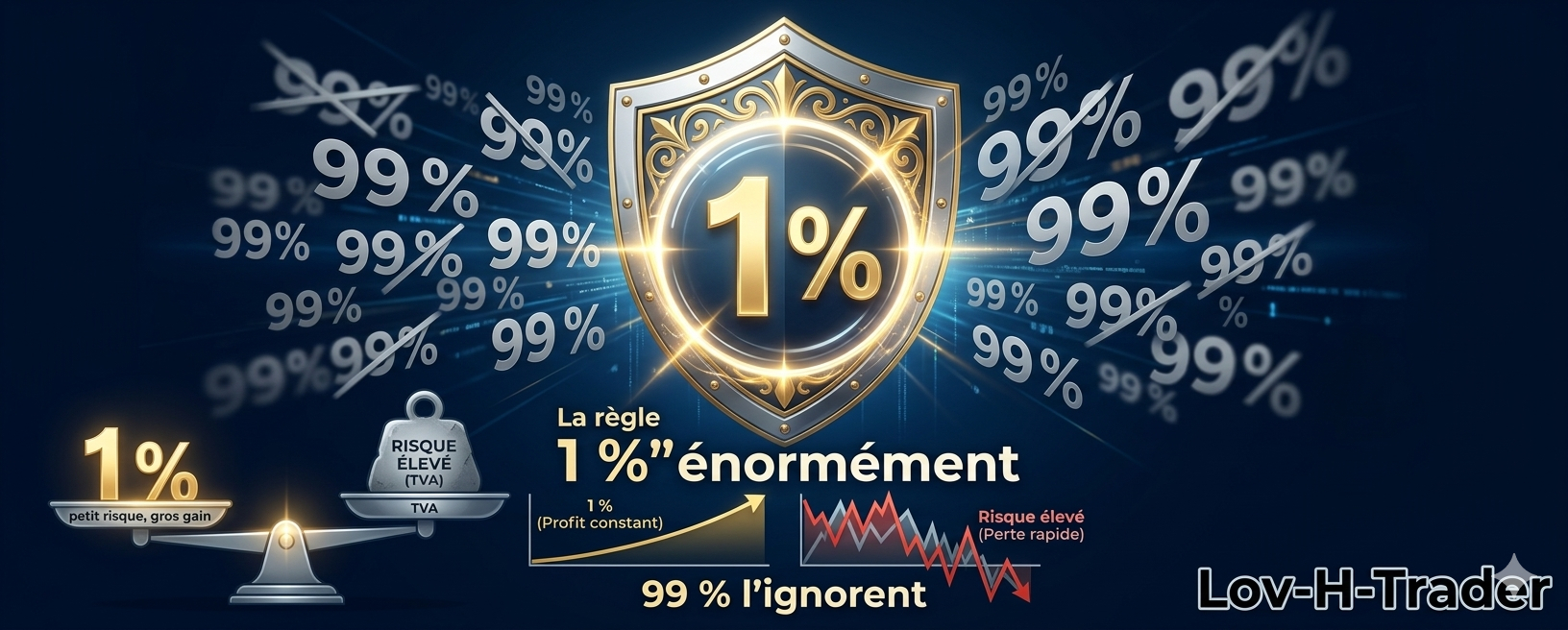
Are you looking for the magic strategy? It doesn’t exist. But there’s one rule that 99% of traders overlook. Those who apply it last. The others blow up.
Here it is.
🧠 The rule: never risk more than 1% of your capital per trade
That's it. Not 5%, not 10%. 1%.
Concrete example:
You have €1,000 in your account. Per trade, you only risk €10.
This means that if your stop-loss is at 2% of the entry price, you can buy for €500 (because €500 × 2% = €10).
If your stop is at 5%, you only buy for €200.
The exact formula:
Position size = (Capital × 1%) / (Stop-loss distance in %)
Example: capital €3,000, stop at 4% → (3,000 × 0.01) / 0.04 = €750 position.
❌ Why does almost no one follow it?
Because it’s frustrating. Risking 1% means accepting to win small. The adrenaline isn’t there. The casino attracts more.
A winning trade at 2:1 only yields 2% of capital. That’s "little".
A losing trade only costs 1%. That's "manageable".
But here’s what beginners don’t see:
Risk per trade After 10 consecutive losses After 20 consecutive losses
1% €90.4 remaining €81.8 remaining
5% €59.9 remaining €35.8 remaining
10% €34.9 remaining €12.2 remaining
With 10% risk, you lose 65% of your capital in 10 losing trades. With 1%, you only lose 10%. The difference is massive.
📊 The real secret of pro traders
It’s not about the win rate. A trader can win only 50% of their trades and still be very profitable.
Example:
50 trades per month
25 winners, 25 losers
Average gain: 2% (risk 1% → reward 2:1)
Average loss: 1%
Result: (25 × 2%) - (25 × 1%) = +25% per month.
With only 40% success: (20 × 2%) - (30 × 1%) = +10% per month.
The key is to ensure your gains are bigger than your losses (reward/risk ratio > 1). And for that, you have to accept small losses.
🛠️ How to immediately apply the 1% rule
Calculate your actual capital (what you have in your trading account, not your total portfolio).
Determine your risk per trade = capital × 0.01.
Before every trade, set your stop-loss (in % or price).
Calculate the position size using the formula above.
On Binance Futures: use "Isolated" mode (isolated margin) and check the liquidation amount. Never exceed 1% loss on total capital.
📉 Micro-analysis of the moment: ...(Kaspa)
While "casino traders" look for the next x100, ... quietly accumulates. This crypto has a rare feature: a fair launch (no presale, no preminted team, no ICO). Many compare it to Bitcoin in its philosophy.
Key data:
Current price: ~0.045 $
ATH: 0.28 $ (end of 2024) → -84% from its peak
Market cap: ~1.1 billion $
Rank: ~#50
Expected catalyst: Toccata Testnet (major update) in the upcoming weeks
Why Kaspa?

Kaspa is a proof-of-work (PoW) protocol that solves the scalability issue through its innovation "GhostDAG". While Bitcoin processes ~7 transactions/second (tps), Kaspa can already exceed 100 tps with blocks per second. The Toccata update aims to increase these performances further, potentially up to 1000 tps.
Technical analysis:
Daily RSI: 42 (neutral, neither overbought nor oversold)
MACD: MACD line about to cross the signal line (possible bullish signal)
7-day volume: +67%
Major support: 0.039 $
Resistance to break: 0.052 $
Operational levels (1% risk):
Buy zone: 0.042 – 0.048 $
Stop-loss: 0.039 $ (-7% to -18% depending on entry) → adjust position size to stay at 1% risk
Target 1: 0.065 $ (+35% to +55%)
Target 2: 0.095 $ (+100% to +125%)
Specific risks of ...:
More established competitors (Kaspa is still young).
The Toccata update could be delayed or may not meet the targets.
High volatility on micro-caps.
⚠️ No financial advice. Even with the best setup, without risk management (the 1%), you will lose.
🎯 Practical exercise for today
Take your account. If you’re not applying the 1%, redo your calculations.
Questions to ask yourself before each trade:
What’s my current capital?
Where is my stop-loss (exact price)?
What’s the distance in % between the entry and the stop?
What position size can I take to not risk more than 1%?
If you can’t answer these 4 questions, you’re not trading – you’re gambling.
💬 And you, what’s your current risk percentage?
1% – I am disciplined
2-5% – I take calculated risks
10 %+ – I'm playing at the casino (and I'm going to blow up)
Answer
with the number. I answer all.