
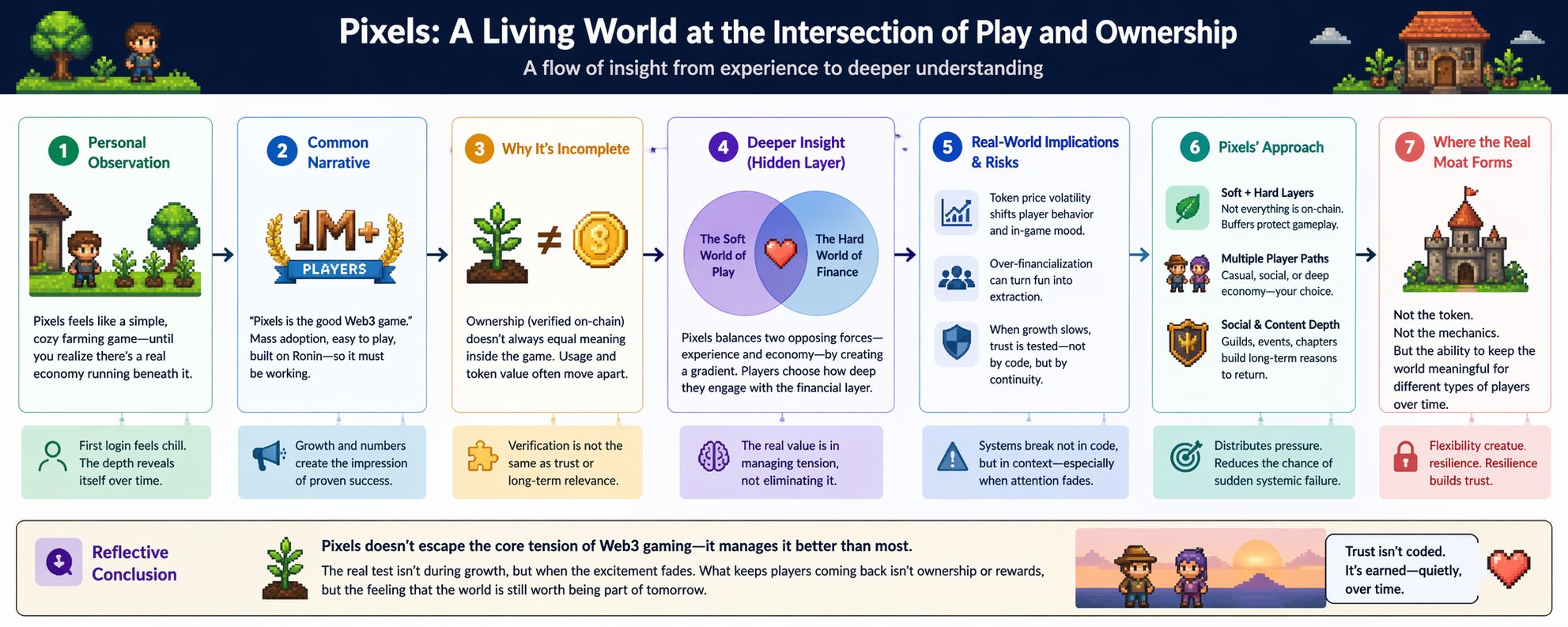
I keep coming back to this strange feeling I had the first time I logged into Pixels like I wasn’t just opening a game, I was stepping into something that was trying to be softer than most Web3 systems… but still carrying all the same weight underneath.
At first glance, it feels simple. You plant crops, walk around, chat with people, maybe grind a few resources. It honestly reminded me of those chill farming games we’ve all played at some point. Nothing aggressive, nothing screaming “make money now.” And that’s exactly why a lot of people got comfortable with it.
The usual story you’ll hear is: this is how Web3 gaming finally gets it right. Pixels grew fast, crossed millions of players, and sits on top of Ronin Network, which already knows how to handle big gaming ecosystems. So it looks like things are working.
But when you spend more time inside, you start noticing something else.
There’s this quiet split in how people experience the game.
I remember talking to a player who just logs in daily, farms, chats, and logs out. For them, it’s just a relaxing routine. Then there’s another kind of player tracking token prices, optimizing yield, thinking in terms of efficiency and extraction. Same world, completely different mindset.
And Pixels doesn’t force you into either. That’s actually one of its smartest moves.
Because here’s the thing most people miss: just because ownership exists doesn’t mean it matters in the way we think it does. Yes, you might “own” assets. Yes, there’s a token layer. But ownership only feels real if the game keeps giving those assets meaning over time.
That’s where things get interesting and a bit fragile.
There were moments when the PIXEL token surged hard, and suddenly the mood inside the game shifted. People weren’t just playing anymore they were calculating. Then when prices cooled off, that energy faded just as quickly. The farms were still there, the mechanics unchanged… but the feeling of the world was different.
That’s the part no blockchain can fix.
Because verification knowing something is yours isn’t the same as trust. Trust is more subtle. It’s that feeling that tomorrow, the game will still be worth opening. That your time inside it isn’t quietly losing meaning.
Pixels seems to understand this, at least a little.
It doesn’t push everything on-chain. It keeps parts of the system “soft” off-chain currencies, flexible mechanics, social layers. It’s almost like it’s trying to protect the game from its own economy. Give players space to just exist without constantly thinking about value.
And honestly, that might be the real reason it’s held together better than most.
I’ve seen other Web3 games where everything is financialized. Every action tied to profit. And those systems usually burn out fast. Players optimize the fun out of it. The game becomes a job… then people quit.
Pixels avoids that trap but not completely.
Because the tension is still there, just quieter.
You can feel it during events, or when new updates drop, or when player activity spikes. Suddenly, the system gets tested. Can it handle more attention? Do rewards still feel fair? Does the economy stretch or start to crack?
That’s when you see what the system is really made of.
And to be fair, building on something like Ronin Network helps. It’s not starting from zero. There’s already history there games that scaled, broke, adapted. That kind of ecosystem memory matters more than people think.
But it also comes with baggage.
Players remember cycles. Growth phases. Crashes. Adjustments. That memory shapes how they behave, even if they don’t talk about it openly.
So what Pixels is really doing whether intentionally or not is managing pressure.
It lets casual players stay casual. It lets hardcore players go deep. It spreads risk across different types of engagement instead of forcing everyone into the same lane. That flexibility is subtle, but it’s probably its strongest defense.
Because most systems don’t fail slowly. They fail when everyone reacts the same way at the same time.
Pixels reduces that risk.
Still, I don’t think it solves the bigger question. It just handles it better than most.
What happens when growth slows? When rewards feel thinner? When the excitement fades and all that’s left is the daily routine?
That’s the real test not for Pixels specifically, but for this whole idea of blending games with economies.
Because in the end, people don’t come back just because they own something.
They come back because it still feels worth being there.
And that’s not something you can code, tokenize, or verify. It’s something you have to keep earningquietly, over time.
