
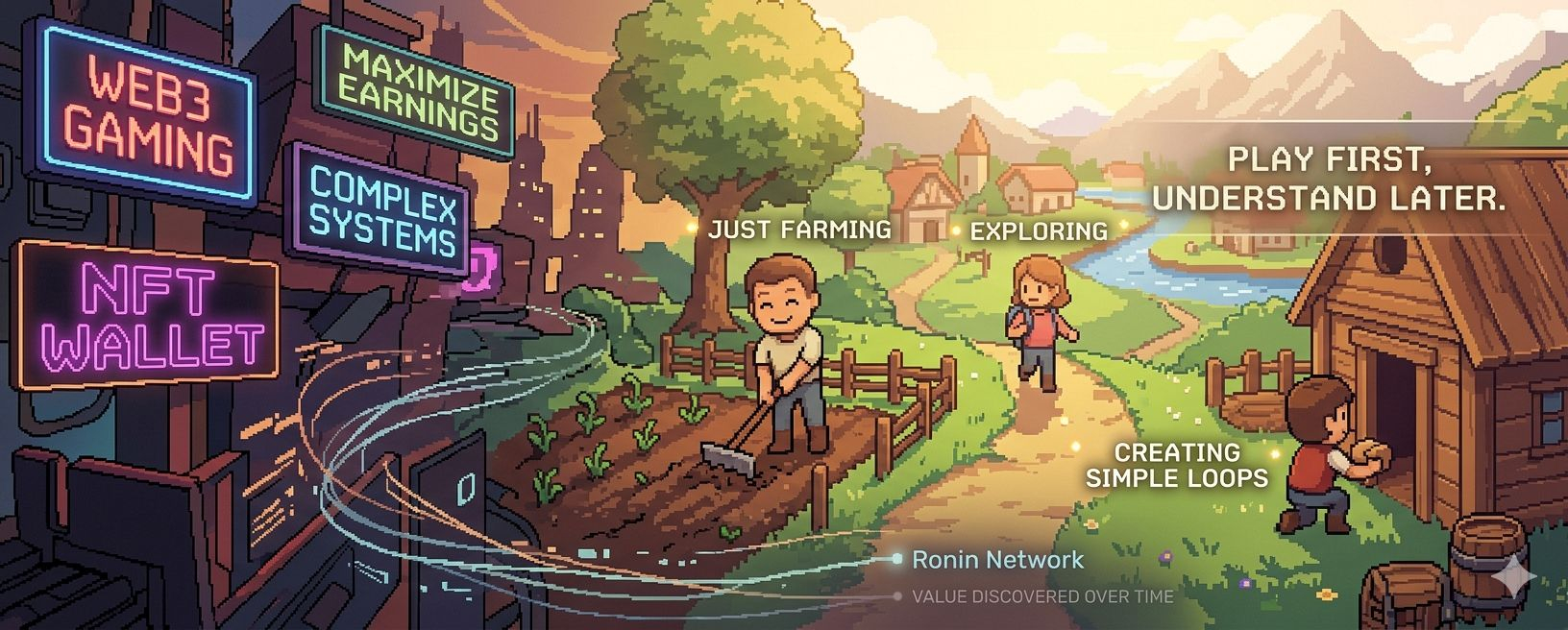

Most people still believe Web3 gaming has to feel complicated to be taken seriously. I used to think that too. Now I’m not so sure. The more I observe the space, the more I feel the real winners will be the ones that don’t look like Web3 at all. That’s exactly why Pixels (video game) stayed on my radar longer than I expected.
At first glance, it doesn’t scream innovation. No aggressive promises. No overwhelming mechanics. Just farming, exploring, creating. Simple loops. Familiar energy. And strangely… that simplicity feels intentional, not lazy.
It runs on Ronin Network, which already has a reputation for handling gaming at scale. But Pixels doesn’t try to show off that tech. It almost hides it. You don’t log in thinking about blockchain. You log in because you want to check your crops or move around the world a bit. That small shift changes the entire experience.
I’ve been watching how people enter crypto for years. Most don’t come in because they understand it. They come in because something catches their attention. Curiosity, boredom, maybe even randomness. Pixels seems built around that reality. You’re not forced to learn anything upfront. You just start playing.
And then, slowly, things begin to click.
You realize the items matter. The time you spend matters. There’s value under the surface, but it’s not thrown in your face. It’s discovered. And that discovery feels personal, not instructed.
That sequencing feels deliberate. Play first. Understand later.
It sounds simple, but it goes against how most Web3 projects operate. Usually, they overwhelm you early. Wallets, tokens, systems, ownership. Pixels delays all of that. It lets you build a connection first. And once that connection exists, everything else becomes easier to accept.
There’s also something interesting about how ownership is presented. In theory, Web3 is built on it. In practice, it often feels forced. Here, it doesn’t feel like you’re managing assets. It feels like you’re growing something over time. That emotional difference is subtle, but it matters more than most people realize.
I’ve also noticed the way Pixels handles its economy. It doesn’t push that typical “earn quickly” narrative. And honestly, that’s refreshing. That model has already shown its weaknesses. It creates short-term behavior. People come in to extract value, not to stay.
Pixels feels different. You engage because it’s enjoyable. The rewards sit in the background. They exist, but they’re not the main reason you’re there. And that changes how people behave inside the game.
Another thing I keep thinking about is how naturally social interaction develops here. It’s not forced. You just find yourself sharing space with others. Trading, interacting, existing together. Over time, that creates something stronger than incentives. It creates presence.
And presence is hard to fake.
Most Web3 projects try to manufacture community with rewards. Pixels doesn’t seem to chase that. It lets the environment do the work. And when that happens, retention feels less like a problem and more like a byproduct.
The more I look at it, the more it feels like Pixels isn’t trying to be a “Web3 game.” It’s trying to be a good game that happens to use Web3 underneath. That difference sounds small, but it completely changes how people experience it.
It sits in a strange middle ground. Traditional gamers don’t feel overwhelmed. Crypto users don’t feel disconnected. That balance is rare. Usually, something breaks when you try to combine both worlds.
But here, it feels… stable.
What really shifted my perspective is this: Pixels doesn’t try to convince anyone about the future of Web3. It just lets people experience something slightly better, without needing to explain why. No pressure. No preaching. Just quiet exposure.
And maybe that’s the real strategy.
Because adoption doesn’t happen when people are forced to understand something. It happens when they start using it without even thinking about it. When it becomes normal.
I’ve seen enough cycles to recognize when something is built for attention and when something is built to last. Pixels doesn’t feel loud. It doesn’t feel desperate. It feels patient.
And that patience… usually means something.
