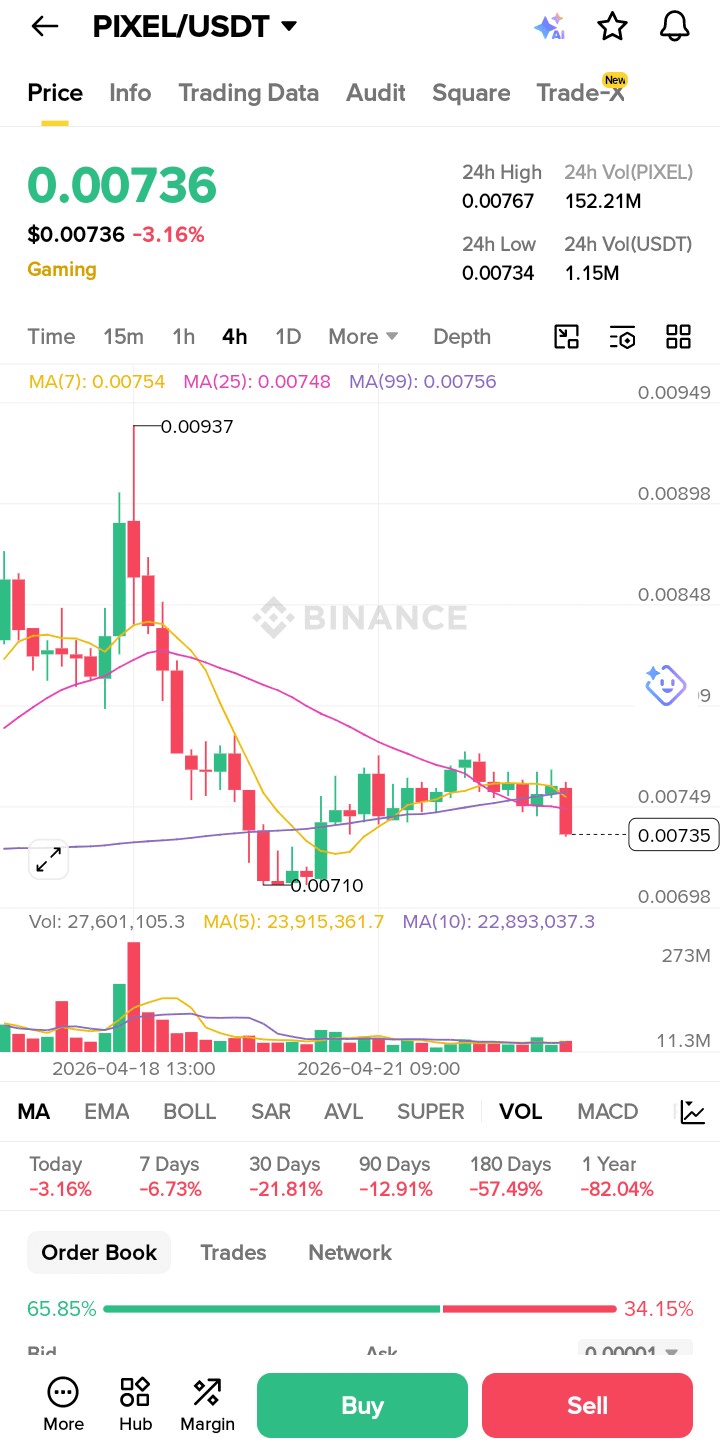
Pixels has quickly grown from a niche pixel-art farming game into one of the most active social gaming ecosystems on-chain. At its core, Pixels blends cozy gameplay, user-generated worlds, and real digital ownership to show what web3 gaming can look like when community comes first. The project’s official updates and announcements are shared via @Pixels (https://www.binance.com/en/square/profile/pixels), where players and builders track new features, partnerships, and ecosystem milestones.
The heart of the economy is
, the native utility and governance token powering the Pixels universe. is used for premium in-game purchases, crafting boosts, land upgrades, VIP memberships, and guild activities. Beyond spend utility, $PIXEL aligns incentives between players, creators, and developers. Holding and staking $PIXEL unlocks reputation perks, seasonal rewards, and a voice in governance proposals that shape game mechanics, token sinks, and expansion plans.
*From Game to Ecosystem: The Stacked Vision*
Pixels started as a single farming MMO, but its roadmap has evolved into something broader: a “Stacked” ecosystem of interconnected experiences. The idea is simple. Instead of siloing players into one world, Pixels provides the social layer, avatar system, and economic rails for many games to plug into. Think of it as a stack of on-chain experiences that share identity, assets, and $PIXEL liquidity.
This Stacked approach shows up in three ways:
1. *Interoperable Avatars & Land*: Your Pixels avatar, wearables, and land aren’t locked to one map. As partner games integrate with the Pixels SDK, assets and reputation travel with you. That turns cosmetic NFTs into cross-game status symbols and gives landowners new reasons to build.
2. *Shared Economy Powered by $PIXEL*: Games in the stack can adopt $PIXEL for mints, battle passes, or marketplace fees. That creates circular demand: players earn $PIXEL in one experience and spend it in another, while developers tap into an existing player base and token liquidity instead of bootstrapping from zero.
3. *Creator Tools & UGC*: Pixels is pushing creator-led content through quests, mini-games, and branded events. Landowners can host games and monetize with $PIXEL , while artists design wearables and consumables. The Stacked ecosystem rewards builders who bring fun, not just speculation.
*Why It Matters*
Web3 gaming often struggles with retention because gameplay and tokenomics pull in opposite directions. Pixels tackles that by leading with fun, social loops, and low-friction onboarding, then using PIXEL to deepen—not define—the experience. The result is daily active wallet counts that rival entire L1s, and a community that logs in to hang out, not just extract value.
Guilds are a big part of that stickiness. Through @Pixels, the team regularly spotlights guild competitions, leaderboards, and collaborative goals that require PIXEL
PIXEL coordination. That turns the token into a social primitive: a way to organize, compete, and celebrate together.
*Looking Ahead*
The Stacked ecosystem roadmap includes more third-party integrations, expanded creator tooling, and deeper on-chain progression systems. For players, that means more places to use hard-earned resources. For builders, it means launching with Pixels-native distribution and PIXEL as a plug-and-play economy.
As the ecosystem grows, the thesis stays the same: make games people want to play, give them real ownership, and let PIXEL tie it all together.
If you’re exploring on-chain gaming, follow @Pixels (https://www.binance.com/en/square/profile/pixels) for live updates, and keep an eye on how $PIXEL evolves as the Stacked ecosystem stacks new worlds.