
I didn’t notice it at first, but Pixels feels different from the kind of crypto game that tries to impress you before it understands you. It is not loud about what it’s doing. It just exists, quietly pulling you into routines that feel simple on the surface. And that’s where the confusion starts. Because the more time you spend in it, the less it behaves like a normal game.
Before this, most Web3 games followed a pattern that now feels almost predictable. Rewards came first. Players followed. Tokens inflated. Systems stretched too thin. What looked like a game slowly revealed itself as an extraction loop. People weren’t really playing for the experience, they were responding to incentives that were never meant to last. The problem wasn’t that these systems failed technically. They failed because they misunderstood how players behave once value becomes real.
Pixels seems to be reacting to that history, even if it doesn’t say it directly. The shift here is subtle. It’s less about handing out rewards and more about shaping how players stay. The world doesn’t rush you, but it also doesn’t let you treat it as disposable. It encourages repetition, presence, and small progression steps that start to stack over time. That change matters because it moves the focus away from quick gains and toward longer-term attachment.
And once that happens, behavior changes.
Players don’t just ask what they can earn today. They start thinking about where they fit tomorrow. They plan. They optimize, but not in a rushed way. There’s a rhythm to it. Logging in isn’t just about extracting value anymore, it’s about maintaining position inside the system. That might sound subtle, but it changes the entire feeling of play. Time stops being something you spend and starts becoming something you manage.
The mechanics underneath this are doing more work than they first appear to. Reward loops aren’t just about earning, they’re about cycling value back into the system in a way that feels natural. If players earn but never spend, the system breaks. If they spend without meaning, they disengage. Pixels tries to sit somewhere in between, where actions feed into progression and progression feeds back into motivation. Social layers help reinforce that, because people tend to stay longer when they feel part of something, not just when they are profiting from it.
But the more interesting layer is harder to see.
This isn’t just a game about farming or exploration. It’s a system that quietly organizes behavior. It rewards consistency more than intensity. It favors players who return, who adapt, who settle into its pace. In a way, it’s not just testing how well you play, it’s testing how you use your time. That’s a different kind of design. It doesn’t push you, it absorbs you.
And that creates a tension.
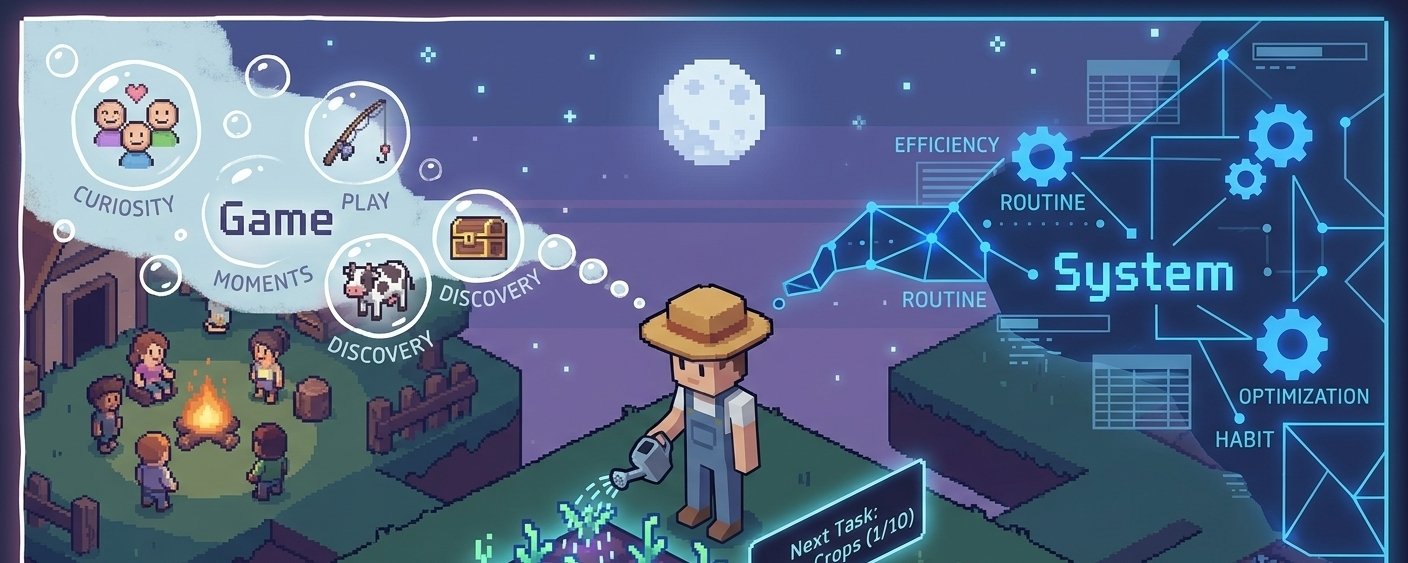
On one side, this structure can make the world feel stable and meaningful. Players might care more because their actions have continuity. On the other side, that same structure can slowly turn play into routine. When everything has value, it’s harder to act freely. Optimization starts replacing curiosity. You begin to see systems instead of moments.
So the real question is not whether Pixels works as a game or as an economy. It’s whether it can be both without losing something essential in the process. Because once a game starts shaping how people think about their time, it stops being just entertainment.
It becomes something closer to a habit.
And maybe that’s the part that still doesn’t fully make sense yet.